Salvador
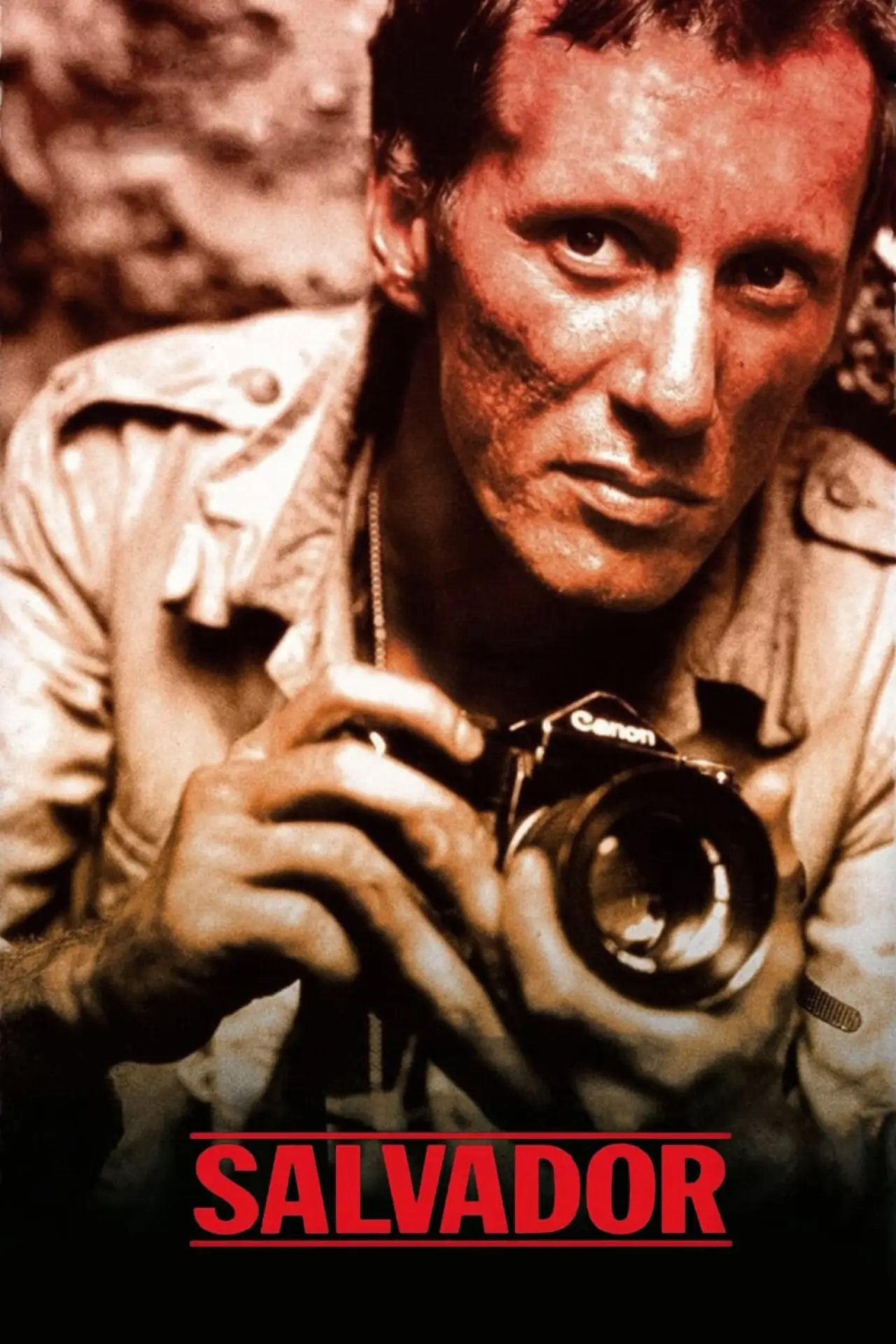
Dateline: 1980, El Salvador. Correspondent: Richard Boyle, Photojournalist - Guatemala, Iran, Vietnam, Chile, Belfast, Lebanon, Cambodia...



![Video for the film Salvador — Salvador (1986) Original Trailer [HD]](https://www.acmodasi.com/amdb/images/posters/0/u/salvador-1986-fhbLx.jpg)
Country
Production
Budget
$4 500 000
Box office
$1 500 000
Director
Actors
James Woods, Jim Belushi, Michael Murphy, John Savage, Elpidia Carrillo, Tony Plana, Colby Chester, Cynthia Gibb, Will MacMillan, Valerie Wildman
All actors and roles (10)
All actors and roles (10)
Scenario
Producer
Oliver Stone, Bob Morones, Brad H. Aronson, Gerald Green, Derek Gibson, John Daly
Camera operator
Composer
Artist
Bruno Rubeo
Audition
Bob Morones
Editing
Short description
In 1980, an American journalist covering the Salvadoran Civil War becomes entangled with both the leftist guerrilla groups and the right-wing military dictatorship while trying to rescue his girlfriend and her children.
What's left behind the scenes
- A consultant working on the film was killed in El Salvador during filming.
- After discovering a blank cartridge in the gun that could have harmed his health, James Woods refused to continue filming, causing another scandal between the actors and the crew.
- According to James Woods, as he was leaving a screening of the film at a cinema, a Salvadoran refugee approached him and tearfully thanked him for telling the story of her family's murder in the film.
- Director Oliver Stone faced certain difficulties in financing the film. He had to mortgage his own home, but then British producer John Daly promised financial support for the film. The film's budget was just under $5 million.
- The confession scene featuring James Woods' character was improvised from beginning to end. Woods believed that this scene was the reason he was nominated for an Oscar.
- Originally, Oliver Stone wanted to cast Marlon Brando (1924-2004) in the lead role, but also considered offering it to Paul Newman (1925-2008) and Lee Marvin (1924-1987). Newman liked the idea, but was busy with other projects. Marvin also liked the script, but felt he was too old for the role, and he didn't want to travel constantly, moving from place to place as the film required, due to health problems (a year after the film's release, Marvin died of a heart attack).
- The screenplay is based on the true story of Richard Boyle, a journalist and friend of director Oliver Stone.
- Towards the end of the film, a cavalry charge is shown. According to James Belushi, to pay for the scene with the horses, director Oliver Stone contributed $25,000 of his own money.
- During filming, there were no individual trailers near the set where the actors could rest, nor were there makeup artists and costume designers. According to Belushi, he sometimes had to film in his own clothes.
- The murder of Kathy is based on a real case in El Salvador, where four American nuns were raped and killed.
- The scene where Richard Boyle pulls the last film cassette from his shoe was invented by James Woods. Director Oliver Stone was angry with him because they only had one take, and it was supposed to be the last scene of all filmed, but the scene was not cut from the film, and he later even admitted that he liked it.
- Upon discovering a blank cartridge in the gun that could have harmed him, James Woods refused to continue filming, sparking another scandal between the actors and the crew members.
- According to James Woods, as he was leaving a cinema screening of the film, a Salvadoran refugee approached him and tearfully thanked him for telling the story of her family's murder in the movie.
- Director Oliver Stone faced certain difficulties regarding the film's financing. He had to mortgage his own home, but later, British producer John Daily promised financial support for the movie. The film's budget amounted to slightly less than $5 million.
- The confession scene featuring James Woods' character was improvised from start to finish. Woods believed that it was precisely because of this scene that he was nominated for an Oscar.
- Initially, Oliver Stone wanted to cast Marlon Brando (1924-2004) in the lead role, but he also considered offering it to Paul Newman (1925-2008) and Lee Marvin (1924-1987). Newman liked the idea but turned out to be busy with other projects. Marvin also liked the script, but he decided he was too old for the role; furthermore, due to health problems, he did not want to be constantly traveling from place to place as the film required (a year after the film's release, Marvin died of a heart attack).
- A cavalry charge is shown toward the end of the film. According to James Belushi, director Oliver Stone paid $25,000 of his own money to fund the scenes with the horses.
- During filming, there were no individual trailers near the set where actors could rest, nor were there makeup artists or costume designers. According to Belushi, he sometimes had to film in his own clothes.
- The scene in which Richard Boyle pulls the last roll of film out of his shoe was conceived by James Woods. Director Oliver Stone was furious with him because they only had one take, and it was supposed to be the final scene of the entire shoot; however, he did not cut the scene from the movie and later admitted that he liked it.
Similar movies
8.7/10
8.3/10
8.2/10
8.1/10
7.8/10
7.8/10
7.8/10
7.8/10
7.8/10
7.8/10


 Auditions in India
 Casting calls in USA
 Castingi w Polsce
 Кастинги в Україні
