Platoon
The first casualty of war is innocence.



Country
Production
Budget
$6 000 000
Box office
$138 545 632
Director
Actors
Scenario
Producer
Arnold Kopelson, Derek Gibson, John Daly
Camera operator
Composer
Artist
Bruno Rubeo
Audition
Pat Golden, Warren McLean, Bob Morones
Editing
Short description
As a young and naive recruit in Vietnam, Chris Taylor faces a moral crisis when confronted with the horrors of war and the duality of man.
What's left behind the scenes
- When choosing a filming location, the filmmakers visited Mexico and the Philippines. The Philippines were preferred because it was more financially advantageous.
- Before filming began, Stone invited retired Marine Corps Captain Dale Dye to serve as a consultant to ensure historical accuracy in the film. For two weeks, Dye trained the actors in the basics of soldierly life; they learned how to move through jungles, swamps, and rocks with weapons and equipment, ate army rations, and slept in trenches. Dye also taught them military jargon. Charlie Sheen later recounted that after the training, he came to respect Vietnam War veterans even more, while Tom Berenger realized how difficult war can be in reality. Willem Dafoe also emphasized the importance of the training. In the film, Dye played the role of Captain Harris.
- Depp was given an episodic role as Private Lerner because the director decided that Depp was not ready to play the lead role at that time.
- Mickey Rourke and Kevin Costner were considered for the role of Sergeant Barnes.
- Keanu Reeves turned down the role of Chris Taylor, finding it too violent for him.
- Stone became interested in Willem Dafoe after watching the film Live and Die in Los Angeles and cast him in the role of Elias.
- Initially, Charlie Sheen was rejected by the creators due to his age, and the role was offered to his older brother, Emilio Estevez. However, the project ran into financial difficulties, and filming was postponed for two years. When filming resumed, Emilio was already committed to other obligations, and Charlie got the role.
- Willem Dafoe caught Stone's attention after watching "Platoon" and was invited to play the role of Elias.
- Depp was given the supporting role of Private Lerner, as the director decided that Depp was not ready to play the lead role at that time.
- The piece serving as the film's main musical theme is titled “Adagio for Strings,” and was composed by Samuel Barber back in 1936.
- The nighttime battle at the end of the film is based on the real battle for the American fire support base Burt (January 2, 1968), in which Oliver Stone participated.
- The voice-over in the film is read by Charlie Sheen, just as his father (Martin Sheen) did in 'Apocalypse Now' (1979).
- Filming took place in the Philippines and lasted 54 days. A military coup occurred in the country shortly before the arrival of the film crew.
- The name of Johnny Depp's then-companion, Sherilyn Fenn, is inscribed on his helmet. Her initials are engraved on Depp's character's guitar.
- The name of Johnny Depp's then-partner, Sherilyn Fenn, is written on his character's helmet. Her initials are also engraved on his character's guitar.
- When creating the film, the director relied on his own experience of the war in Vietnam. Oliver Stone said that the key moments of the film were based on real events in which he participated, and the characters were based on the personalities of real people with whom Stone fought.
- Oliver Stone stated that he decided to film 'Platoon' because he believed that the truth about the Vietnam War had not been shown in any previous films, and he felt it was his duty to demonstrate how the war actually unfolded.
- Charlie Sheen was initially not interested in starting an acting career. This was due to his father, Martin Sheen, having a heart attack during the filming of "Apocalypse Now." He later changed his mind, however.
- Before filming the scene where the soldiers smoke marijuana, the actors actually had to try it. But, according to Willem Dafoe, by the time of filming, the effects of the drug had worn off and the actors felt terrible.
- Audio samples of some dialogue from the film were used in the song “Flashback” from the Ministry album The Land of Rape and Honey (1988).
- The scene where Chris saves a Vietnamese girl from rape is based on a real event that happened to Oliver Stone in Vietnam.
- Real Vietnamese refugees were used as extras in the film.
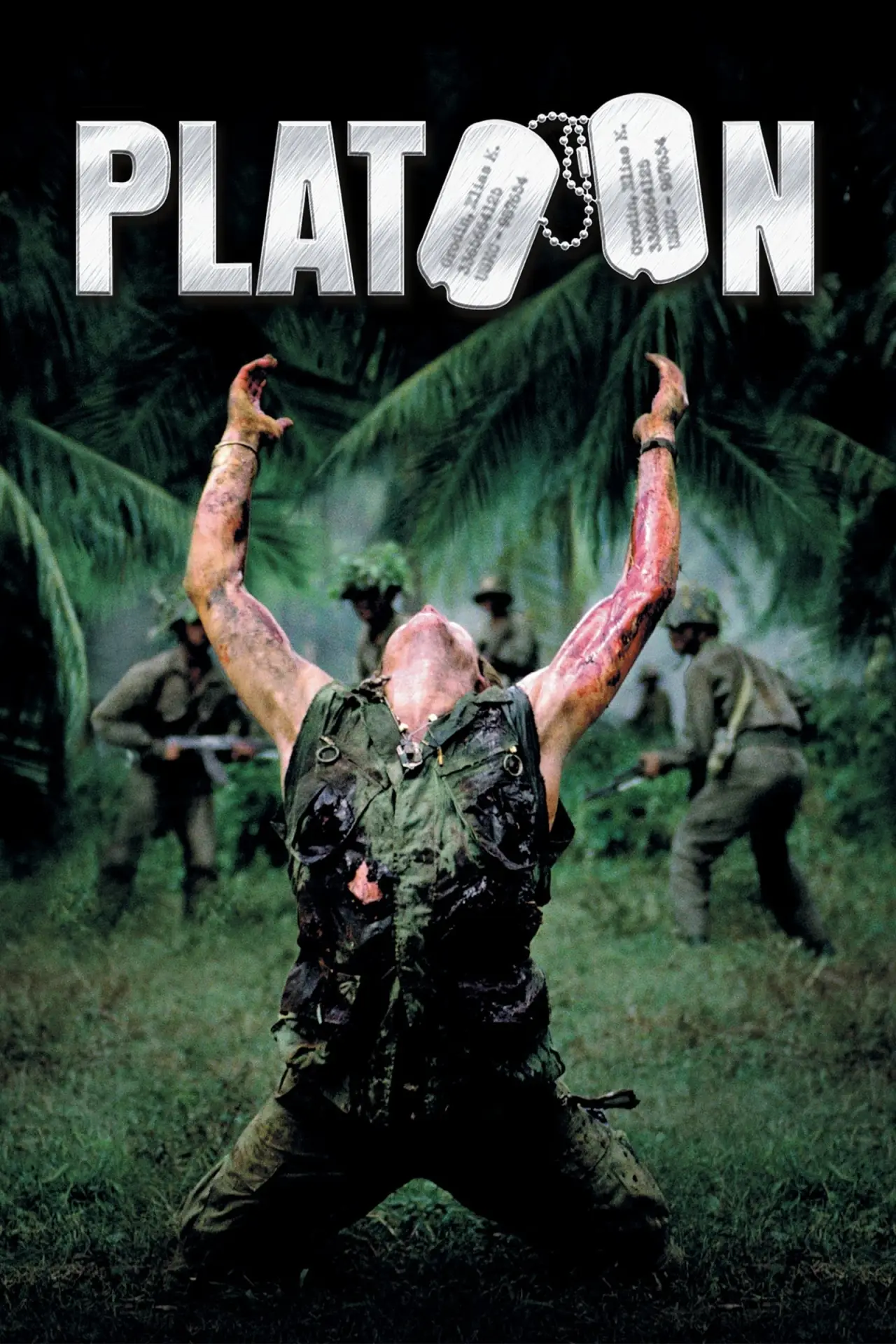
- On the film's promotional poster, the letters “o” in the title are replaced with personal U.S. Army dog tags, known among soldiers as “dog tags”.
- After Elias's departure, O'Neil says: "He's been in there for three years and thinks he's Jesus fucking Christ!". Notably, two years later, Willem Dafoe would play Christ in "The Last Temptation of Christ" (1988).
- Oliver Stone played a small cameo as an officer in the bunker.
- In creating the film, the director relied on his own experience in the Vietnam War. Oliver Stone stated that the key moments of the film are based on real events in which he participated, and the characters are based on the personalities of real people with whom Stone fought.
- The voiceover in the film is narrated by Charlie Sheen, just as his father (Martin Sheen) did in the movie 'Apocalypse Now' (1979).
- Initially, Charlie Sheen was rejected by the creators due to his age, and the role was offered to his older brother, Emilio Estevez. However, the project encountered financial difficulties, and filming was postponed for two years. When filming resumed, Emilio was already tied up with other commitments, and Charlie got the role.
- Even before filming began, Stone invited retired Marine Captain Dale Dye, who served as a consultant, ensuring historical accuracy in the film. For two weeks, he trained the actors in the basics of soldier life – they learned to move through jungles, swamps, and rocks with weapons and equipment, ate army food, and slept in trenches; Dye also taught them military slang. Charlie Sheen later said that after the training, he began to respect Vietnam War veterans even more, and Tom Berenger felt how difficult it could be to be at war in reality. Willem Dafoe also emphasized the importance of the training. Dye played the role of Captain Harris in the film.
- At the end of the film, a napalm attack is carried out by a Philippine Air Force F-5 fighter jet.
- The scene in which Chris saves a Vietnamese girl from rape is based on a real-life incident involving Oliver Stone in Vietnam.
- Two years after the film's release, a computer game called Platoon was released for a number of platforms, based on the film.
- Oliver Stone said he decided to make 'Platoon' because he believed that the truth about the Vietnam War had not been shown in any of the previously filmed films, and he considered it his duty to demonstrate what the war was really like.
- Keanu Reeves and Kyle MacLachlan turned down the role of ordinary Chris Taylor.
- The actors were advised by retired Marine Corps officer Dale Dye.
- Oliver Stone wrote the screenplay for 'Platoon' in 1976. The script he wrote was autobiographical – in the image of Chris Taylor, the director depicted himself. However, he was unable to bring his project to life at that time due to a lack of support – film studio representatives believed that a film depicting the war in this way would not be financially successful. The first attempt to start filming was made in 1976, the second – in 1984. Initially, producer Dino De Laurentiis was interested in the project, but then refused to participate in it. Only in 1986 did Stone secure funding for the film from the British company Hemdale Film Corporation, which had previously funded another Oliver Stone film – 'Salvador.' The success of 'Salvador' helped the filmmakers raise the necessary financial resources to work on 'Platoon'.
- The night battle occurring at the end of the film is based on the real-life battle for the American fire support base Burt (January 2, 1968), in which Oliver Stone participated.
- Taylor's helmet reads: “When I die Bury me Upside down So the world Can kiss my ass”.
- Oliver Stone made a small cameo appearance as an officer in the bunker.
- Keanu Reeves and Kyle MacLachlan both turned down the role of Private Chris Taylor.
- Before filming the scene where the soldiers smoke marijuana, the actors actually had to try it. However, according to Willem Dafoe, by the time filming started, the drug's effects had worn off and the actors felt terrible.
- Oliver Stone wrote the screenplay for 'Platoon' in 1976. The script was autobiographical in nature, with the director depicting himself through the character of Chris Taylor. However, he was unable to bring his project to life at the time due to a lack of support; film studio representatives assumed that a movie depicting war in such a manner would not be a financial success. The first attempt to begin filming was made in 1976, and the second in 1984. Initially, producer Dino De Laurentiis was interested in the project, but he later withdrew. It was not until 1986 that Stone secured funding for the film from the British company Hemdale Film Corporation, which had previously funded another Oliver Stone film, 'Salvador'. The success of 'Salvador' helped the creators raise the necessary funds to work on 'Platoon'.
- The Philippine government supported the film crew by providing military equipment and vehicles.
- The U.S. Department of Defense refused to provide any assistance in making the film, deeming it “unpatriotic”.
- Initially, the director intended for Sergeant Elias to be a Native American.
- Before filming began, all the actors underwent thirteen days of military training.
- Charlie Sheen was initially uninterested in starting an acting career. This was because his father, Martin Sheen, suffered a heart attack during the filming of Apocalypse Now. Later, however, he changed his mind.
Similar movies
8.7/10
8.3/10
8.3/10
8.2/10
8.2/10
7.8/10
7.8/10
7.8/10
7.8/10
7.7/10


 Auditions in India
 Casting calls in USA
 Castingi w Polsce
 Кастинги в Україні
