Gettysburg
Same Land. Same God. Different Dreams.




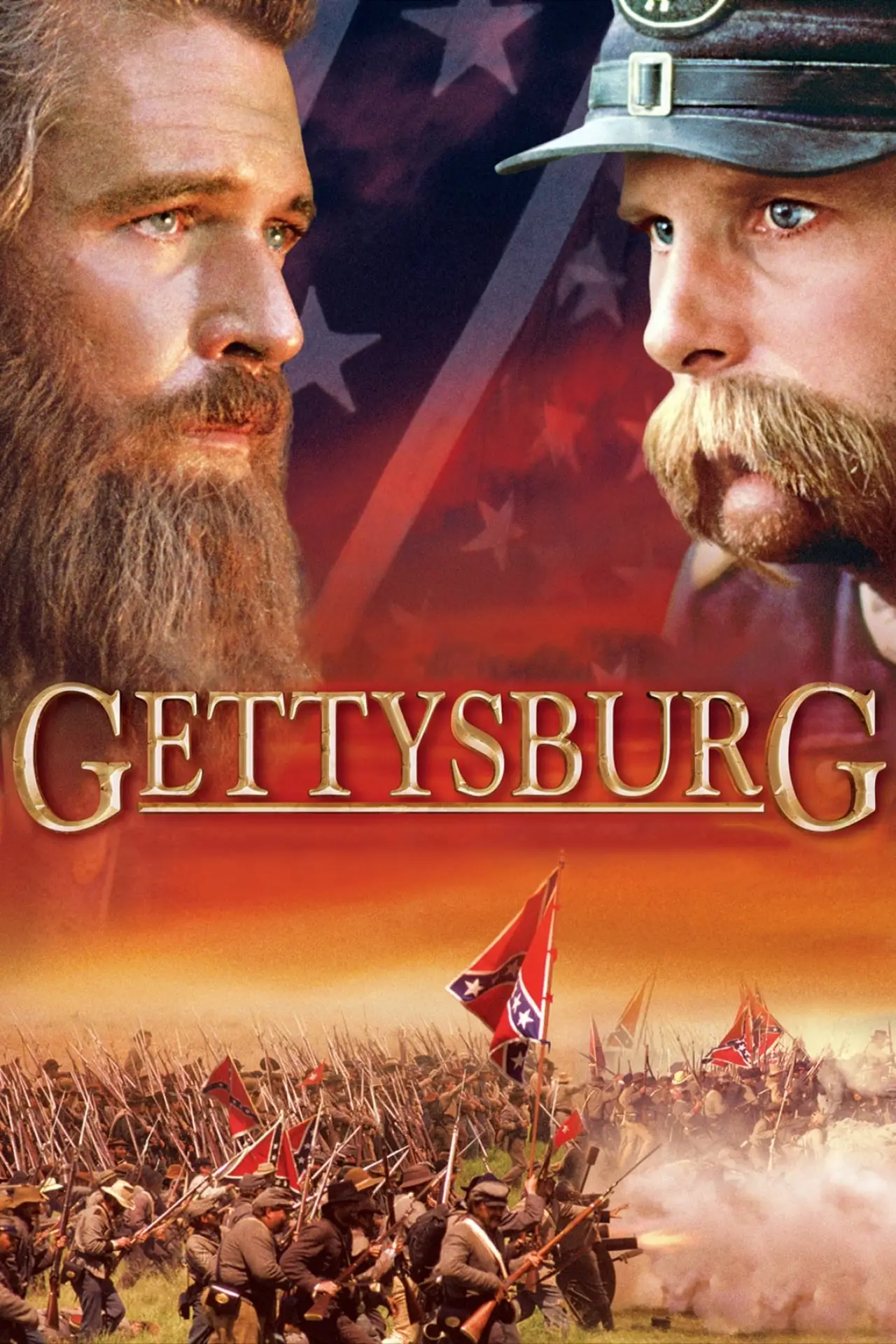
Country
Production
Budget
$25 000 000
Box office
$10 769 960
Director
Actors
Scenario
Producer
Robert Katz, Moctesuma Esparza, Mace Neufeld, Robert Rehme
Camera operator
Kees Van Oostrum
Composer
Artist
Cary White
Audition
Joy Todd
Editing
Corky Ehlers
Whole Team (57)
Whole Team (57)
Short description
In the summer of 1863, General Robert E. Lee leads the Confederate Army of Northern Virginia into Gettysburg, Pennsylvania with the goal of marching through to Washington, D.C. The Union Army of the Potomac, under the command of General George G. Meade, forms a defensive position to confront the rebel forces in what will prove to be the decisive battle of the American Civil War.
What's left behind the scenes
- Director Ron Maxwell instructed James Lancaster (who played a British Army officer) to wear a bright red uniform and carry a cup of tea. In reality, a British Army officer's uniform should have been dark blue, similar to the uniforms of Union Army officers. Furthermore, the character played by Lancaster did not wear a uniform at all while in America, but rather civilian clothes.
- During the film’s premiere in Atlanta, Martin Sheen (who played General Robert E. Lee, 1807-1870) was extremely irritated by someone in the audience sitting directly behind him who constantly made comments about the film’s characters. When the lights came up during an intermission, the actor turned to the back row to express his frustration and discovered that sitting behind him was none other than former US President Jimmy Carter.
- While preparing for the role of Colonel Joshua Chamberlain, actor Jeff Daniels intentionally deprived himself of sleep and food.
- George Lazenby (who played General James Pettigrew, 1828-1863) insisted on growing a real beard, like his historical counterpart. Scenes with Pettigrew were not started until the actor's beard had grown in.
- The hat that Tom Berenger wore during filming as General Longstreet was a source of constant contention. Consultants disliked it because it wasn't authentic, while cinematographers argued that it obscured the actor's face. During close-ups, Berenger was sometimes persuaded to do without the hat. The actor's fondness for this particular headwear remained a mystery to everyone.
- During the film's premiere in Atlanta, Martin Sheen (who played General Robert E. Lee, 1807-1870) was extremely irritated by an audience member sitting directly behind him who kept making comments about the characters. When the lights came up during the intermission, the actor turned toward the back row to vent his frustration, only to find that the person sitting behind him was none other than former U.S. President Jimmy Carter.
- The role of General Lee, played by Martin Sheen, was at one time intended for William Hurt, but he left the project due to financial difficulties facing the film studio at the time (the studio eventually went bankrupt). The role was offered to Tommy Lee Jones, but he was busy with other projects. The next candidate was Robert Duvall. He prepared for the role and proposed himself to the filmmakers, but at the very last moment, they preferred to cast Martin Sheen.
- At the very beginning of production, Tom Berenger (who played General James Longstreet, 1821-1904) gave every cast member playing a Confederate officer a saber with the names of that officer and General Longstreet engraved on the blade. Berenger paid for these gifts out of his own pocket.
- Approximately $40,000 was spent on building a model of the Lutheran Theological Seminary building. The authentic building itself was shown in only one shot, filmed from a carefully chosen angle. This building can be seen in a night scene before the battle, when Sam Elliott's character writes a dispatch to General Reynolds (1816-1876), played by John Rothenberg.
- The stone wall that the military used as cover was built by the extras (historical reenactors) literally a couple of minutes before the start of filming.
- The hat that Tom Berenger wore while playing General Longstreet was a source of constant dispute. Consultants disliked it because it wasn't authentic, and the camera operators claimed it obscured the actor's face. During close-ups, Berenger sometimes managed to convince them to do without the hat. The actor's fondness for this specific headgear remained a mystery to everyone.
- The film is based on Michael Shaara's novel "The Angels of the Battlefield".
- Sam Elliott was the only actor who wore the old, faded uniform. After receiving a brand new uniform, he turned to costume designer Luster Bayless for advice on how to best age it, and then meticulously followed the instructions in his motel room.
- The project was originally conceived as a miniseries for the TNT channel (Turner Network Television). One day, while reviewing the footage shot during the day, TNT founder Ted Turner realized that this could become a great project—literally on the level of "Lawrence of Arabia" (David Lean, 1962) and "Gone with the Wind" (Victor Fleming, George Cukor, and Sam Wood, 1939). Turner came up with the idea to first release the film in theaters so that it would already have gained popularity by the time it aired on TNT and was released on VHS. The most serious objection to his plan was that the film was becoming too long, and that even with ruthless editing, it would be difficult to bring the runtime under five hours.
- News of actor Richard Jordan's death reached the filmmakers just as they were editing the scene depicting the death of his character (Brigadier General Lewis Armistead, 1817-1863).
- To prepare for the role of Colonel Joshua Chamberlain, actor Jeff Daniels deliberately stayed awake and refused to eat.
- Sam Elliott was the only actor in the film to wear an old, faded uniform. After receiving a brand-new, crisp uniform, he asked costume designer Luster Bayless for advice on how best to age it, and then followed the instructions precisely in his motel room.
- The film was made to commemorate the 130th anniversary of the battle.
- The project was initially conceived as a miniseries for the “TNT,” or “Turner Network Television” channel. Once, while reviewing the footage shot that day, the founder of “TNT,” Ted Turner, realized that this could become a great project – on the level of “Lawrence of Arabia” (David Lean, 1962) and “Gone with the Wind” (Victor Fleming, George Cukor and Sam Wood, 1939). Turner came up with the idea of first releasing the film in theaters to build popularity before its broadcast on “TNT,” and releasing it on video cassettes. The most serious objection to his idea was that the film was too long, and even with ruthless editing, it would be difficult to make it less than 5 hours long.
- During filming, only some of the explosions were truly loud, as the filmmakers feared the explosions might frighten the numerous horses on set, and they might get spooked and throw their riders. A significant portion of the sound for the explosion scenes was added during post-production.
- Almost all of the extras in the film were participants in historical reenactments. They owned the army uniforms, weaponry, clothing items, tents, and telescopes of the appropriate era, which were used as props. During filming, they also acted as consultants on a wide range of issues and aspects of the corresponding historical period.
- News of the death of actor Richard Jordan reached the filmmakers at the moment they were editing the scene of his character's death (Brigadier General Lewis Armistead, 1817-1863).
- Work on the film took almost 15 years – from the first ideas and script drafts to the final editing and post-production.
- At the very beginning of work on the project, Tom Berenger (who played General James Longstreet, 1821-1904) gifted each member of the film’s cast who played a Confederate officer with a saber engraved with the names of that officer and General Longstreet on the blade. Berenger paid for this gift to the actors out of his own pocket.
- The role of General Lee, played by Martin Sheen, was originally intended for William Hurt, but he left the project due to the financial difficulties of the film studio working on it at the time (the studio went bankrupt altogether). The role was offered to Tommy Lee Jones, but he was busy with other projects. Robert Duvall was the next candidate. He prepared for the role and offered his candidacy to the filmmakers himself, but at the very last moment they preferred to see Martin Sheen in the role.
- After filming ended, by agreement with the historical reenactors involved in the film, “Turner Pictures” donated $100,000 to the preservation of Civil War battlefields.
- George Lazenby (who played General James Pettigrew, 1828-1863) insisted on growing a real beard, just like his real-life counterpart. Scenes featuring Pettigrew were only filmed once the actor's beard had grown in.
- Approximately $40,000 was spent on constructing a model of the Lutheran Theological Seminary building. The authentic building itself was shown in only one shot, filmed from a carefully calibrated angle. This building can be seen in the night scene before the battle, when Sam Elliott's character writes a dispatch to General Reynolds (1816-1876), played by John Rothman.
- Director Ron Maxwell instructed James Lancaster (who played a British Army officer) to wear a bright red uniform and carry a cup of tea. In reality, a British Army officer's uniform should have been dark blue, similar to the color of the Union Army officers' uniforms. Furthermore, the character played by Lancaster did not wear a uniform at all while in America, but dressed in civilian clothes.
- One of the costumes used during the filming of the movie was later used in the prequel film "Gods and Generals" by the well-known American media mogul Ted Turner.
Similar movies
9/10
8.6/10
8.3/10
8.3/10
8.2/10
8.2/10
8.1/10
8/10
8/10
7.8/10


 Auditions in India
 Casting calls in USA
 Castingi w Polsce
 Кастинги в Україні
