Cellular
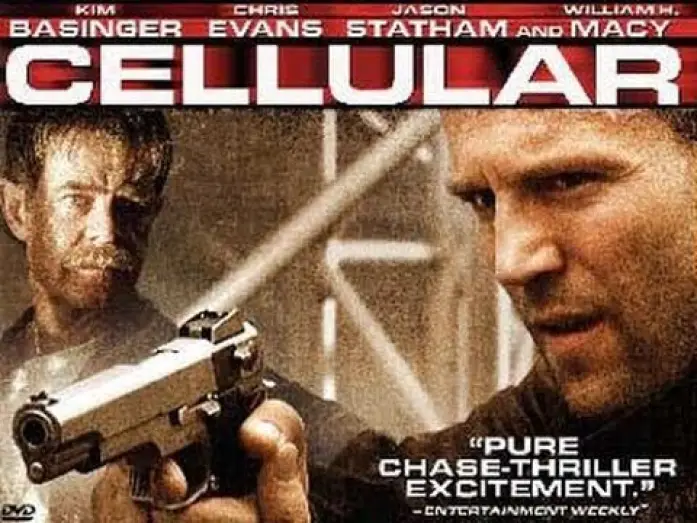
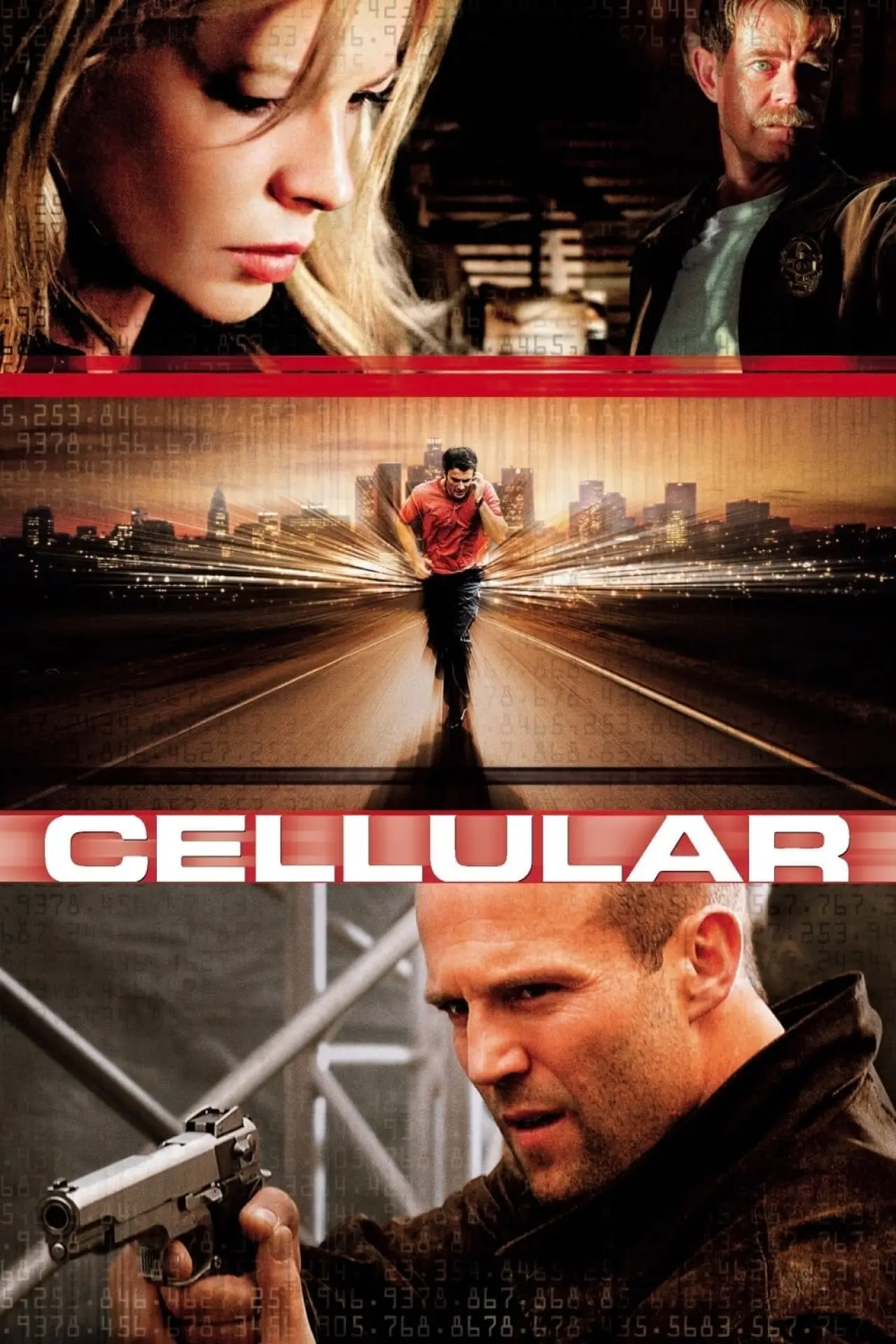
If the signal dies so does she.



Country
Production
Budget
$25 000 000
Box office
$56 051 920
Website
Director
Actors
Kim Basinger, Chris Evans, Jason Statham, William H. Macy, Noah Emmerich, Valerie Cruz, Richard Burgi, Eric Christian Olsen, Jessica Biel, Adam Taylor Gordon
All actors and roles (10)
All actors and roles (10)
Scenario
Producer
Dean Devlin, Lauren Lloyd, Toby Emmerich, Douglas Curtis, Richard Brener, Keith Goldberg
Camera operator
Gary Capo
Composer
Artist
Jaymes Hinkle
Audition
Roger Mussenden
Editing
Eric A. Sears
Whole Team (54)
Whole Team (54)
Short description
A young man receives an emergency phone call on his cell phone from an older woman. She claims to have been kidnapped – and the kidnappers have targeted her husband and child next.
What's left behind the scenes
- Erik Bress and J. Mackie Grubber reworked the screenplay, but they were never credited in the film's titles.
- Larry Cohen worked on the film's script while trying to sell the script for "Phone Booth" (2002). In an article in "The New Yorker," he stated that his intention was to create a film that was the complete opposite of "Phone Booth," where the protagonist cannot move away from the phone, while in the new film he is tied to the phone but can go anywhere. His friends didn't understand the concept and said he had simply written the same script twice.
- Throughout the film, various references to New Line Cinema, which financed the project, can be noticed repeatedly. The head of the studio, Robert Shaye, appears in a cameo as an irritated man at the police station. The film's producer, Dean Devlin, appears in a cameo as a taxi driver who drives Ryan in one of the film's scenes. On Ricky's school backpack, you can see a poster for "The Lord of the Rings: The Fellowship of the Ring" (2001), and "Final Destination" (2000) is playing on the television in the kidnappers' house. Both films were also produced by New Line Cinema.
- The film was supposed to be Dean Devlin's directorial debut, but in the process of preparing for filming, he decided to step down and became one of the film's producers.
- The mobile phone model used by Ryan in the film is a Nokia 6600.
- The cell phone Chris Evans had throughout the filming of the movie didn't actually work. He heard Kim Basinger's lines intended for him through a small earpiece.
- The tattoo on Ryan's right arm is a Japanese kanji meaning 'loyalty' and 'honor,' the only hint of heroism in this ordinary guy.
- Chris Evans performed all of his car stunts himself without the help of professional stunt performers. He underwent five weeks of training at a Los Angeles stunt school for this purpose. Most of the other stunts in the film were also performed by the actors themselves.
- On August 5, 2004, on an American talk show, Kim Basinger recounted that when she was talking on her cell phone while standing outside a movie theater restroom waiting for her friend, she was greatly annoyed by a small, rude crowd that had gathered around, laughing and pointing at her. Only when her friend came out of the restroom and pointed out that she was standing directly in front of the 'Cellular' poster depicting Kim Basinger talking on a cell phone did she understand what had caused such a reaction from those around her.
- While Ryan is at Los Angeles Airport, an announcement can be heard regarding the start of boarding for flight 180 to Paris. This is the same flight on which the heroes of 'Final Destination' (2000) perished.
- Eric Breсс and J. Mackie Gruber reworked the film's script, but they were never credited in the titles.
- Larry Cohen worked on the screenplay during the period when he was trying to sell the script for "Phone Booth" (2002). In an article for The New Yorker, he explained that his intention was to create a film that was the complete opposite of "Phone Booth": while in that film the protagonist cannot leave the phone, in the new film he is tied to the phone but can go anywhere. His friends did not understand the concept and told him he had simply written the same script twice.
- Throughout the film, there are numerous references to New Line Cinema, the studio that financed the project. Studio boss Robert Shaye makes a cameo as an irritated man in the police station. The film's producer, Dean Devlin, appears in a cameo as the taxi driver who drives Ryan in one of the scenes. A poster for "The Lord of the Rings: The Fellowship of the Ring" (2001) can be seen on Ricky's school backpack, and "Final Destination" (2000) is playing on the television in the kidnappers' house. Both films were also produced by New Line Cinema.
- The cell phone Chris Evans used throughout the filming was actually non-functional. He heard Kim Basinger's lines intended for him through a small earpiece.
- Chris Evans performed all of his car stunts himself without the use of professional stunt doubles. To achieve this, he underwent five weeks of training at a stunt school in Los Angeles. Most of the other stunts in the film were also performed by the actors themselves.
- On August 5, 2004, during an appearance on an American talk show, Kim Basinger shared that while she was talking on her cell phone outside a movie theater restroom waiting for a friend, she became very irritated by a small, rude crowd that had gathered around her, laughing and pointing. It was only when her friend exited the restroom and pointed out that she was standing directly in front of a poster for the movie 'Cell', which depicted Kim Basinger talking on a cell phone, that she realized what had caused the reaction of those around her.
Similar movies

8.5/10
8.5/10
8.3/10
8.3/10
8.2/10

8.1/10
8.1/10

8.1/10
8/10

8/10


 Auditions in India
 Casting calls in USA
 Castingi w Polsce
 Кастинги в Україні
