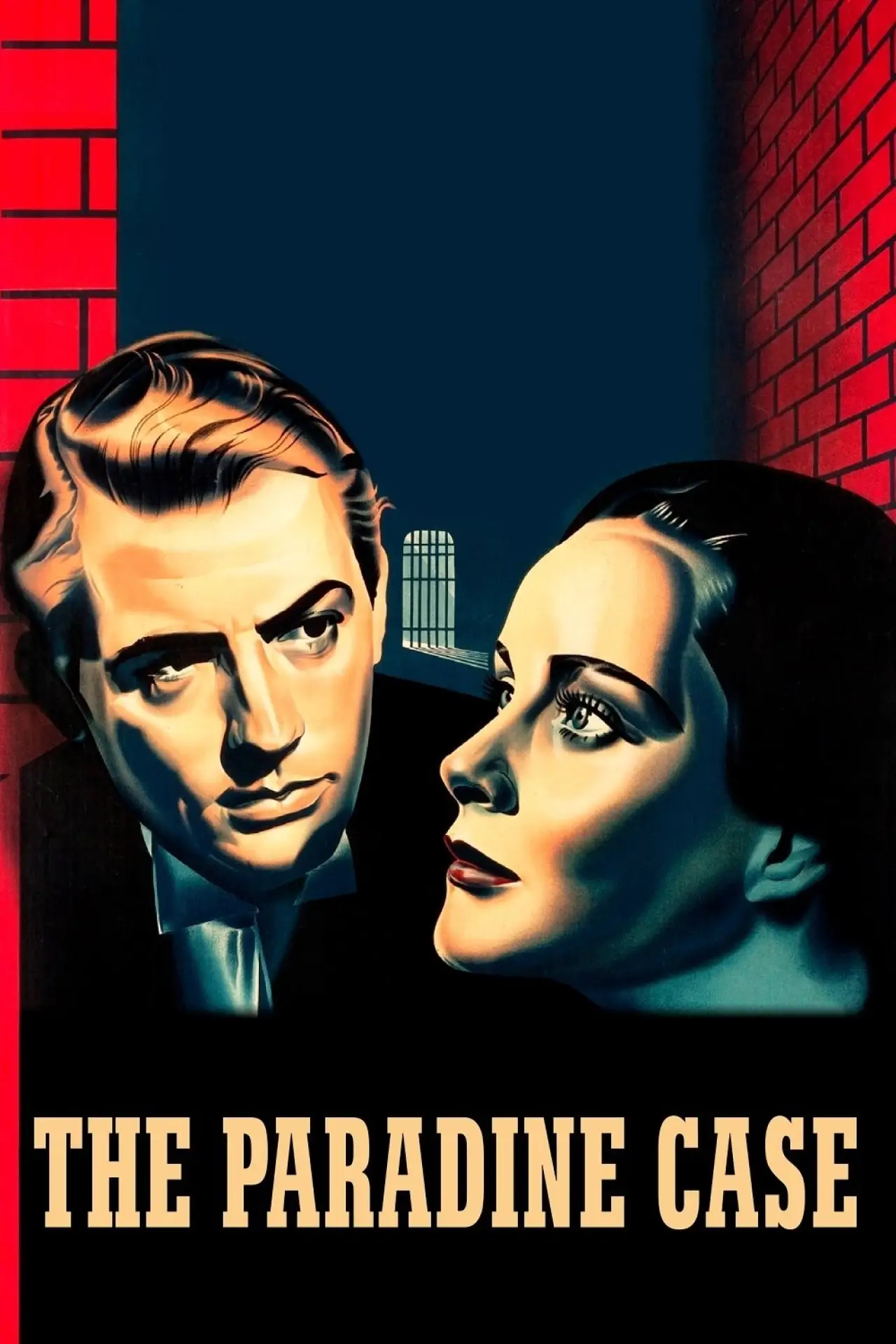
The Paradine Case
The dramatic case of a beautiful woman whose trial for murder held the nation spellbound.




Country
Production
Budget
$4 258 000
Box office
$2 100 000
Director
Actors
Scenario
Producer
Camera operator
Composer
Artist
J. McMillan Johnson
Audition
Editing
Short description
In London, barrister Anthony Keane takes the case of Maddalena Paradine, a beautiful woman accused of poisoning her blind husband. Though happily married, Keane becomes infatuated with his enigmatic client and convinced of her innocence. His obsession clouds his judgment as he builds a defense implicating her servant, André Latour—an act that leads to devastating consequences both in court and at home.
What's left behind the scenes
- Director's cameo: Alfred Hitchcock can be seen as a man with a cello in the crowd of people exiting the train.
- An exact replica of the Old Bailey courtroom was built for the film's theatrical adaptation.
- After a record-breaking shooting period for him (92 days), Alfred Hitchcock (1899-1980) handed over the fully filmed movie to the studio, its duration was almost three hours. The version shown to the American Academy of Arts and Sciences was cut down to 2 hours 12 minutes. In this version, Ethel Barrymore (1879-1959) portrays the half-mad wife of Lord Horfield, which, in fact, explains her Oscar nomination. Then, producer David O. Selznick (1902-1965) reduced the film to 2 hours 5 minutes, and then to its current length – 1 hour 54 minutes, with Barrymore’s screen time in this version limited to just 3 minutes or so. In 1980, the original version of the film (before all the cuts) was destroyed by a flood, making the restoration of the deleted material now quite problematic, although it is claimed that copies of some scenes have been preserved in the George Eastman Museum (one of the oldest film archives in the world) in Rochester, New York.
- Alfred Hitchcock liked the actors and actresses involved in the film, but he felt that Gregory Peck (1916-2003), Alida Valli (1921-2006) and Louis Jourdan (1921-2015) were poorly suited to their roles. Producer David O. Selznick insisted on casting them in these roles.
- The film's production cost was virtually identical to that of the 1939 historical melodrama "Gone with the Wind" by Victor Fleming (1899-1949), George Cukor (1899-1983), and Sam Wood (1883-1949). Scenes were repeatedly reshot due to the insistence of producer David O. Selznick, who also constantly offered unsolicited advice to Alfred Hitchcock, whose work was meticulously planned in advance and down to the smallest detail. Hitchcock's contract stipulated $1,000 per day of filming, and ultimately Selznick took over the film entirely – including overseeing the editing and resolving issues with the musical score.
- The original screenplay was written by Ben Hecht (1894-1964) and James Bridie (1888-1951) based on an adaptation by Alma Reville (1899-1982). However, producer David O. Selznick disliked the result, so he became one of the screenwriters, and in the credits, he was listed as the sole author of the screenplay.
- Director's cameo: Alfred Hitchcock can be spotted as the man with a cello in the crowd of people exiting the train.
- After a filming period of 92 days—a record for him—Alfred Hitchcock (1899–1980) delivered the completed film to the studio with a runtime of nearly three hours. The version shown to the Academy of Motion Picture Arts and Sciences was trimmed to 2 hours and 12 minutes. In this version, Ethel Barrymore (1879–1959) appears as Lord Horfield's semi-insane wife, which explains her Oscar nomination. Producer David O. Selznick (1902–1965) later cut the film to 2 hours and 5 minutes, and eventually to its current length of 1 hour and 54 minutes; in this final version, Barrymore's screen time is limited to only about 3 minutes. In 1980, the original uncut version of the film was destroyed by a flood, making the restoration of the deleted material quite problematic, although it is claimed that copies of some scenes are preserved at the George Eastman Museum (one of the oldest film archives in the world) in Rochester, New York.
- Alfred Hitchcock liked the actors and actresses cast in the film; however, he felt that Gregory Peck (1916-2003), Alida Valli (1921-2006), and Louis Jourdan (1921-2015) were poor fits for their characters. Producer David O. Selznick insisted that they be cast in these roles.
- The filming of the movie cost almost exactly the same amount as the 1939 historical melodrama Gone with the Wind, directed by Victor Fleming (1899-1949), George Cukor (1899-1983), and Sam Wood (1883-1949). Scenes had to be reshot repeatedly because producer David O. Selznick insisted on it; he also constantly interfered with advice for Alfred Hitchcock, who had everything planned in advance and in full detail. Hitchcock received $1,000 per filming day under his contract, and eventually, Selznick took over the work on the film exclusively—which included supervising the editing and resolving issues with the film's musical score.
- The original screenplay was written by Ben Hecht (1894-1964) and James Bride (1888-1951) based on an adaptation by Alma Reville (1899-1982). However, producer David O. Selznick did not like the result, so he became one of the screenwriters; in the end, he was the only writer credited in the titles.
Similar movies
8.2/10
8.1/10
8.1/10
8/10
8/10
8/10
8/10
7.9/10
7.9/10
7.9/10


 Auditions in India
 Casting calls in USA
 Castingi w Polsce
 Кастинги в Україні
