Destroy All Monsters
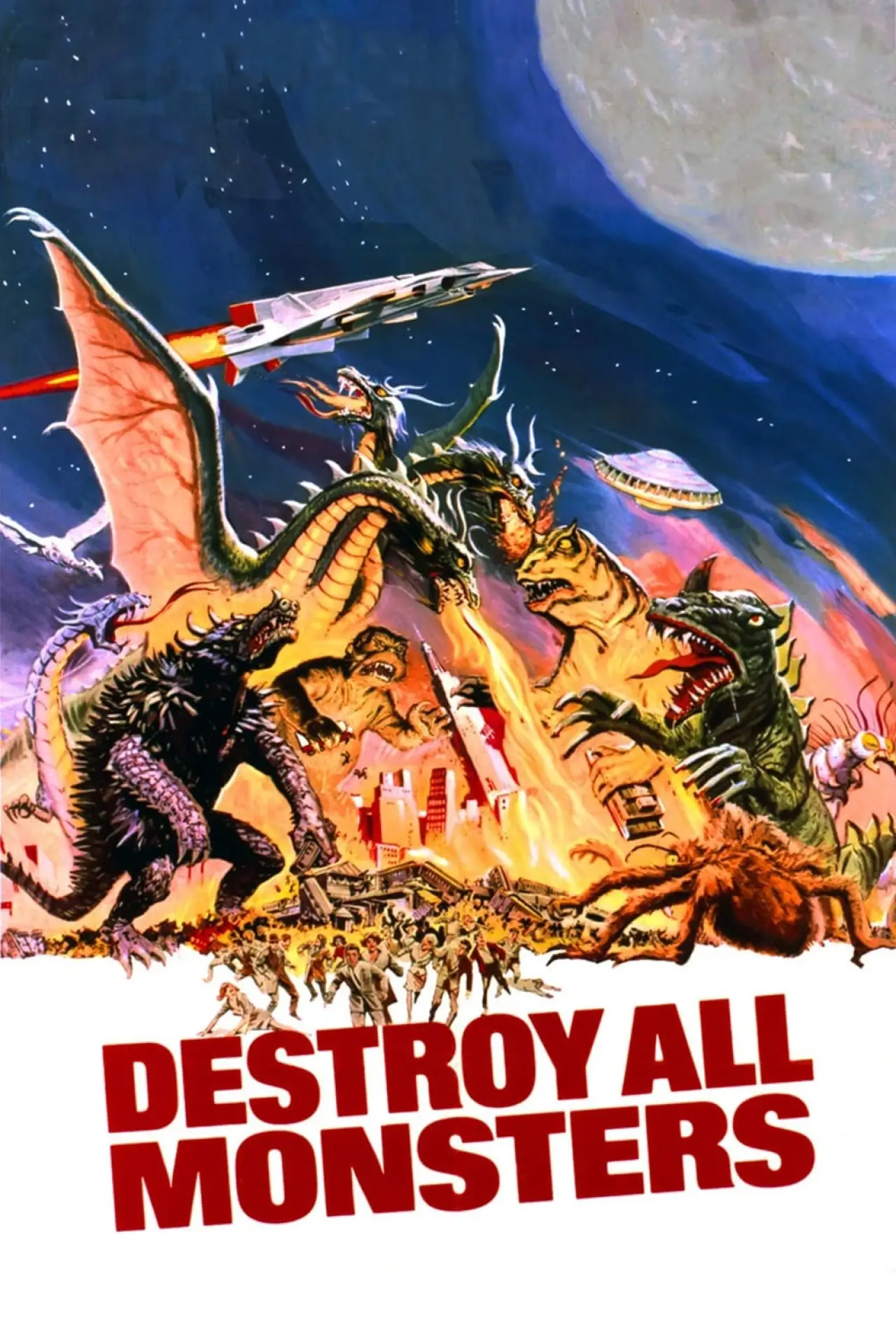
The mysterious Kilaaks appear! Shaking the universe, the great battle of 11 monsters!




Country
Production
Genre
Budget
$200 000 000
Box office
$1 568 760
Director
Actors
Akira Kubo, Jun Tazaki, Yukiko Kobayashi, Yoshio Tsuchiya, Chōtarō Tōgin, Yoshifumi Tajima, Kenji Sahara, Heihachirō Ōkawa, Kyôko Ai, Andrew Hughes
All actors and roles (10)
All actors and roles (10)
Scenario
Producer
Camera operator
Taiichi Kankura
Composer
Artist
Takeo Kita, Mutsumi Toyoshima
Audition
Editing
Ryôhei Fujii
Whole Team (13)
Whole Team (13)
Short description
At the turn of the century, all of the Earth's monsters have been rounded up and kept safely on Monsterland. Chaos erupts when a race of she-aliens known as the Kilaaks unleash the monsters across the world.
What's left behind the scenes
- The film was originally going to be titled “All Monsters Attack Directive.” The initial script featured Godzilla, Mothra’s larva, King Ghidorah, Rodan, Baragon from “Frankenstein vs. Baragon” (1965), Varan from “Varan the Unbelievable” (1958), Kumonga from “Son of Godzilla” (1967), Mandah from “Atragon” (1963), Ebira from “Ebirah, Horror of the Deep” (1966), and the giant walrus Maguma from “Horah” (1962). According to the script, Maguma was supposed to guard the Kilaaks' base alongside Baragon. Ebira and Maguma were removed from the final script. Three more monsters were added – Anguirus from “Godzilla Raids Again” (1955), Minilla from “Son of Godzilla” (1967), and Gorosaurus from “King Kong Escapes” (1967). Baragon’s role was also reduced. In the final script, he was supposed to attack Paris, but during the filming of the Paris attack scene, Baragon’s suit was on the set of the “Ultraman” (1966) series and had to be replaced by Gorosaurus.
- During filming, Varan's costume tore. Because of this, the monster was shown relatively little.
- This is the last film in the Showa series of Godzilla films, receiving positive feedback from fans.
- The American version of the film became Toho’s “International Version.” The film, without the removed scenes, dubbed by William Ross’s Tokyo company – Frontier Enterprises, began to be sold abroad in 1968. Later, American International Pictures discovered that the dubbing was standard and passed the film without the removed scenes to Titan Productions for a new dubbing.
- The film is set in 1999. In reality, Roland Emmerich's film featuring an 'American Godzilla' destroying New York was released in 1998, just like in this film.
- The film was originally planned to be titled 'All Monsters Attack Directive'. The initial version of the script featured Godzilla, Mothra larva, King Ghidorah, Rodan, Baragon from 'Frankenstein Conquers the World' (1965), Varan from 'Varan the Unbelievable' (1958), Kumonga from 'Son of Godzilla' (1967), Manda from 'Atragon' (1963), Ebirah from 'Godzilla vs. the Sea Monster' (1966), and the giant walrus Maguma from 'Gorath' (1962). According to the script, Maguma and Baragon were to guard the Kilaak base together. In the final version of the script, Ebirah and Maguma were removed. Additionally, three more monsters were added: Anguirus from 'Godzilla Raids Again' (1955), Minilla from 'Son of Godzilla' (1967), and Gorosaurus from 'King Kong Escapes' (1967). Baragon's role also became less significant; in the final script, he was supposed to attack Paris, but during the filming of the Paris attack scenes, the Baragon suit was being used for the 'Ultraman' series (1966) and had to be replaced by Gorosaurus.
- This is the ninth film featuring Godzilla, the fifth featuring Mothra, the fourth featuring Rodan, and the third to feature King Ghidorah and the second to feature Anguirus, Varan, Manda, Baragon, Gorosaurus, Minilla, and Kumonga.
- The film takes place in 1999. In reality, Roland Emmerich's film was released in 1998, in which an 'American Godzilla' destroys New York, similar to this film.
- In 1969, American International Pictures broadcast the film in North America. The American broadcast version was created by Titan Productions (formerly known as Titra Studios). The following changes were made: Dialogues were dubbed into English by American actors. The narrator's opening words 'The end of the twentieth century' were replaced with 'The year 1999'. The opening credits were moved to the end of the film and changed to white text on a black background. Deleted scenes include: Minilla covering his eyes with his front paws when King Ghidorah throws Anguirus; Baragon and Varan fighting the army; and the battle between Godzilla and Manda in Tokyo. A march written by Akira Ifukube, which played during the monster invasion of Tokyo, was added as background music for the closing credits.
- In 1969, American International Pictures broadcast the film in North America. The version for American broadcast was created by Titan Productions (formerly known as Titra Studios). The following changes were made: The dialogue was dubbed into English by American actors. The narrator’s opening words, “The end of the twentieth century,” were changed to “The year 1999.” The opening credits were moved to the end of the film and changed to white titles on a black background. Cut: Minilla covers his eyes with his front paws when King Ghidorah drops Anguirus. Cut: Baragon and Varan fight against the army. Cut: Godzilla and Mandah’s battle in Tokyo. The march composed by Akira Ifukube, which played during the monsters’ invasion of Tokyo, was added as background music to the end credits.
Similar movies

8.2/10
8.2/10
7.7/10
7.7/10
7.7/10
7.6/10
7.6/10
7.6/10
7.4/10

7.4/10


 Auditions in India
 Casting calls in USA
 Castingi w Polsce
 Кастинги в Україні
