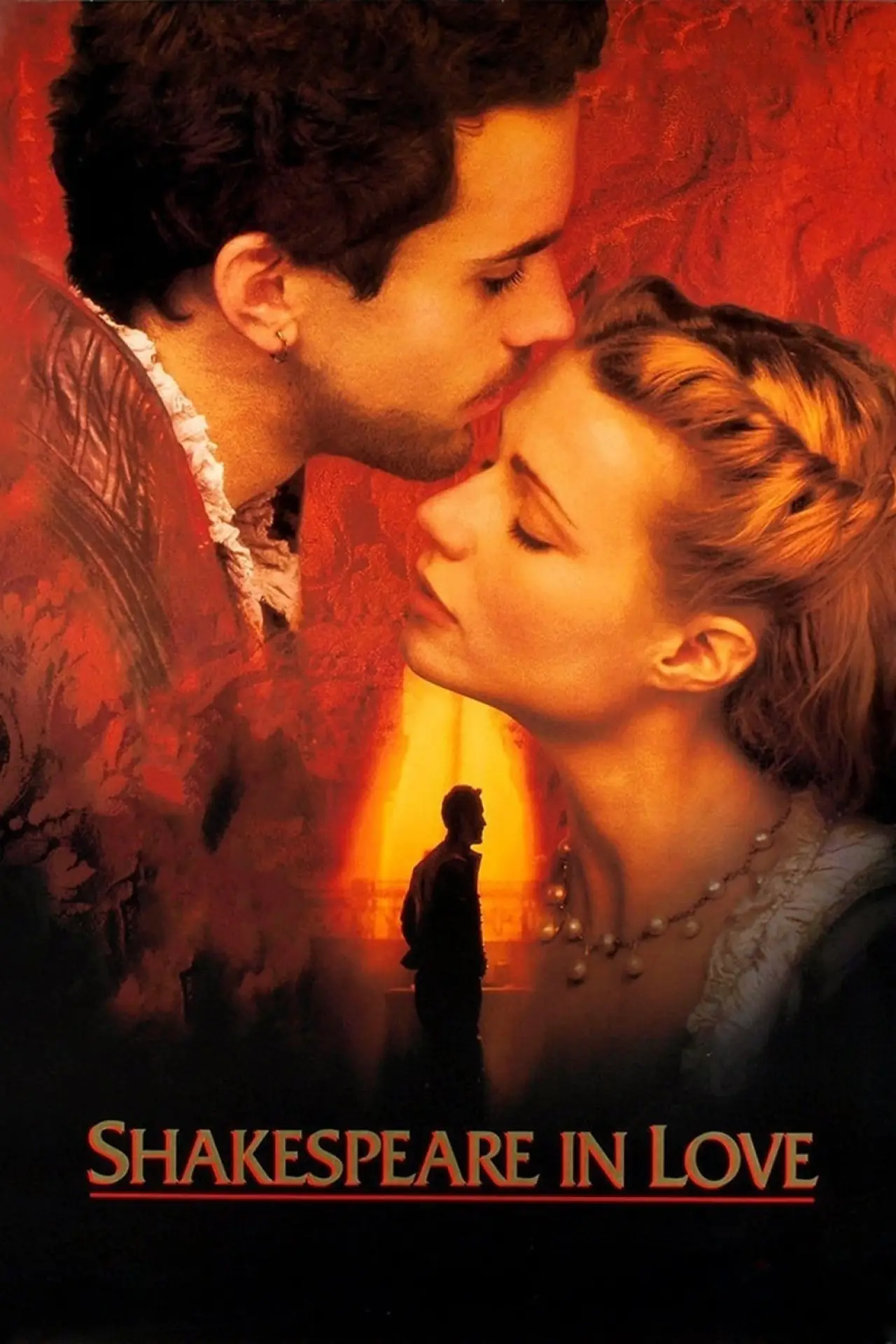
Shakespeare in Love
Love is the only inspiration.




Country
Production
Budget
$25 000 000
Box office
$289 317 794
Director
Actors
Scenario
Marc Norman, Tom Stoppard
Producer
Harvey Weinstein, Edward Zwick, Marc Norman, David Parfitt, Donna Gigliotti, Bob Weinstein, Julie Goldstein
Camera operator
Richard Greatrex
Composer
Artist
Audition
Michelle Guish
Editing
Short description
Young William Shakespeare is forced to stage his latest comedy, 'Romeo and Ethel, the Pirate's Daughter', before it's even written. When lovely noblewoman Viola de Lesseps auditions for a role, they fall into forbidden love — and Shakespeare's play finds a new life (and title). As their relationship intensifies, the comedy soon transforms into tragedy.
What's left behind the scenes
- Judi Dench received an Academy Award for her role as Queen Elizabeth, which appears on screen for approximately eight minutes in four scenes. This is one of the shortest roles among Oscar winners, second only to Beatrice Straight's role in 'Network' (1976), which had only 6 minutes of screen time.
- The play performed for the Queen at the beginning of the film is titled "Two Gentlemen of Verona".
- Besides Gwyneth Paltrow, Meg Ryan, Jodie Foster, Winona Ryder, and Kate Winslet were also considered for the lead female role.
- Judi Dench was so impressed with the full-scale replica of the historic London Rose Theatre, built for the film's shooting, that after filming wrapped, Miramax Studios gave it to her entirely and allowed her to take the disassembled structure home.
- Six years before work on the film finally began, Universal Studios signed Julia Roberts for the lead female role. Daniel Day-Lewis was approached for the lead male role, but he declined, preferring "In the Name of the Father" (1993). Ultimately, after failing to find a suitable alternative, the studio decided to abandon plans to make the project.
- With seven Academy Awards, "Shakespeare in Love" holds the record for the most Oscars won by a film not awarded Best Director.
- For the first and only time in the history of the American Film Academy, two actresses were nominated in the same year for the role of the same character, British Queen Elizabeth. Judi Dench was nominated for and received an award for Best Supporting Actress for "Shakespeare in Love," while Cate Blanchett was nominated for Best Actress for the historical drama "Elizabeth."
- Producer Edward Zwick was originally intended to direct the film when it was being prepared by Universal. Later, when the project gained momentum, he was occupied filming the thriller "The Siege" (1998), and the Miramax studio, which took over the film, was forced to look for other candidates for the director's position. At the same time, Edward Zwick's production company, Bedford Falls, still participated in the project.
- The idea for the film came to screenwriter Mark Norman when his son Zachary called him from Boston University and suggested he write something about Shakespeare's early years in the Elizabethan theatre. It took the author another two years to develop this idea.
- After the final scene of the film received a mixed reaction at test screenings, it was decided to reshoot it just weeks before the scheduled premiere in early December 1998. In November 1998, a new version of the final scene with Will and Viola was filmed, forcing Joseph Fiennes to interrupt his work on a play in a British theater, and Gwyneth Paltrow was specially flown in for a few days from the set of "The Talented Mr. Ripley" (1999).
- During the numerous delays in the film's production, Kevin Reynolds and Kenneth Branagh were contenders for the director's position.
- In one scene, Viola asks Will, "Are you the author of William Shakespeare's plays?" This is a reference to numerous modern theories and speculations that question the authorship of William Shakespeare.
- The unattractive street urchin John Webster, shown in one scene playing with mice, was a real historical figure. He later became a famous writer, whose plays were distinguished by a large number of bloody scenes and violence.
- Kate Winslet, after the colossal success of "Titanic," turned down the role offered to her, preferring Jane Campion's drama "The Portrait of a Lady" (1999).
- Although "Shakespeare in Love" contains numerous phrases and fragments from "Romeo and Juliet" along with quotes from other Shakespearean plays, the famous playwright and writer himself was not credited among the screenwriters.
- The role of Philip Henslowe was originally intended for Simon Callow, but after the film's production was resumed after a long break, it went to Geoffrey Rush. In return, Simon Callow received a smaller, but very significant role as Tilney. Mel Gibson was also considered for the role of Philip Henslowe.
- Ben Affleck was not considered a potential candidate for the role until the very last moment, receiving it only after Gwyneth Paltrow sent the producers a tape of their joint audition material.
- Julie Andrews could have played the role of Queen Elizabeth.
- Judy Dench won an Academy Award for her role as Queen Elizabeth, who appears on screen for approximately eight minutes across four scenes. This is one of the shortest roles among Oscar winners, surpassed only by Beatrice Straight's role in 'Network' (1976), who had only 6 minutes of screen time.
- The play performed for the Queen at the beginning of the film is titled 'The Two Gentlemen of Verona'.
- In addition to Gwyneth Paltrow, the lead female role could have gone to Meg Ryan, Jodie Foster, Winona Ryder, or Kate Winslet.
- Judy Dench was so delighted with the full-scale replica of the ancient London Rose Theatre created for the film that after filming concluded, Miramax placed it at the actress's complete disposal and allowed her to take the collapsible structure home.
- Six years before production finally began, Universal signed Julia Roberts for the female lead. Daniel Day-Lewis was sought for the male lead, but the actor declined at the time, choosing instead to appear in 'In the Name of the Father' (1993). Ultimately, after failing to find a worthy alternative, the studio opted to abandon its plans to produce the project.
- With seven Academy Awards, 'Shakespeare in Love' holds the record for the most Oscars won by a film that did not win the award for Best Director.
- For the first and only time in the history of the Academy of Motion Picture Arts and Sciences, two actresses were nominated in a single year for playing the same character: the British Queen Elizabeth. Judy Dench was nominated and won for Best Supporting Actress in 'Shakespeare in Love,' while Cate Blanchett was nominated for Best Actress in the historical drama 'Elizabeth'.
- Producer Edward Zwick was originally intended to direct the film when Universal was preparing it. Later, when the project finally gained momentum, he happened to be busy filming the thriller 'The Siege' (1998); consequently, Miramax, which had taken over the film, was forced to look for other directorial candidates. At the same time, Edward Zwick's production company, Bedford Falls, still participated in the project.
- The idea for the film came to screenwriter Marc Norman when his son, Zachary, called him from Boston University and suggested writing something about Shakespeare's early years in the Elizabethan theatre. It took the author another two years to develop this idea.
- After the film's final scene drew a mixed reaction during test screenings, it was decided to redo it just a few weeks before the premiere, which was scheduled for early December 1998. In November 1998, a new version of the final scene with Will and Viola was filmed; for this, Joseph Fiennes had to interrupt his work on a play at a British theatre, and Gwyneth Paltrow was flown in for a few days from the set of 'The Talented Mr. Ripley' (1999).
- During the numerous production delays, Kevin Reynolds and Kenneth Branagh were considered for the director's position.
- In one of the scenes, Viola asks Will, "Are you the author of the plays of William Shakespeare?" This is a nod to numerous modern theories and conjectures that question the authorship of William Shakespeare.
- The unattractive street urchin John Webster, shown in one scene playing with mice, was a real historical figure. He later became a famous playwright whose plays were noted for their abundance of bloody scenes and violence.
- Following the colossal success of Titanic, Kate Winslet turned down a offered role, opting instead for Jane Campion's drama Holy Smoke (1999).
- Although Shakespeare in Love contains numerous phrases and fragments from Romeo and Juliet, as well as quotes from other plays by Shakespeare, the famous playwright and writer himself was not credited as one of the screenwriters.
- The role of Philip Henslowe was originally intended for Simon Callow, but after production resumed following a long hiatus, it went to Geoffrey Rush. In return, Simon Callow received the smaller but still significant role of Tilney. The role of Philip Henslowe was also considered for Mel Gibson.
- Ben Affleck was not considered as a potential candidate for the role until the very last moment, only securing it after Gwyneth Paltrow sent the producers a tape of their joint audition material.
Similar movies
8.7/10
8.6/10
8.6/10
8.5/10
8.5/10

8.3/10
8.3/10
8.3/10
8.2/10
8.2/10


 Auditions in India
 Casting calls in USA
 Castingi w Polsce
 Кастинги в Україні
