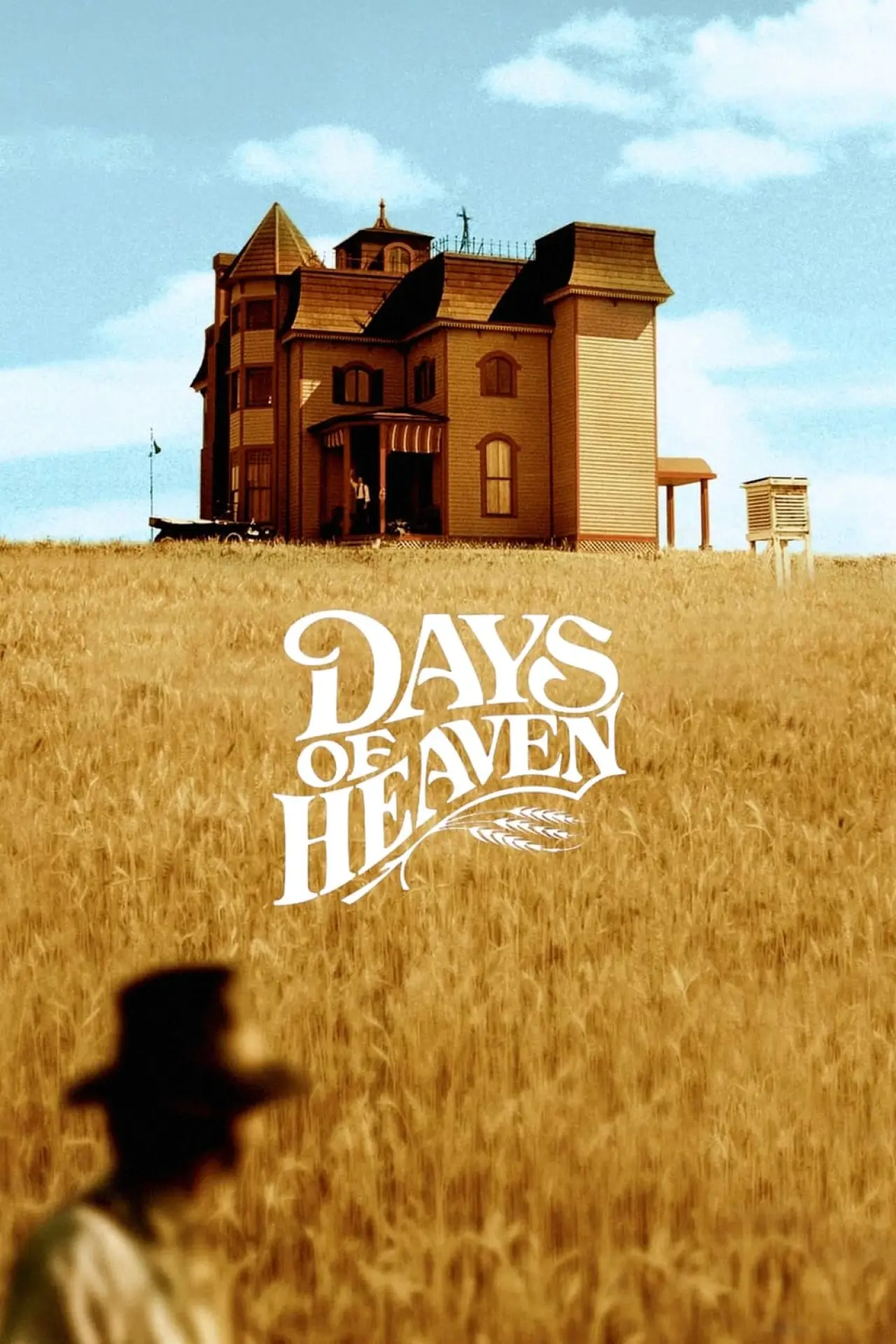
Days of Heaven
She gave her hand to one man, but her heart to another.



Country
Production
Budget
$3 000 000
Box office
$3 446 749
Director
Actors
Richard Gere, Brooke Adams, Sam Shepard, Linda Manz, Robert J. Wilke, Jackie Shultis, Stuart Margolin, Timothy Scott, Gene Bell, Doug Kershaw
All actors and roles (10)
All actors and roles (10)
Scenario
Producer
Bert Schneider, Harold Schneider, Jacob Brackman
Camera operator
Composer
Artist
Audition
Dianne Crittenden
Editing
Short description
In 1916, a Chicago steel worker accidentally kills his supervisor and flees to the Texas panhandle with his girlfriend and little sister to work harvesting wheat in the fields of a stoic farmer.
What's left behind the scenes
- John Travolta, Al Pacino, and Dustin Hoffman all turned down the role of Bill.
- Filming proceeded very slowly, mainly during the short 20-minute period of "golden light" immediately preceding sunset.
- When Bill picks up a rifle at the 84th minute of the film, it is a standard double-barreled shotgun. When he shoots at the police at the 86th minute, he fires three times in a row without reloading.
- The shots of the locust swarm taking flight were filmed as follows: a helicopter circled over the fields, scattering ordinary peanuts in large quantities, while the actors simultaneously backed away. In the finished film, this footage was simply reversed.
- The scene in which Bill falls face-first into the water was filmed in a large aquarium in Sissy Spacek's living room (Terrence Malick had worked with Sissy Spacek in his previous 1973 film, 'Badlands').
- Haskell Wexler, credited as an additional cinematographer, told film critic Roger Ebert in a private conversation that he had actually shot most of the film.
- Almost immediately after filming began, Terrence Malick abandoned his own script and filmed the movie for about a year almost entirely based on actors' improvisation. He wanted the actors to "find this story" themselves.
- Haskell Wexler, credited as an additional cinematographer, told renowned American film critic Roger Ebert in a private conversation that he actually shot most of the film.
- Striving for maximum realism, costume designer Patricia Norris sewed the costumes from worn clothing and old fabrics.
- Cinematographer Néstor Almendros, due to vision problems, filmed the movie practically blind. Before each take, his assistant would take a Polaroid photo, which the cinematographer would examine under a powerful magnifying glass.
- A solitary rural house on the horizon, surrounded by wheat fields (this visual image runs throughout the film) is reminiscent of the painting "Christina's World" by the great American artist Andrew Wyeth.
- The book that Linda flips through at the farmer's house is an illustrated edition of Rudyard Kipling's "The Jungle Book".
- Terrence Malick spent two years editing this film.
- John Travolta, Al Pacino, and Dustin Hoffman turned down the role of Bill.
- Location filming took place in Alberta, Canada. All the buildings, including the farmer's house, were constructed from plywood by set designer Jack Fisk.
- The film was shot on location in Alberta, Canada. All the buildings, including the farmhouse, were constructed from plywood by set decorator Jack Fisk.
- The book Linda flips through in the farmer's house is an illustrated edition of Rudyard Kipling's "The Jungle Book."
- Due to vision problems, cinematographer Nestor Almendros filmed the movie practically blind. Before every take, his assistant took a Polaroid photo, which the cinematographer would then examine under a powerful magnifying glass.
- Almost immediately after filming began, Terrence Malick abandoned his own screenplay and spent about a year filming based almost entirely on actor improvisation. He wanted the actors to "find the story" themselves.
- Haskell Wexler, who is credited as an additional cinematographer, told film critic Roger Ebert in a private conversation that he was actually the one who shot the majority of the film.
- The scene in which Bill falls face-first into the water was filmed in a large aquarium in Sissy Spacek's living room (Terrence Malick had worked with Sissy Spacek on his previous film, "Badlands" from 1973).
Similar movies
8.1/10
8.1/10
7.9/10
7.8/10
7.8/10
7.8/10

7.7/10
7.6/10
7.6/10
7.6/10


 Auditions in India
 Casting calls in USA
 Castingi w Polsce
 Кастинги в Україні
