Rope
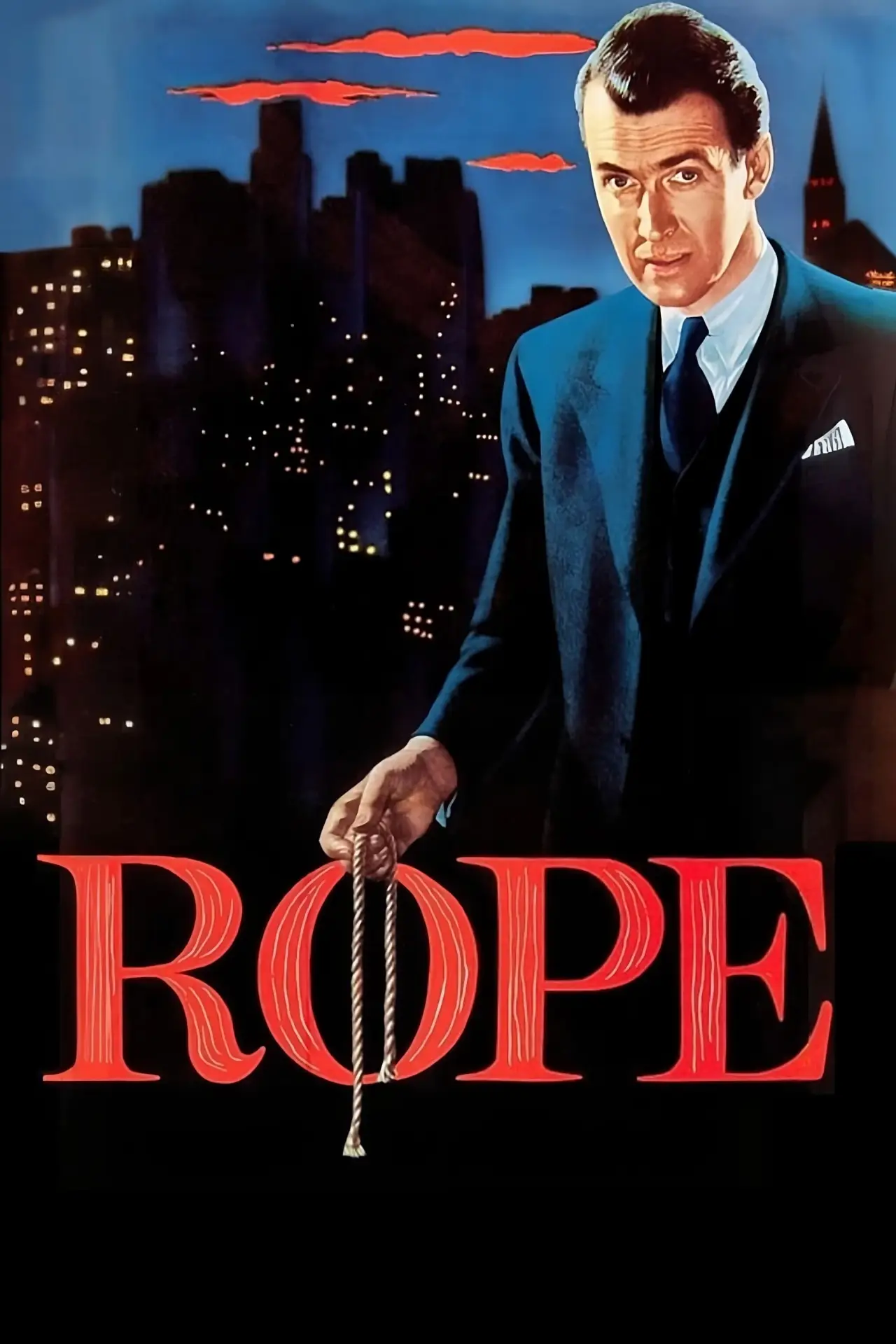
It begins with a shriek...it ends with a shot! From beginning to end, nothing ever held you like Alfred Hitchcock's ROPE!




Country
Production
Budget
$1 500 000
Box office
$2 200 000
Director
Actors
James Stewart, John Dall, Farley Granger, Cedric Hardwicke, Constance Collier, Douglas Dick, Edith Evanson, Dick Hogan, Joan Chandler, Alfred Hitchcock
All actors and roles (10)
All actors and roles (10)
Scenario
Producer
Alfred Hitchcock, Sidney Bernstein
Camera operator
William V. Skall
Composer
Artist
Audition
Editing
William H. Ziegler
Whole Team (32)
Whole Team (32)
Short description
Two young men attempt to prove they committed the perfect murder by hosting a dinner party for the family of a classmate they just strangled to death.
What's left behind the scenes
- Part of the film's plot is based on a real murder committed by Nathan Leopold and Richard Loeb, students at the “University of Chicago.” This crime also formed the basis of the plot of “Compulsion” (1959).
- The film was shot using long takes lasting from four to ten minutes (ten minutes being the maximum amount of time the camera’s film would allow).
- While filming, Alfred Hitchcock drew inspiration from a BBC television production – "Rope" (1939).
- Despite the film's runtime of 80 minutes, it is assumed that the action unfolds in real time. However, the events shown in the film last approximately 100 minutes.
- The film features only nine editing cuts.
- When Janet and Mrs. Atwater discuss their favorite actors, both mention how good Cary Grant was "in that new film with Ingrid Bergman." Neither of them names the film, but it is most likely a reference to "Notorious" (1946), also directed by Alfred Hitchcock.
- During filming, the actors had to watch their step carefully, as the entire floor was covered with wires running to the cameras and lighting.
- According to Arthur Laurents, the play on which the film was based supposedly featured a love affair between Cadell (James Stewart) and one of the murderers.
- Several of the film's final scenes were reshot multiple times because Alfred Hitchcock was dissatisfied with the color of the sunset.
- “Rope” was Alfred Hitchcock’s first color film.
- The film was shot entirely on studio sets, with the exception of the scene against which the opening credits roll.
- The clouds that viewers can see in some scenes were made of fiberglass.
- To achieve the desired sound effect of a police siren approaching the house, an ambulance was used, which drove up to the Warner Brothers studio building at full speed with its siren on. The sound of the siren was recorded through a microphone installed at the main studio gate.
- Alfred Hitchcock filmed a romantic scene in Central Park between Joanna Chandler (Janet Walker) and Dick Hogan (David Kentley). This scene was used for a promotional trailer for the film, but was removed from the finished picture.
- Cary Grant was the initial candidate for the role of Rupert Cadel.
- Montgomery Clift was the initial candidate for the role of Brandon Shaw.
- The film was banned in some US cities due to allusions to a homosexual relationship between Phillip (Farley Granger) and Brandon (John Dall).
- In London, the play on which the film was based was called 'Rope'. When the play was staged on Broadway, the title was changed to 'Rope’s End'.
- According to Arthur Laurents, Hitchcock initially assured him that the film would not show a murder, which, in turn, was supposed to make viewers doubt whether the main characters had committed a crime; whether a corpse was lying in the chest of drawers. However, Hitchcock still filmed the murder scene and showed it at the very beginning of the film.
- Hitchcock did not miss the opportunity to appear in his signature cameo in this film as well. Around the 55th minute of the film, his profile appears on a neon sign visible from the apartment window. Additionally, some claim that Hitchcock can be seen walking down the street in shots accompanying the opening credits.
- Since the episodes were filmed continuously in incredibly long takes, all members of the film crew tried to avoid mistakes. Even once, when a camera dolly ran over the foot of the cameraman (resulting in a fracture), filming did not stop. And on another occasion, one of the actresses tried to place a glass on the table, but missed. Then someone from the crew instantly rushed forward and managed to catch the glass before it broke. Incidentally, both of these takes were included in the final version of the film.
- This is the first film in which Hitchcock himself acted as a producer.
- This film was unavailable for several decades because the rights to this picture (as well as to four others) were bought by Alfred Hitchcock, and after his death, passed to his daughter, Patricia Hitchcock. These five films were known for many years as "Hitchcock's Lost Five" (5 lost Hitchcock’s). All five films were re-released in 1984. The other four films are "The Man Who Knew Too Much" (1956), "Rear Window" (1954), "The Trouble with Harry" (1955), and "Vertigo" (1958).
- The film's plot is partially based on the real-life murder committed by University of Chicago students Nathan Leopold and Richard Loeb. This crime also served as the basis for the plot of 'Violence' (1959).
- While filming the movie, Alfred Hitchcock drew inspiration from the BBC television production 'Rope' (1939).
- When Janet and Mrs. Atwater discuss their favorite actors, they both mention how great Cary Grant was 'in that new film with Ingrid Bergman.' Neither of them mentions the title of the movie, but they are most likely referring to 'Notorious' (1946), which was also directed by Alfred Hitchcock.
- According to Arthur Laurents, in the play upon which the film was based, Cadell (James Stewart) was allegedly involved in a romantic affair with one of the killers.
- This film was unavailable for several decades because the rights to this picture (as well as four others) were bought by Alfred Hitchcock and, after his death, were inherited by his daughter, Patricia Hitchcock. For many years, these five films were known as 'Hitchcock's Lost Five.' All five films were re-released in 1984. The other four films are 'The Man Who Knew Too Much' (1956), 'Rear Window' (1954), 'The Trouble with Harry' (1955), and 'Vertigo' (1958).
- 'Rope' was Alfred Hitchcock's first film in color.
- The film was shot entirely in studio pavilions, with the exception of the scene during which the opening credits appear.
- The clouds that the viewer can notice in some scenes were made of fiberglass.
- To achieve the desired sound effect of a police siren approaching a house, an ambulance was used, which drove toward the Warner Brothers studio building at full speed with its siren on. The sound of the siren was recorded via a microphone installed at the main entrance gates of the studio.
- Alfred Hitchcock filmed a romantic scene in Central Park between Joanna Chandler (Janet Walker) and Dick Hogan (David Kentley). This scene was used for the film's promotional trailer but was removed from the final cut.
- Cary Grant was the original candidate for the role of Rupert Cadell.
- Montgomery Clift was the original candidate for the role of Brandon Shaw.
- The film was banned in some US cities due to hints of a homosexual relationship between Philip (Farley Granger) and Brandon (John Dall).
- According to Arthur Laurents, Hitchcock initially assured him that the murder would not be shown in the film, which in turn was intended to leave the audience doubting whether the protagonists had committed the crime and whether the body was actually in the chest of drawers. However, Hitchcock did film the murder scene and showed it at the very beginning of the movie.
- Hitchcock did not miss the opportunity to make his signature cameo appearance in this film as well. Around the 55th minute, his profile appears on a neon sign visible from the apartment window. Additionally, some claim that Hitchcock can be spotted walking down the street in the shots accompanying the opening credits.
- This is the first film in which Hitchcock served as the producer himself.
Similar movies
8.1/10
8.1/10
8.1/10
8/10
7.9/10
7.9/10
7.9/10
7.9/10
7.9/10
7.8/10


 Auditions in India
 Casting calls in USA
 Castingi w Polsce
 Кастинги в Україні
