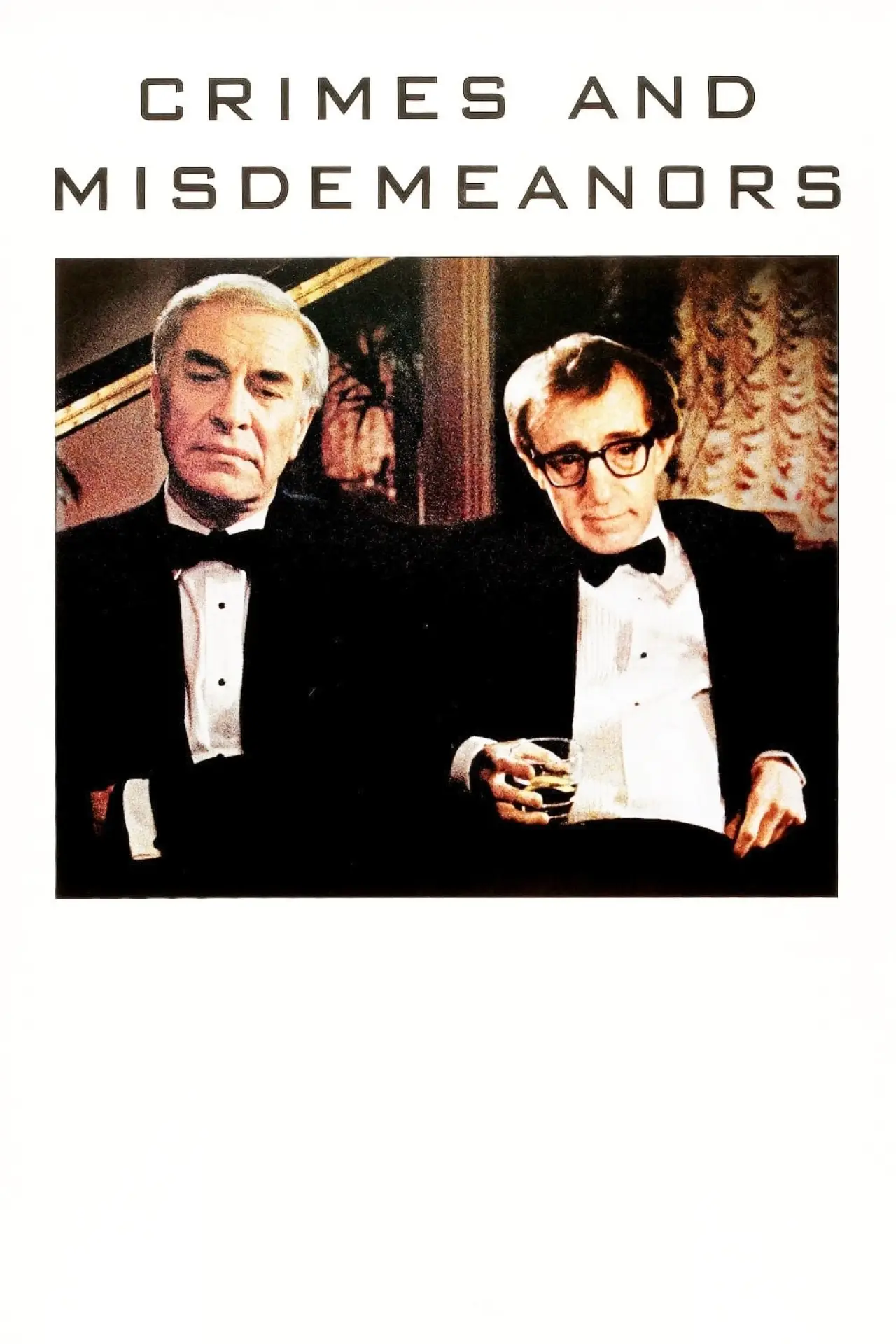
Crimes and Misdemeanors
It's about love and reality. Faith and delusion. Good and evil. Success and failure.




Country
Budget
$19 000 000
Box office
$18 254 702
Director
Actors
Scenario
Producer
Robert Greenhut, Charles H. Joffe, Jack Rollins
Camera operator
Composer
Artist
Santo Loquasto
Audition
Juliet Taylor
Editing
Susan E. Morse
Whole Team (65)
Whole Team (65)
Short description
A renowned ophthalmologist is desperate to cut off an adulterous relationship…which ends up in murder; and a frustrated documentary filmmaker woos an attractive television producer while making a film about her insufferably self-centered boss.
What's left behind the scenes
- The lady who says, "Hi Lester... Thank you so much for the invitation... This is a wonderful party" at the 10 minute and 10 second mark of the film is Wanda Toscanini-Horowitz, the wife of the great pianist Vladimir Horowitz.
- Martin Landau originally auditioned for the role of Jack Rosenthal.
- For one-third of the film, Woody Allen's character films a documentary under the guidance of Mia Farrow. In the final cut, Allen was unhappy with these scenes. During post-production, he cut an entire third of the movie, then rewrote and reshot those scenes from scratch. As a result, Shaun Young's scenes were cut entirely, and Daryl Hannah's role was reduced to a cameo.
- Lester (Alan Alda) was created in the image of Larry Gelbart, with whom both Woody Allen and Alan Alda worked. Both felt animosity towards him due to his despotic methods. Various remarks by Lester, such as: “Comedy is tragedy plus time” and “If it bends – it’s funny, if it breaks – it’s not funny” – are quotes by Larry Gelbart. Despite his well-known dislike for Gelbart, Allen called him “the best comedy writer of anyone I’ve ever known and just a wonderful human being” in a statement shortly after Gelbart’s death. And Alda said: “Larry’s genius as a writer changed my life because I got to say his lines, which are so good they will live on. But his other genius was his enormous talent for companionship, and that ‘light’ went with him, and we are left sitting in the dark” (from the Los Angeles Times obituary).
- Woody Allen felt he was too "nice" to the other characters at the end of "Hannah and Her Sisters" (1986), and he made this film as a response to those feelings.
- The role of Professor Louis Levy was not played by an actor, but by Woody Allen's acquaintance and therapist, world-renowned Martin S. Bergman – a clinical professor of psychology teaching a postdoctoral program at New York University.
- For one-third of the film, Woody Allen shoots a documentary, directed by Mia Farrow. Allen disliked these scenes in the final version of the film. During post-production, he cut a third of the film and then rewrote and reshot those scenes from scratch. As a result, Sean Young's scenes were completely cut, and Daryl Hannah's role was reduced to a cameo.
- The woman who says “Hello Lester… Thank you so much for the invitation… It’s a lovely party” at 10 minutes and 10 seconds into the film is Wanda Toscanini-Horowitz, the wife of the greatest pianist Vladimir Horowitz.
- Alan Alda's appearance in the opening scene with Daryl Hannah was originally only intended to be brief. Woody Allen asked Alan to improvise during the scene. He liked the result and ultimately decided to keep it in the final version of the film.
- When Jude decides to kill Dolores, he dials only 7 digits when calling his brother, Jack. Jude lives in Connecticut, and Jack lives in New York, so he would have needed to dial at least 10 digits to reach him.
- Clifford's sarcastic remark to Haley Reed (Mia Farrow) that she loves Lester like a brother is a reference to David Greenglass, the brother of executed 'atomic spy' Ethel Rosenberg, whose court testimony helped convict her and her husband, Julius Rosenberg, of espionage.
- During the wedding celebration, a jazz orchestra plays Crazy Rhythm, with muted trumpet sounds audible, even though the trumpeter isn't playing at that moment.
- Alan Alda was initially only supposed to appear in the opening scene with Daryl Hannah. Woody Allen asked Alan to improvise in that scene. He liked the result and ultimately decided to leave it in the final version of the film.
- The role of Professor Louis Levy was played not by an actor, but by Woody Allen's acquaintance and therapist, the world-renowned Martin S. Bergmann—a clinical professor of psychology who teaches the postdoctoral program at New York University.
- Clifford's sarcastic remark, directed at Hayley Reed (Mia Farrow), that she loves Lester like a brother, is a reference to David Greenglass, who was the brother of convicted “atomic spy” Ethel Rosenberg, and whose testimony in court helped convict her and her husband Julius Rosenberg of espionage.
- Woody Allen felt he had been too "sweet" toward the other characters at the end of Hannah and Her Sisters (1986), and he made this film as a response to those feelings.
- During an argument with Cliff, Lester mentions that he has a closet full of Emmys. In real life, Alan Alda had won four Emmys before appearing in this film.
- During his argument with Cliff, Lester states he has a closet full of Emmys. In real life, Alan Alda had won four Emmys before appearing in this film.
- Lester (Alan Alda) was based on Larry Gelbart, with whom both Woody Allen and Alan Alda had worked. Both disliked him due to his despotic methods. Various comments made by Lester, such as "Comedy is tragedy plus time" and "If it bends, it's funny; if it breaks, it's not funny," are quotes from Larry Gelbart. Despite his well-known dislike for Gelbart, Allen called him "the best comedy writer I've ever known and just a wonderful man" in a statement shortly after Gelbart's death. Alda said: "Larry's genius as a writer changed my life because I got to deliver lines of his that were so good they will stay with us for a long time. But his other genius was his immense talent for companionship, and that 'light' went with him, leaving us sitting in the dark" (from the Los Angeles Times obituary).
Similar movies
9/10
8.6/10
8.5/10
8.5/10
8.4/10
8.4/10
8.2/10
8.2/10
8.1/10
8.1/10


 Auditions in India
 Casting calls in USA
 Castingi w Polsce
 Кастинги в Україні
