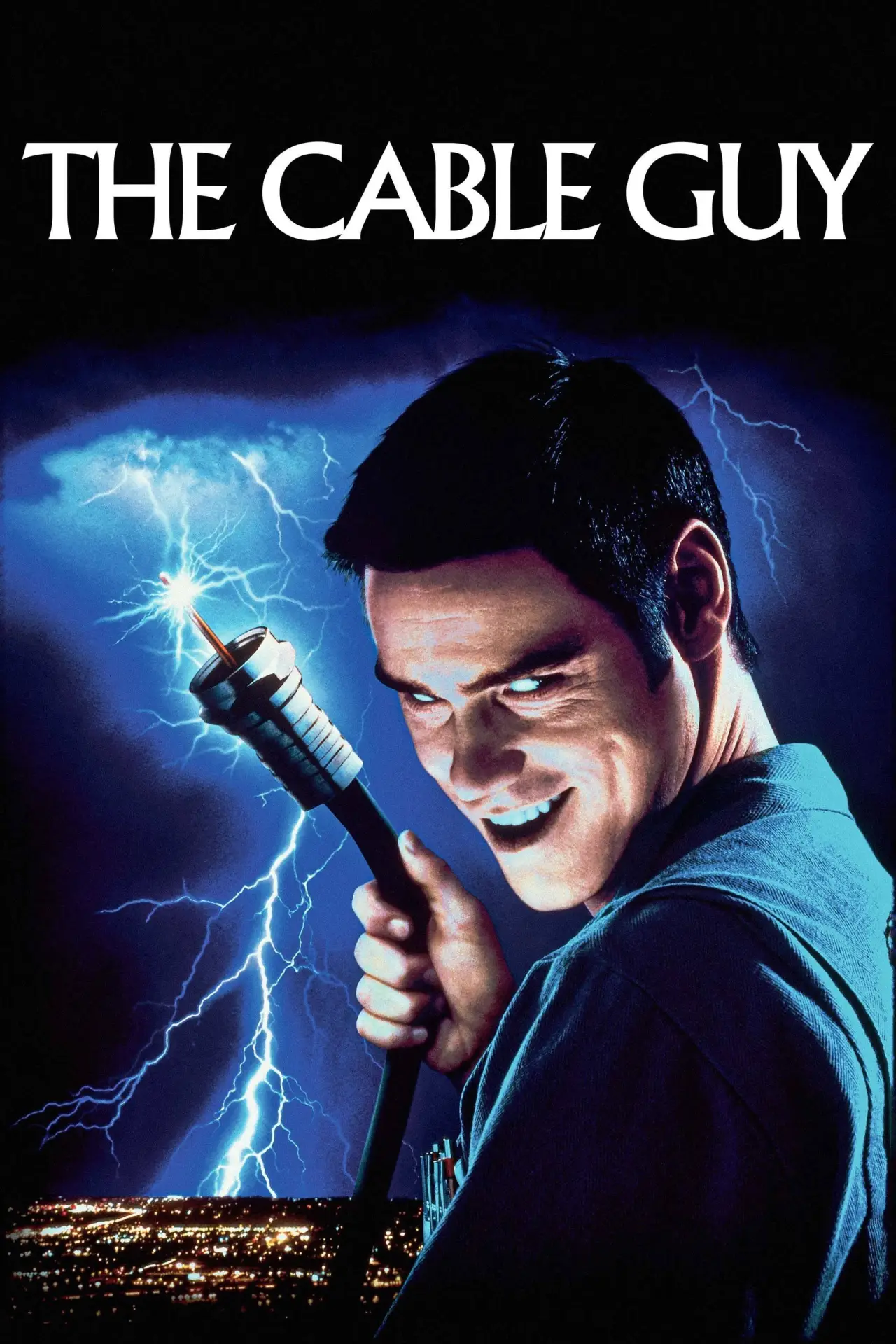
The Cable Guy
There's no such thing as free cable.



Country
Budget
$47 000 000
Box office
$102 825 796
Director
Actors
Scenario
Producer
Judd Apatow, Andrew Licht, Jeffrey A. Mueller, Brad Grey, Bernie Brillstein, Marc Gurvitz
Camera operator
Robert Brinkmann
Composer
Artist
Sharon Seymour, Lori Rowbotham
Audition
Juel Bestrop
Editing
Short description
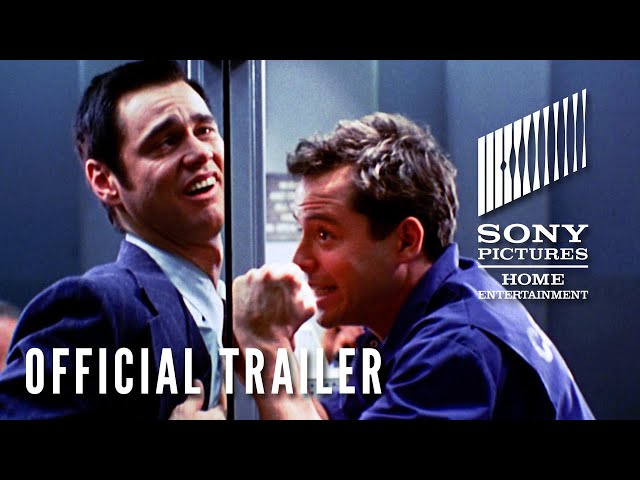
When recently single Steven moves into his new apartment, cable guy Chip comes to hook him up—and doesn't let go. Initially, Chip is just overzealous in his desire to be Steven's pal, but when Steven tries to end the 'friendship', Chip shows his dark side. He begins stalking Steven, who's left to fend for himself because no one else can believe Chip's capable of such behaviour.
What's left behind the scenes
- During the filming of the scene with Chip on the basketball court, it turned out that actor Jim Carrey dribbled the ball poorly and couldn't shoot it into the hoop. Director Ben Stiller instructed the actor to mime playing without the ball, which was then added to the shot during editing.
- The Cable Guy role was written for Chris Farley, however, he had to decline it due to commitments to other projects.
- Some of The Cable Guy's predictions about what cable would eventually bring to people have already come true – the Internet, the ability to play computer games online, telephony, and television.
- Jim Carrey's fee for filming the movie was $20 million – a new record for those years (the late 20th century).
- When preparing for negotiations about his fee, Jim Carrey insisted that his lawyer and both managers wear Ace Ventura costumes.
- Judd Apatow is credited as a producer in the credits, but he also contributed to the screenplay. The Writers Guild of America denied him authorship. Apatow disagreed with this decision. His authorship of the screenplay is properly reflected in the book written about the film.
- Ben Stiller initially intended to play the Cable Guy himself. Shortly after filming began, he realized how difficult it was to combine the roles of director and actor.
- When Jim Carrey's stunt double dunked a basketball, the backboard shattered and fell directly on him, although it was supposed to fall backward. The pyrotechnician who prepared the stunt was fired as a result.
- The only Ben Stiller film where he directs but does not play the main role.
- In one of Judd Apatow's drafts, Chip was supposed to die, but this ending was rejected.
- Judd Apatow told reporters for The Los Angeles Times about scenes that didn't make the film: Chip shoots Steven with a furniture stapler and then stitches up his wound on his backside; Chip pretends to be a firefighter and throws a fire axe at Steven; Chip on horseback, resembling the Headless Horseman, rides up to Steven and jumps on him; Chip impersonates the Terminator on top of Steven’s car.
- The film was made by Columbia Pictures, which paid $1 million for the screenplay—more than the competition.
- Kyle Gass played the bit part of the homebody whose television gets turned off. He is an actor, producer, screenwriter, composer, and musician, a member of the rock band Tenacious D.
- Ben Stiller played the roles of brothers Sam and Stan Sweaty, with Sam accused of murdering Stan. These characters were based on brothers Lyle and Erik Menendez, who were sentenced to life in prison in 1984 for the murder of their parents.
- The film says nothing about Sam's sentence, but judging by the book, he was convicted of his brother's murder.
- The book, written based on the film, makes it clear that late at night, the Cable Guy calls Steven from the ventilation duct above the closet in Robin's apartment. (He is shown crawling through this duct in one of the earlier scenes of the film.) This explains why a harvestman spider crawls across his face and why Robin is taken hostage by him in the very next scene.
- According to the script, Rick is killed by Chip with a staple gun. This happens when Rick calls Steven to tell him that Chip was fired from the television company for harassing clients, that he was previously discharged from the US Marine Corps for insubordination, and that Chip's mother had been arrested for prostitution.
- The film could have had a different ending that would have more logically concluded the story of Sam and his trial. In this version, Chip would have confessed to Steven that he killed Stan, that he adored the TV show hosted by the Sweaty brothers, that Sam was one of the clients he stalked, and when Sam rejected him, Chip killed Stan and framed Sam.
- The scene in which Jim Carrey reenacts a moment from the thriller "The Silence of the Lambs" (Jonathan Demme, 1991) is improvised. You can see on Stephen's face, played by Matthew Broderick, that he's barely holding back laughter.
- All the participants of "The Ben Stiller Show" (1991-1992) appeared on screen at least once.
- During the fight with the character played by Owen Wilson, the Cable Guy throws him against the wall saying, "It's going to hurt, Gene." This refers to Gene Okerlund, a wrestling ring announcer.
- In one episode, Stephen says he feels "like Felix Unger." This refers to the character from Neil Simon's play "The Odd Couple." Matthew Broderick would later play this character in the 2005 Broadway production.
- Chip's scream when he scores a basket is a reference to Russell Mulcahy's fantasy action film "Highlander" (1986). When Stephen is fired from his job, he goes down to the garage where all the parked cars start honking and flashing their headlights – also as in "Highlander."
- At the beginning of the film, a 1971 movie called "Play Misty for Me" is shown on television, in which a character played by Clint Eastwood is pursued by a mentally unstable woman. This concept is also repeated in the plot of "The Cable Guy".
- To discuss the script, Ben Stiller and Judd Apatow traveled to South Carolina, where Jim Carrey was filming "Ace Ventura: When Nature Calls" (Steve Oedekerk, 1995). During a conversation in a bar, Carrey came up with the idea of recreating the glass and chest scene from Alan Parker’s drama "Midnight Express" (1978).
- Leslie Mann, who played Robin, auditioned with Judd Apatow, who read the lines of the character later played by Jim Carrey. A year after the release of "The Cable Guy," Apatow and Mann got married.
- At the entertainment center, knights reenact a scene from "Amok Time," the first episode of the second season of "Star Trek," which originally aired on NBC on September 15, 1967.
- Throughout the film, the Cable Guy introduces himself using different names – Chip and Ernie Douglas, Larry Tate, Ricky Ricardo. All of these are characters from television series. Chip and Ernie Douglas are characters from the sitcom "My Three Sons" (1960-1972), Larry Tate is a character from "Bewitched" (1964-1972), and Ricky Ricardo appeared in the sitcom "I Love Lucy" (1951-1957). His real name is never revealed to the audience. Even in the credits, Jim Carrey’s character is simply listed as "The Cable Guy."
- Jim Carrey's character parodies a scene from Jonathan Demme's film 'The Silence of the Lambs' (1990), for which he is arrested by a police officer played by Charles Napier. Napier played a police officer in 'The Silence of the Lambs' who is killed by Dr. Lecter in the very scene parodied in 'The Cable Guy'.
- The scene in which Jim Carrey mimics a moment from the thriller "The Silence of the Lambs" (Jonathan Demme, 1991) was improvised. It is evident from the face of Steven, played by Matthew Broderick, that he is barely holding back laughter.
- During the filming of the scene with Chip on the basketball court, it became clear that Jim Carrey was not very good at dribbling and could not make a basket. Director Ben Stiller told the actor to simulate playing without the ball, which was then added to the shot during post-production.
- The role of the Cable Guy was written for Chris Farley, but he was forced to turn it down due to commitments to other projects.
- Jim Carrey's fee for filming the movie was $20 million—a new record for that time (the end of the 20th century).
- Every member of 'The Ben Stiller Show' (1991-1992) appeared on screen at least once.
- While preparing for salary negotiations, Jim Carrey insisted that his lawyer and both of his managers wear Ace Ventura costumes.
- In the credits, Judd Apatow is listed only as a producer, although he also contributed to the screenplay. He was denied writing credit by a decision of the Writers Guild of America. Apatow disagreed with this decision. His contribution to the screenplay is properly acknowledged in the book based on the film.
- During the fight with the character played by Owen Wilson, the Cable Guy throws him against a wall, saying, "It's gonna hurt, Gene." This is a reference to Gene Okerlund, the professional wrestling ring announcer.
- Initially, Ben Stiller intended to play the role of the Cable Guy himself. Shortly after filming began, he realized how difficult it was to balance the roles of director and actor.
- In one episode, Steven says he feels "like Felix Unger." This refers to the character from Neil Simon's play "The Odd Couple." Matthew Broderick would later play this character in a 2005 Broadway production.
- Chip's scream when he makes a basket is a reference to Russell Mulcahy's sci-fi action film "Highlander" (1986). When Steven is fired from his job, he goes down to the garage, where all the parked cars begin to honk and flash their headlights—also as in the movie "Highlander."
- At the beginning of the film, the 1971 movie 'Play Misty for Me' is shown on television, in which a mentally unstable woman stalks a character played by Clint Eastwood. This concept is mirrored in the plot of 'Cable Guy'.
- The only Ben Stiller film in which he serves as director but does not play the lead role.
- In one version of the script written by Judd Apatow, Chip was supposed to die, but this ending was rejected.
- To discuss the script, Ben Stiller and Judd Apatow traveled to South Carolina, where Jim Carrey was filming 'Ace Ventura: When Nature Calls' (Steve Oedekerk, 1995). During a conversation in a bar, Carrey came up with the idea to recreate the scene with the glass and the breast from Alan Parker's drama 'Midnight Express' (1978).
- Leslie Mann, who played Robin, auditioned with Judd Apatow, who read the lines of the character later played by Jim Carrey. A year after the release of 'Cable Guy', Apatow and Mann got married.
- Judd Apatow told The Los Angeles Times about scenes that didn't make it into the movie: Chip shoots Steven with a furniture stapler and then stitches up the wound on his backside; Chip pretends to be a firefighter and throws a fire axe at Steven; Chip, looking like the Headless Horseman on a horse, rides up to Steven and jumps on him; Chip portrays a Terminator on the roof of Steven's car.
- The cameo role of the homebody whose television is turned off was played by Kyle Gass. He is an actor, producer, screenwriter, composer, and musician, and a member of the rock band Tenacious D.
- Ben Stiller played the roles of brothers Sam and Stan Sweet, with Sam being accused of murdering Stan. These characters are based on brothers Lyle and Erik Menendez, who were sentenced to life imprisonment in 1984 for the murder of their parents.
- In the entertainment center, knights act out a scene from "The Return of the Many," the 1st episode of the 2nd season of the series "Star Trek," first aired on NBC on September 15, 1967.
- Throughout the film, the Cable Guy introduces himself by various names—Chip and Ernie Douglas, Larry Tate, Ricky Ricardo. All of these are characters from television series. Chip and Ernie Douglas are characters from the sitcom "My Three Sons" (1960-1972), Larry Tate is a character from the series "Bewitched" (1964-1972), and Ricky Ricardo appeared in the sitcom "I Love Lucy" (1951-1957). The audience never learns his real name. Even in the credits, Jim Carrey's character is listed simply as "The Cable Guy."
- In the MTV news program, Sam Sweet speaks with the voice of Jim Carrey, who plays Chip, rather than the voice of Ben Stiller, who portrays him.
- Jim Carrey's character parodies a scene from Jonathan Demme's film 'The Silence of the Lambs' (1990), for which he is arrested by a police officer played by Charles Napier. Napier played the police officer in 'The Silence of the Lambs' whom Dr. Lecter kills in the exact scene being parodied in 'The Cable Guy'.
Similar movies
8.8/10
8.8/10
8.8/10
8.6/10
8.6/10
8.5/10
8.4/10
8.2/10
8.2/10
8.2/10


 Auditions in India
 Casting calls in USA
 Castingi w Polsce
 Кастинги в Україні
