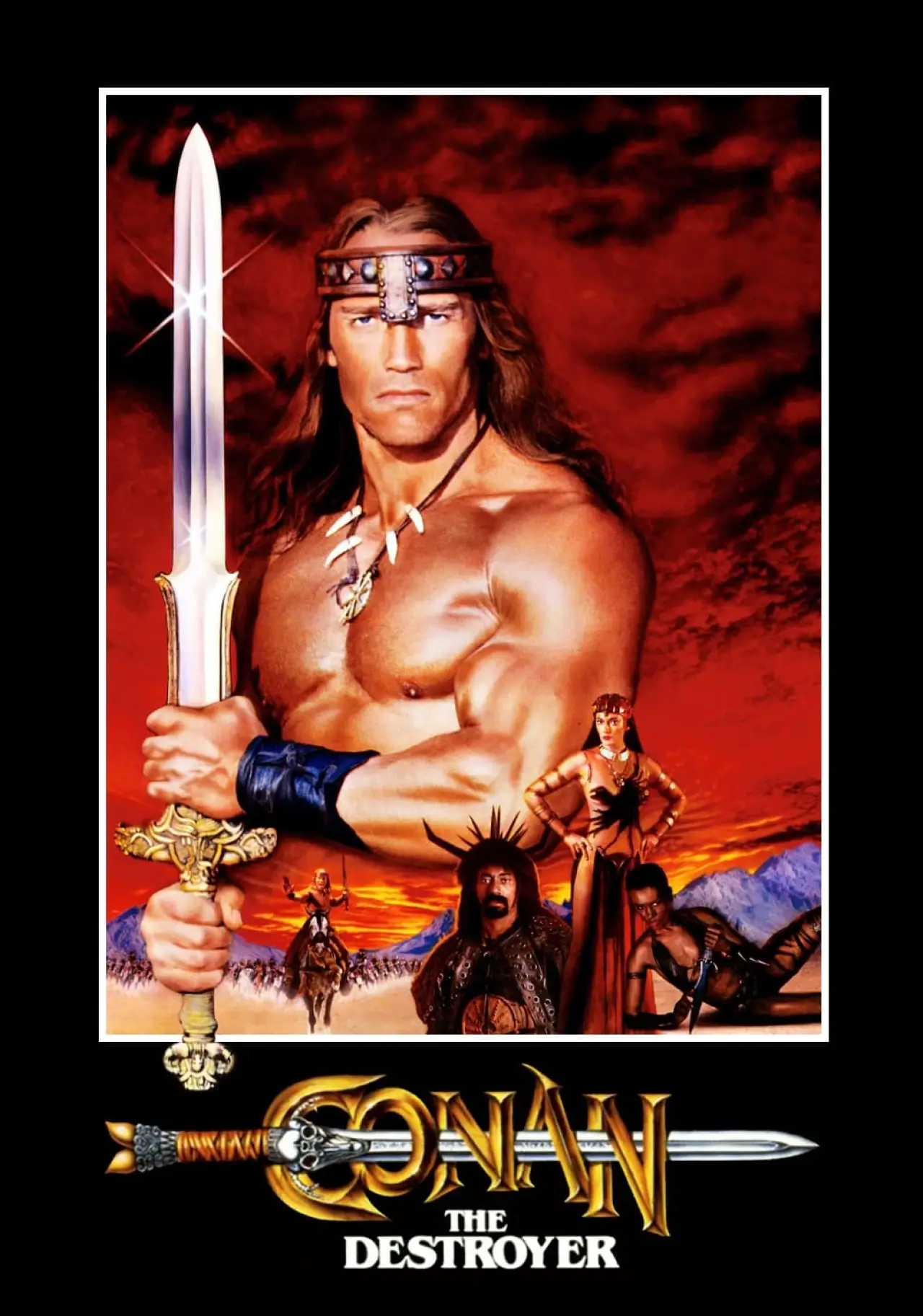
Conan the Destroyer
The most powerful legend of all is back in a new adventure.




Country
Production
Budget
$18 000 000
Box office
$31 042 035
Director
Actors
Scenario
Producer
Dino De Laurentiis, Raffaella De Laurentiis, Edward R. Pressman, Dino De Laurentiis, Stephen F. Kesten
Camera operator
Composer
Artist
Pier Luigi Basile
Audition
Johanna Ray
Editing
Frank J. Urioste, Anuar Badin
Whole Team (71)
Whole Team (71)
Short description
Conan is commissioned by the evil queen Taramis to safely escort a teen princess and her powerful bodyguard to a far away castle to retrieve the magic Horn of Dagoth. Unknown to Conan, the queen plans to sacrifice the princess when she returns and inherit her kingdom after the bodyguard kills Conan. The queen's plans fail to take into consideration Conan's strength and cunning and the abilities of his sidekicks: the eccentric wizard Akiro, the warrior woman Zula, and the inept Malak. Together the hero and his allies must defeat both mortal and supernatural foes in this voyage to sword-and-sorcery land.
What's left behind the scenes
- The filmmakers found it difficult to find a horse for Wilt Chamberlain (1946-1999). The actor was so tall that when he sat in the saddle, his legs touched the ground. Eventually, a horse suitable for riders of such height was found in Spain and brought to Mexico.
- The director of "Conan the Barbarian" (1982), John Milius, was busy and unable to shoot the film. Leading studio executives took a more active role than in the first film of the franchise, and, according to Arnold Schwarzenegger, they made a number of serious mistakes. Riding the wave of success of Steven Spielberg's "E.T. the Extra-Terrestrial" (1982), Universal decided that the film would gross more if it were made into a family-friendly film. Schwarzenegger strongly objected, but his opinion was not heeded. Director Richard Fleischer (1916-2006) agreed with Schwarzenegger, but was forced to go along with Universal's desire to make a sequel in the style of a comic book. The sequel grossed more than the first film in the franchise, but box office results in the US were not as impressive as Schwarzenegger and Fleischer had feared. Schwarzenegger expressed similar concerns later, when the Terminator in James Cameron's "Terminator 2: Judgment Day" (1991) was forbidden from killing anyone. After that, Schwarzenegger and Dino De Laurentiis (1919-2010) decided to end the franchise, and Schwarzenegger has since only starred in films about contemporary times.
- The swords cost $10,000 each.
- Wilt Chamberlain and Grace Jones performed 90% of their own stunts. Once, while working with a pole, Jones accidentally sent two stuntmen to the hospital; preparing for the role in this film took her a year and a half.
- The movements of the dagota's (monster's) hands, eyes, mouth, and torso were controlled by six people.
- When creating the city of Shadizar, filmmakers built a small model of it and placed it in front of the camera.
- The role of Malak was initially reserved for actor David L. Lander (1947-2020), however, due to his deteriorating health (he was diagnosed with multiple sclerosis) and difficulties in his relationship with director Richard Fleischer (1916-2006), the actor was replaced by Tracey Walter.
- To create the impression of steam coming from the mouth while breathing in cold weather, the actors held small pieces of dry ice wrapped in a light cloth in their mouths (as it is not recommended to touch dry ice directly).
- The character of Zula was originally conceived by screenwriter Roy Thomas as a Black warrior. “Zula” is a real male name in Africa, as the inhabitants of the Black Kingdoms are considered the ancestors of Black Africans. Producers decided it was a female character because the name ends in “a,” so they secured Grace Jones and designed costumes for her. When Roy Thomas noticed the mistake, it was too late – both for financial reasons and because a contract had already been signed with Grace Jones – so he had to change the character's gender in the script.
- During the fight scene between Zula and Bombatta, Grace Jones actually bit Wilt Chamberlain on the ear. Blood was genuinely running down his neck, and his surprised, offended expression was completely sincere and not at all acted. This was Jones's first role in a film, and she had never performed stunts on screen before.
- Wilt Chamberlain and Grace Jones performed 90% of their own stunts. Once, while working with a pole, Jones accidentally sent two stuntmen to the hospital; preparation for the role took her a year and a half.
- For Olivia d’Abo, the role of Princess Jenna was her debut.
- In 1987, “Conan the Conqueror,” based on Howard’s story “The Hour of the Dragon,” was intended to be the third and final film in the Conan trilogy, where Conan becomes king of Aquilonia. However, Schwarzenegger was unable to participate in this film as he was busy with “Predator,” and Kevin Sorbo, who was chosen as a replacement, did not want to play someone else’s role. As a result, the planned trilogy remained unfinished. The script was reworked, replacing Conan with another of Howard’s heroes – Kull of Atlantis – and the film was titled “Kull the Conqueror” (1997).
- The character named Zula was originally conceived by screenwriter Roy Thomas as a Black warrior. Producers decided it was a woman, as the name ends in “a,” so they secured Grace Jones and designed costumes for her. By the time Roy Thomas noticed the mistake, it was too late – both for financial reasons and because Grace already had a contract.
- The role of Princess Jenna marked the debut of Olivia d'Abo.
- The third and final film of the Conan trilogy was intended to be 'Conan the Conqueror' in 1987, based on Howard's novella 'The Hour of the Dragon,' in which Conan becomes the king of Aquilonia. However, Schwarzenegger was unable to participate as he was busy filming 'Predator,' and Kevin Sorbo, who was chosen as a replacement, did not want to step into someone else's role. As a result, the planned trilogy remained unfinished. The script was rewritten, replacing Conan with another Howard hero—Kull of Atlantis—and the film was titled 'Kull the Conqueror' (1997).
- The filmmakers found it difficult to find a horse for Wilt Chamberlain (1946–1999). The actor was so tall that when he sat in the saddle, his legs touched the ground. Eventually, a horse suitable for a rider of his height was found in Spain and brought to Mexico.
- John Milius, the director of 'Conan the Barbarian' (1982), was unavailable and could not direct this film. Studio executives took a more active role than they had in the first film of the franchise, and according to Arnold Schwarzenegger, they made a series of serious mistakes. Riding the wave of success from Steven Spielberg's 'E.T. the Extra-Terrestrial' (1982), Universal decided that the movie would be more profitable if it were made as a family-friendly film. Schwarzenegger strongly objected, but his opinion was ignored. Director Richard Fleischer (1916–2006) agreed with Schwarzenegger but was forced to yield to Universal's wishes to make a sequel in the spirit of the comics. The sequel earned more than the first film in the franchise, but the US box office was not as impressive as Schwarzenegger and Fleischer had feared. Schwarzenegger expressed similar concerns later when the Terminator was forbidden from killing anyone in James Cameron's 'Terminator 2: Judgment Day' (1991). After this, Schwarzenegger and Dino De Laurentiis (1919–2010) decided to end the franchise, and Schwarzenegger has since appeared only in films set in modern times.
- Wilt Chamberlain and Grace Jones performed 90% of their own stunts. Once, while working with a staff, Jones accidentally sent two stuntmen to the hospital; preparing for the role took her a year and a half.
- The role of Malak was initially reserved for actor David L. Lander (1947–2020), but due to his deteriorating health (he had been diagnosed with multiple sclerosis) and difficulties in his relationship with director Richard Fleischer (1916–2006), the actor was replaced by Tracy Walter.
- The character named Zula was conceived by screenwriter Roy Thomas as a Black male warrior. The producers assumed the character was a woman because the name ended in 'a,' so they secured Grace Jones's agreement and designed costumes for her. By the time Roy Thomas pointed out the mistake, it was already too late—both for financial reasons and because Grace had already signed a contract.
- In the battle scene between Zula and Bombatta, Grace Jones actually bit Wilt Chamberlain on the ear. Blood really ran down his neck, and his surprised, offended expression was completely genuine and not acted at all. This was Jones's first film role, and she had never performed on-screen stunts before.
Similar movies

8.4/10
8.3/10
8.1/10

8/10
7.9/10
7.8/10
7.8/10

7.8/10
7.7/10
7.7/10


 Auditions in India
 Casting calls in USA
 Castingi w Polsce
 Кастинги в Україні
