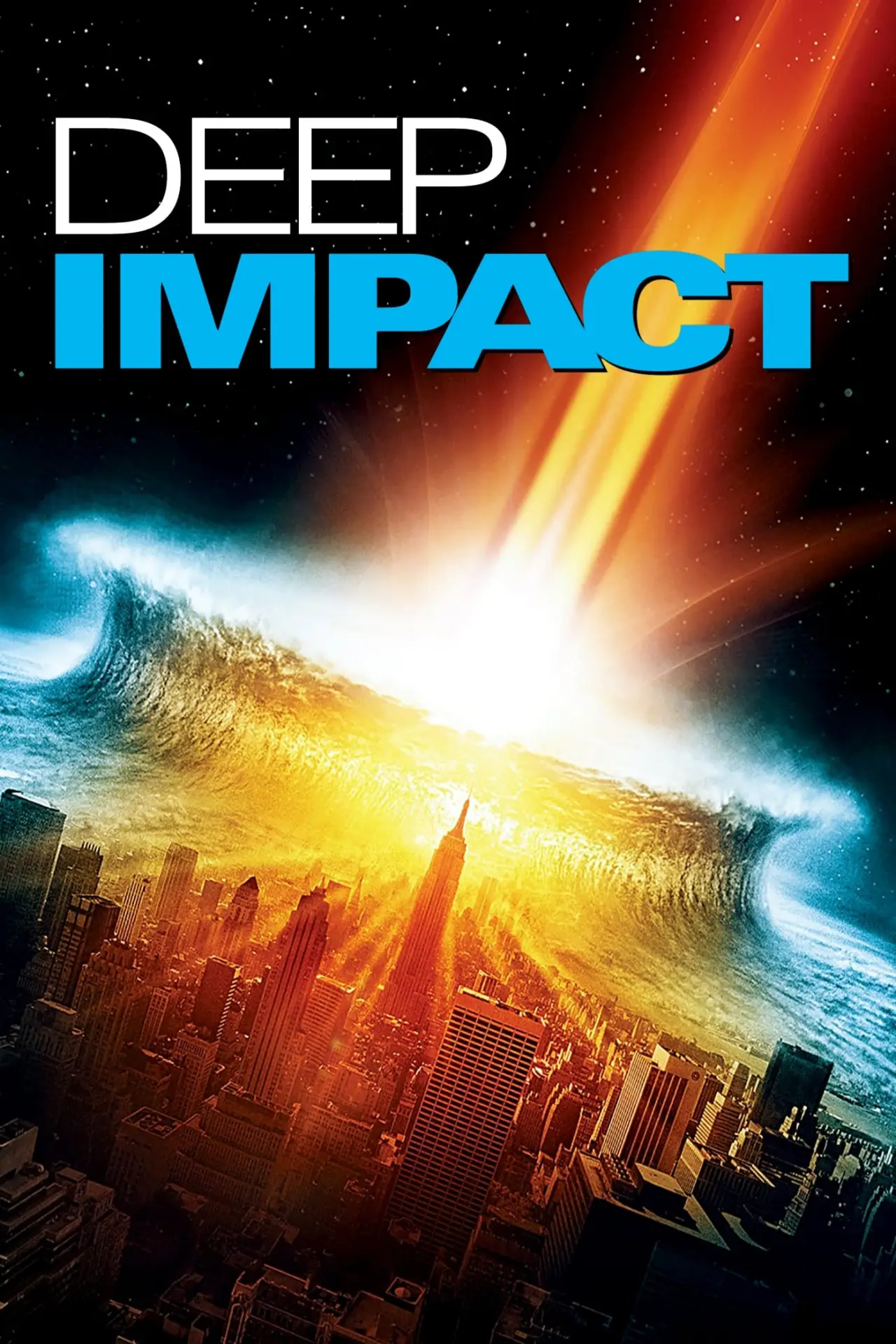
Deep Impact
Oceans rise. Cities fall. Hope survives.




Country
Production
Genre
Budget
$75 000 000
Box office
$349 464 664
Director
Actors
Scenario
Producer
Richard D. Zanuck, David Brown, Steven Spielberg, Walter F. Parkes, Joan Bradshaw
Camera operator
Dietrich Lohmann
Composer
Artist
Leslie Dilley, Steve Nichols, Jason Ivimey
Audition
Allison Jones, Judith Bouley
Editing
Paul Cichocki, David Rosenbloom, Peter M. Tobyansen
Whole Team (195)
Whole Team (195)
Short description
A seven-mile-wide space rock is hurtling toward Earth, threatening to obliterate the planet. Now, it's up to the president of the United States to save the world. He appoints a tough-as-nails veteran astronaut to lead a joint American-Russian crew into space to destroy the comet before impact. Meanwhile, an enterprising reporter uses her smarts to uncover the scoop of the century.
What's left behind the scenes
- That same year, a similar film about the threat of Earth being bombarded by an asteroid, 'Armageddon,' was released.
- The role of one of NASA’s officials in the film was played by Gerry Griffin, who previously headed 12 Apollo flights and later became director of the Johnson Space Center in Houston.
- Following Tea Leoni's role in this film, an asteroid (8299) Tealoni was named in her honor.
- In the film, after the discovery of a comet, one of the astronomers dies in a car accident. This reflects the real-life event of the death of astronomer Eugene Shoemaker, one of the co-discoverers of Comet Shoemaker-Levy 9, on July 18, 1997, in Australia when he was struck by a car.
- While Bruce Joel Rubin was finalizing the screenplay, he gained access to some highly classified rooms in the White House and the Pentagon. He later attributed such luck to the name of Steven Spielberg, as Spielberg was originally intended to be the director of the film.
- This was the last work of operator Dietrich Lohmann, who died a year before the film's premiere. The film is dedicated to his memory.
- The film depicts a giant wave hitting New York, and at the end of the scene, only the tops of the World Trade Center buildings are visible above the water's surface. Following the September 11th attacks, these shots of the WTC buildings were sometimes cut from television broadcasts of the film. Furthermore, the film shows the tidal wave coming from the west, from New Jersey, rather than from the Atlantic to the south.
- It all started when producers Richard D. Zanuck and David Brown offered Steven Spielberg (with whom they worked on the horror film "Jaws" in 1975) to make a remake of Rudolf Maté's science fiction action film "When Worlds Collide" (1951). Spielberg preferred to work on Arthur C. Clarke's 1993 novel "The Hammer of God" (about an asteroid heading towards Earth and humanity's attempts to avoid a collision). Eventually, it was decided to combine these two ideas into one. The overall message remained the same, but the film's script was significantly changed, so Clarke was not mentioned on screen.
- The role of one of the NASA officials was played by Gerry Griffin, who had previously managed 12 Apollo missions and later became the director of the Johnson Space Center in Houston.
- Following Tea Leoni's role in this film, an asteroid, (8299) Tealeoni, was named in her honor.
- It all began when producers Richard D. Zanuck and David Brown approached Steven Spielberg (with whom they had worked on the 1975 horror film 'Jaws') to make a remake of Rudolph Maté's sci-fi action movie 'When Worlds Collide' (1951). Spielberg preferred working on Arthur C. Clarke's 1993 novel 'The Hammer of God' (about an asteroid heading toward Earth and humanity's attempts to avoid the collision). Ultimately, it was decided to combine these two ideas into one. While the general premise remained the same, the screenplay was significantly altered, and Clarke was not mentioned on screen.
- While Bruce Joel Rubin was refining the script, he was granted access to several top-secret areas of the White House and the Pentagon. He later attributed this luck to Steven Spielberg's name, as it was originally intended that Spielberg would direct the film.
- This was the final work of cinematographer Dietrich Lohmann, who passed away a year before the film's premiere. The movie is dedicated to his memory.
Similar movies
8.6/10
8.6/10
8.5/10
8.4/10
8.3/10
8.3/10

8.3/10
8.2/10

8/10

8/10


 Auditions in India
 Casting calls in USA
 Castingi w Polsce
 Кастинги в Україні
