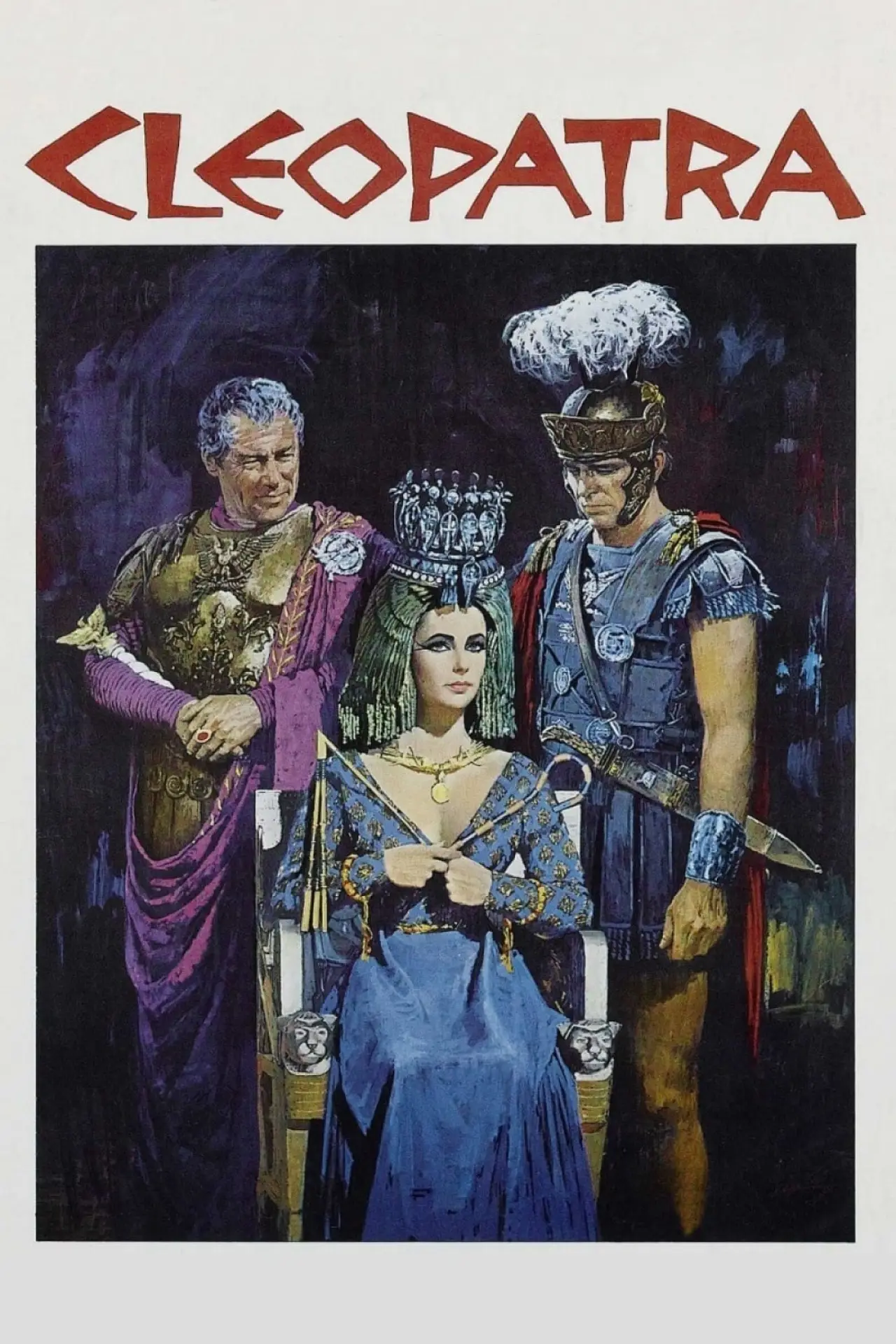
Cleopatra
The motion picture the world has been waiting for!




Country
Production
Budget
$44 000 000
Box office
$57 778 564
Director
Actors
Elizabeth Taylor, Richard Burton, Rex Harrison, Pamela Brown, George Cole, Hume Cronyn, Cesare Danova, Kenneth Haigh, Andrew Keir, Martin Landau
All actors and roles (10)
All actors and roles (10)
Scenario
Producer
Walter Wanger, Peter Levathes
Camera operator
Leon Shamroy
Composer
Artist
John DeCuir, Don Picton
Audition
Editing
Dorothy Spencer
Whole Team (45)
Whole Team (45)
Short description
Determined to hold on to the throne, Cleopatra seduces the Roman emperor Julius Caesar. When Caesar is murdered, she redirects her attentions to his general, Marc Antony, who vows to take power—but Caesar’s successor has other plans.
What's left behind the scenes
- The possibility of casting Laurence Olivier as Julius Caesar was discussed, owing to his acclaimed performance as the dictator in Shaw's 'Caesar and Cleopatra' at the Old Vic theatre. However, Olivier was more attracted to the prospect of appearing in 'Becket'. Negotiations also took place with Frederic March, but were unsuccessful. Ultimately, Peter Finch was cast as Caesar. After all revisions and changes to the cast, the film’s budget was estimated at $5 million.
- After viewing a rough cut of the film, lasting 320 minutes, Zanuck characterized the result as “clumsy, amateurish, second-rate” and ordered Joseph Leo Mankiewicz to be removed from further work on the film. The controversy between the company head and the director spilled over into the press. Zanuck, in particular, was unhappy with the already filmed battle scenes; Mankiewicz, in response, said that the battle scenes were not the main focus of the film. At a press conference, Zanuck told reporters that Mankiewicz needed to rest and that he himself would finish the film. By December 1962, passions had somewhat subsided. Zanuck admitted that everything that had happened was nothing more than a public humiliation of the famous director and apologized to him. He even invited Mankiewicz back to film the remaining battle scenes and consulted with him on individual issues relating to the film. The final edit of “Cleopatra” was completed by Mankiewicz under the close supervision of Zanuck.
- During the final months of work on the film, Mankiewicz lived on psychotropic drugs (he later developed an addiction). The nurse administering the injections accidentally hit the sciatic nerve, causing one of his legs to almost stop moving; consequently, Mankiewicz spent the end of the shoot in a wheelchair.
- Taylor was the first candidate for the role; however, the studio's backup list in case of refusal included A-list stars: Brigitte Bardot, Sophia Loren, Audrey Hepburn, and Susan Hayward. Preliminary negotiations were held with some of them. In particular, Loren demanded that filming take place exclusively in Italy.
- Due to Elizabeth Taylor's illness during filming, the studio began a hasty search for a replacement. Marilyn Monroe could have landed the lead role. Mamoulian, in the early stages of preparation, proposed greater involvement of Black actors and considered Dorothy Dandridge for the role of Cleopatra. However, Wanger convinced studio management to wait for Taylor to recover.
- The possibility of casting Laurence Olivier as Julius Caesar was discussed due to his acclaimed performance as the dictator in Shaw's play 'Caesar and Cleopatra' at the Old Vic Theatre. However, Olivier was more attracted to the prospects of appearing in the film 'Becket'. Negotiations were also held with Frederic March, but they were unsuccessful. Ultimately, Peter Finch was cast as Caesar. After all the adjustments and changes to the acting ensemble, the film's budget was estimated at $5 million.
- Wanger optimistically predicted that the worldwide release of the film would exceed $100 million, but this did not happen. By 1966, the total revenue was $38 million, of which $23.5 million came from domestic box office in the United States. For any other film, this would have been an excellent result, but 'Cleopatra' did not recoup its enormous budget. The film only broke even in 1967. In 1966, ABC paid $5 million for the right to the first television broadcast. The film was first shown on ABC on February 13, 1972, and received a Nielsen rating of 24.5.
- The filming of Cleopatra's ships and the battle scenes of the Battle of Actium took place off the coast of Ibiza in the Mediterranean Sea. “Alexandria” was built near Torre Asturo, on the Tyrrhenian Sea coast. Separate location scenes were filmed near the cities of Anzio and Lanuvio, in the area of the island of Ischia, and in the vicinity of Alexandria in Egypt. The port of Alexandria was built near Anzio, on the shore of the Mediterranean Sea. During the large-scale work of bulldozers preparing the port’s pier, a tragic incident occurred: workers stumbled upon a mine left over from World War II – one of them was killed and several were wounded.
- In 2013, a new restoration of the film was carried out to mark its 50th anniversary. The restoration was done from a 65mm negative preserved in the archives. The updated version was presented on May 21st at a retrospective program of the Cannes Film Festival. The event was attended by Richard Burton’s children; a small exhibition of Elizabeth Taylor’s jewelry was held, including pieces she wore during filming.
- Fox Studios was forced to take emergency measures to revive work on the film. Rouben Mamoulian disagreed with the direction of the filming, the script, and failed to find common ground with Elizabeth Taylor. He began to threaten the studio with leaving the set. Elizabeth Taylor was more than an actress in the project: she had a voice in key decision-making. The studio sided with the actress in this conflict and agreed to the director’s resignation. Remembering their successful collaboration on 'Suddenly, Last Summer,' Taylor suggested Joseph Leo Mankiewicz, and the producers supported her. Joseph was at that moment an independent agent and was slowly preparing the script for 'Justin,' taking a creative break in the Caribbean islands. He listened to Scaure’s proposal without much enthusiasm. Mankiewicz was not inspired by the idea of taking over work from someone else, but Scaure literally begged him to save the project. Fox made Mankiewicz an offer he 'couldn't refuse,' completely buying out his film studio Figaro Inc. and offering a percentage of the future film's profits. In total, Mankiewicz’s fee and the sale of the studio brought him around $1 million, which was the highest payment for a director's services in cinema history at that time. The parties agreed that the new director could completely rewrite the script and make any changes to the cast. The replacement cost Fox an additional $3 million. With all the revisions, the film was now scheduled for release in the fall of 1962.
- Taylor and Burton married in March 1964. In April 1964, Fox Studios sued Elizabeth Taylor for breach of contract during the filming of the movie. The lawsuit amounted to $50 million. By that time, Taylor and Burton filed a countersuit using the same wording. These mutual attempts to win money from one another continued fruitlessly for several years.
- Elizabeth Taylor became seriously ill during filming and underwent a tracheotomy, causing production to halt for eight months. Another issue was the tempestuous romance between Richard Burton and Elizabeth Taylor. Ultimately, they both left their former spouses and married after work on the film was completed.
- Elizabeth Taylor became seriously ill during filming; she underwent a tracheotomy and production of the film was halted for 8 months. Another problem was the tumultuous romance between Richard Burton and Elizabeth Taylor. Ultimately, they both left their former spouses, marrying after completing work on the film.
- Elizabeth Taylor became the primary and sole contender for the role. Initially, the actress did not want to participate in the film, but the producers saw Taylor as the only choice for Cleopatra; in fairness, there were as many legends about the actress's beauty and wild temperament as there were about the Egyptian queen. Elizabeth herself remained adamant and joked that she would only agree for a million dollars; the studio made an offer of a million, and Taylor could not resist.
- Fox Studio was forced to take emergency measures to revitalize work on the film. Ruben Mamoulian disagreed with the course of filming and the script, and was unable to find common ground with Elizabeth Taylor. He began threatening the studio that he would leave the set. Elizabeth Taylor was more than just an actress in the project; she had a voice in key decision-making. In this conflict, the studio sided with the actress and agreed to the director's resignation. Recalling their successful collaboration on 'Suddenly, Last Summer,' Taylor proposed Joseph Leo Mankiewicz, and the producers supported her choice. At the time, Joseph was an independent agent slowly preparing the script for 'Justine' while on a creative sabbatical in the Caribbean. He listened to Skouras's offer without much enthusiasm. Mankiewicz was not inspired by the idea of taking over someone else's work, but Skouras practically begged him to save the project. Fox made Mankiewicz an offer 'he couldn't refuse,' completely buying out his film studio, Figaro Inc., and offering a percentage of the future film's box office. In total, Mankiewicz's fee and the studio sale brought him about $1 million, which was the highest payment for a director's services in cinematic history at that time. The parties agreed that the new director could completely rewrite the script and make any changes to the cast. The replacement cost Fox an additional $3 million. With all the adjustments, the film was now scheduled for release in the autumn of 1962.
- Taylor was the first candidate for the role, but the studio's shortlist in case of refusal included A-list stars: Brigitte Bardot, Sophia Loren, Audrey Hepburn, and Susan Hayward. Preliminary negotiations were held with some of them. Specifically, Loren demanded that filming take place exclusively in Italy.
- The film's popularity was aided by a powerful marketing campaign, which involved 75 of the largest newspapers, television and radio programs in the United States in advertising the film. In March 1963, Fox Vice President Seymour Poe held a special conference in Paris with representatives from 17 countries to coordinate efforts to market the film. The release of 'Cleopatra' attracted increased attention from cinema chains in the United States and around the world. It also didn’t hurt that in many cinema centers, owners had to incur additional expenses related to the installation of projection equipment designed for 70mm film. It was decided that the film would be released using the Roadshow system. Ticket prices for the film were $5.50, about three times the usual price. In the case of 'Cleopatra', the film company agreed to a 70% share of the revenue from ticket sales, whereas normally cinema chains and studios split the revenue 50/50. Revenue from pre-sold tickets reached an unprecedented $20 million for Fox.
- The film's director, Mankiewicz, received an ultimatum: filming had to be completed by June 30th. After that date, funding would be terminated. The director was forced to quickly finish one of the key scenes of the film – the meeting of Cleopatra and Antony on board the royal ship. Several large battle scenes remained. In July, the crew traveled to Egypt for location shooting to complete the battle scenes. It all ended in complete failure. Nothing could be organized in such a short time. By October 1962, Mankiewicz had finished a rough cut, after which he and editor Dorothy Spencer flew to Paris for consultations with Zanuck regarding the future of “Cleopatra.” The concept of dividing the film into two independently released parts clashed with the views of the new management. The company head feared that the first part – “Caesar and Cleopatra” – would not be of interest to audiences after the scandal with Burton and Taylor. Despite warnings of funding cuts, the film still wasn’t finished. Another $2 million was allocated to these battle scenes. Fortunately for the company, the unexpectedly successful release of “The Longest Day” saved Fox from financial collapse, and the money was found.
- The film 'Cleopatra' was banned in Egypt because Elizabeth Taylor had Jewish roots.
- The world premiere took place in New York on June 12, 1963, at the Rivoli Theatre. Daryl F. Zanuck, Joseph L. Mankiewicz, and Rex Harrison attended the first screening. Burton and Taylor did not attend. In an interview, the actress mentioned that she wasn't particularly drawn to seeing the film. The duration of the roadshow version was 243 minutes. Following the recommendation of influential critic Bosley Crowther, the film ran in a more edited version of 217 minutes in general American theaters. A 192-minute edit was also released.
- In the summer of 1961, the project underwent a restart. The small amount of material that Mamoulian had filmed proved unusable. Fox's costs had already exceeded $7 million. The studio was forced to freeze most projects and completely halt operations at its television studio.
- By mid-1962, the financial situation of Fox Studios had neared bankruptcy. The tragedy on the set of another expensive project – “Something’s Got to Give” – threatened the very existence of Fox. The studio began laying off personnel and selling assets. For some time, “Cleopatra” was the only film remaining in production. Since the spring of 1962, Spyros Skouras had been under continuous criticism. On June 27, 1962, after 20 years of service, he was dismissed from his position as president of 20th Century Fox by a decision of the shareholders and then the board of directors. He was replaced by Darryl F. Zanuck – one of the company's largest shareholders. Unlike Skouras, he was not only an experienced executive but also had a detailed understanding of filmmaking. Zanuck energetically took on the “sinking” project.
- In 2013, a new restoration of the film was carried out to mark its 50th anniversary. The restoration was done using a 65mm negative preserved in the archives. The updated version was presented on May 21 as part of a retrospective program at the Cannes Film Festival. Richard Burton's children attended the event, and a small exhibition of Elizabeth Taylor's jewelry was held, including pieces she wore during filming.
- Individual episodes of the Battle of Pharsalus were filmed in Spain (near the town of Almería) and later near London in February 1963. Originally, the scene was intended to logically unite the two main characters. Caesar was supposed to meet with Antony after the battle, but Richard Burton was already committed to another film and had to be replaced with Rufio (Martin Landau). A key moment of the film lost its message. In fact, the battle itself is absent from the final edited version – due to the rush, nothing coherent could be filmed and assembled, although around $500,000 was spent solely on its staging. The viewer only sees the smoke from a funeral pyre over the field of the finished battle. Considering all of Zanuck's revisions, the final running time of the film for release was approximately 248 minutes. Mankiewicz met this decision with deep disappointment, believing that the film should have been around 6 hours long and many of his ideas were lost. Hume Cronyn and Roddy McDowall also maintained that their best scenes were cut during editing.
- The making of the film was accompanied by amazing twists and turns. Initially, the film's budget was planned to be around $2 million, but it eventually exceeded $40 million. The film became one of the most expensive in cinema history ($40 million is approximately $300 million in 2007 prices). XX Century Fox nearly went bankrupt as the film practically flopped at the box office. And the filming itself was difficult to complete, as the film company changed directors and producers of the protracted project several times. Ultimately, the 6-hour epic was cut down to 4 hours during editing.
- Due to Elizabeth Taylor's illness during filming, the studio began an urgent search for a replacement. The lead role could have gone to Marilyn Monroe. In the early stages of preparation, Mamoulian suggested a greater involvement of Black actors and considered Dorothy Dandridge for the role of Cleopatra. However, Wencke persuaded the studio management to wait for Taylor's recovery.
- Filming of Cleopatra's ship and the battle scenes of the Battle of Actium took place near the island of Ibiza in the Mediterranean Sea. "Alexandria" was constructed near the Torre Astura area on the coast of the Tyrrhenian Sea. Certain location scenes were filmed near the towns of Anzio and Lanuvio, in the area of Ischia island, and in the vicinity of Alexandria in Egypt. The port of Alexandria was built near Anzio on the shores of the Mediterranean. During large-scale bulldozer work to prepare the port pier, a tragic incident occurred: workers struck a mine left over from World War II, resulting in one death and several injuries.
- The world premiere took place in New York on June 12, 1963, at the Rivoli theater. Darryl F. Zanuck, Joseph Leo Mankiewicz, and Rex Harrison attended the first screening. Burton and Taylor did not come. In an interview, the actress said that she wasn't particularly drawn to watching the film. The duration of the film in the roadshow version was 243 minutes. At the recommendation of influential critic Bosley Crowther, the film was shown in a shorter version – 217 minutes – in regular cinemas in American release. A 192-minute edit was also released.
- On the set, Mankiewicz became close with his future wife, Rosemary Matthews, an English assistant art director. They married in 1962.
- According to Mankiewicz’s son, the complete version of the film has been lost, as Fox Studios destroyed the negatives that were not included in the final cut in order to reduce the cost of storing archival materials. Sean Beston, the 20th Century Fox representative who oversaw the restoration, reported that all efforts to find the 6-hour version of the film were in vain.
- By the fall of 1960, the film still lacked a finished script. Producer Walter Wanger changed several screenwriters, turning to anyone he could. A new screenwriter, Nanallie Johnson, was brought on board. He wrote a 75-page script for the first part of the film, which ultimately went unused. The studio unsuccessfully approached Paddy Chayefsky. The writer requested at least six months of work, which was unacceptable. Without a clear script, it was impossible to task the production designer, contractors responsible for building the sets, costumers, and other specialists. Thus, plans to finish filming in February 1961 proved far from reality, and the project had to be postponed, requesting a budget increase. After two years of filming, the studio had only 12 minutes of footage suitable for final editing.
- On set, Mankiewicz grew close to his future wife, Rosemary Matthews, an English assistant art director. They married in 1962.
- Elizabeth Taylor became the main and only candidate for the role. The actress initially did not want to participate in the film, but the producers only saw Cleopatra in Taylor, because, to be fair, there were no fewer legends about the actress's beauty and fiery temperament than about the Egyptian queen. Elizabeth herself was resolute and joked that she would only agree for a million dollars: the studio made its offer of a million, and Taylor couldn't resist.
- The process of casting the film was suspended in early 1960. The first nationwide SAG strike in March-April paralyzed the work of the largest US studios, and casting assistants had to wait for it to end. The strike became another reason to move the main filming location to Europe.
- The insurance company Lloyd’s paid out approximately $2 million in compensation for the delay in the film’s production, caused by Taylor’s illness.
- The complete director's cut of the film has a runtime of 320 minutes.
- The project was restarted in the summer of 1961. The small amount of footage shot by Mamoulian proved useless. Fox's expenses had already exceeded $7 million. The studio was forced to freeze most of its projects and completely suspend the operations of its television studio.
- Taylor and Burton married in March 1964. In April 1964, Fox Studios sued Elizabeth Taylor for breach of contract during filming. The claim amounted to $50 million. By that time, Taylor and Burton filed a countersuit with the same claim. Their mutual attempts to win the money lasted unsuccessfully for several years.
- The insurance company Lloyd’s paid approximately $2 million in compensation for production delays caused by Taylor's illness.
- In September 1961, the film's production continued at the Cinecittà Studios. A significant delay led to the suspension of contracts with actors and some specialists, necessitating a recasting. Hildyard was replaced by cinematographer Leon Shamroy. Peter Finch had begun filming another movie. Mankiewicz offered the role of Caesar to Rex Harrison, with whom he had extensive prior experience. For the role of Mark Antony, Mankiewicz initially envisioned Marlon Brando, but the actor was unavailable. Mankiewicz noticed Richard Burton and Roddy McDowall in the musical “Camelot.” He had known Burton for a long time as an excellent stage actor and offered him the role of Mark Antony. The studio strongly opposed Burton's casting – the actor was known for his capriciousness and excessive love of alcohol. Mankiewicz managed to persuade management. Richard himself was happy to leave the musical, as he claimed he was tired of playing King Arthur for a year straight. Burton's contract cost the company $300,000 and was his highest-paying job at the time.
- For many of the team members who worked on the film, it became a defining stage in their careers. After “Cleopatra,” Reuben Mamoulian and Walter Wanger never directed or produced anything again. Spyros Skouras also left the film industry and went into shipbuilding. For the rest of his life, Mankiewicz preferred not to remember his work on “Cleopatra,” and he didn’t direct and produce another film until 1967. As his son recalled, Mankiewicz became disillusioned with the profession and avoided active work in the film industry for the rest of his life.
- On June 1, 1962, producer Walter Wanger was fired, despite being willing to work for free. Wanger asked for permission to stay on the set of the film until its completion.
- Wenger optimistically predicted that the film's worldwide gross would exceed $100 million, but this did not happen. By 1966, total earnings amounted to $38 million, of which 23.5 million came from the domestic US market. For any other film, this would have been an excellent figure, but due to its enormous budget, Cleopatra did not break even. The film only recouped its costs in 1967. In 1966, the ABC company paid $5 million for the right to the first television broadcast. The film was first shown on the ABC channel on February 13, 1972, and received a Nielsen rating of 24.5.
- On June 1, 1962, producer Walter Wanger was fired, despite his willingness to work for free. Wanger requested permission to remain on set until the film's completion.
- Filming was planned to begin in early 1960. Like many high-budget epics of the time ('Ben-Hur', 'Lawrence of Arabia'), production was moved to Europe for economic reasons. Italian and Spanish studios were equipped with everything necessary to produce a film of 'Cleopatra's' scale. Filming was to take place near Rome, but the Olympic Games began in the Italian capital in the summer of 1960, which came as a surprise to the film's management. All hotels were occupied, there were difficulties in hiring personnel, and the studio decided to move the main filming location to the outskirts of London. Furthermore, the British government promised subsidies to foreign film companies shooting in England. As a result, filming began on September 1, 1960. By that point, approximately $6 million had already been spent on the film.
- Taylor was the first candidate for the role, but the studio's list of backups included major stars: Brigitte Bardot, Sophia Loren, Audrey Hepburn, and others. Preliminary negotiations were held with some of them. In particular, Loren demanded that filming could only take place in Italy. Up until the last moment, Audrey Hepburn, who had agreed to participate in the film, and Susan Hayward remained on the shortlist.
- This complex film with a multitude of intertwined plot lines, surprisingly, was shot without a single script. Many scenes were largely improvisations by the actors.
- By the autumn of 1960, the film still lacked a finished screenplay. Producer Walter Wanger cycled through as many screenwriters as he could possibly contact. A new writer, Nunnally Johnson, was brought in; he wrote a 75-page script for the first part of the film, which ultimately went unused. Studio representatives reached out to Paddy Chayefsky to no avail. The writer requested at least six months for the work, which was unacceptable. Without a coherent script, it was impossible to assign tasks to the production designer, the contractors responsible for set construction, the costume designers, and other specialists. Consequently, plans to finish filming by February 1961 proved unrealistic, and the project had to be postponed with a request for a budget extension. After two years of filming, the studio ended up with only 12 minutes of footage suitable for the final cut.
- By mid-1962, Fox's financial position had neared bankruptcy. A tragedy on the set of another costly project, "Something Has Happened," threatened the very existence of Fox. The studio began laying off staff and selling off assets. For a time, "Cleopatra" was the only film remaining in production. From the spring of 1962, Spyros Skouras was under continuous fire from critics. On June 27, 1962, after 20 years of service, he was removed from his position as president of 20th Century Fox by a decision of the shareholders and subsequently the board of directors. He was replaced by Darryl F. Zanuck, one of the company's largest shareholders. Unlike Skouras, Zanuck was not only an experienced executive but also possessed a detailed understanding of film production. Zanuck energetically took charge of the "sinking" project.
- After viewing a rough cut of the film, which lasted 320 minutes, Zanuck described the result as 'clumsy, amateurish, second-rate' and ordered that Joseph L. Mankiewicz be removed from further work. The dispute between the company head and the director spilled over into the press. Zanuck, in particular, was dissatisfied with the battle scenes already filmed; Mankiewicz, objecting, replied that the battle scenes were not the main point of the film. At a press conference, Zanuck told reporters that Mankiewicz needed a rest and that he would finish the film himself. By December 1962, tensions had subsided somewhat. Zanuck admitted that everything that had happened was nothing other than a public humiliation of a famous director and asked for his forgiveness. He even invited Mankiewicz back to film the remaining battle scenes and consulted him on specific questions regarding the film. The final edit of 'Cleopatra' was carried out by Mankiewicz under Zanuck's close supervision.
- Initially, the film's budget was planned to be $3 million (excluding personnel and actor costs). The film was supposed to begin production in 1959 and, after 64 days of filming and editing the following year, be released.
- For many members of the production team, the film became a defining stage in their careers. After 'Cleopatra,' Ruben Mamoulian and Walter Wenger never directed or produced again. Spyros Skouras also left the film industry to enter the shipbuilding business. For the rest of his life, Mankiewicz preferred not to recall his work on 'Cleopatra,' and he did not direct or produce another film until 1967. As his son recalled, Mankiewicz became disillusioned with the profession and avoided active work in the film industry for the remainder of his life.
- The film's director, Mankiewicz, was given an ultimatum: filming must be completed by June 30, after which funding would be terminated. The director was forced to hastily finish one of the film's key scenes—the meeting of Cleopatra and Antony aboard the royal ship. Several major battle scenes still remained. In July, the crew traveled to locations in Egypt to complete the battle scenes. It ended in total failure; nothing could be organized in such a short time. By October 1962, Mankiewicz had finished the rough cut, after which he and editor Dorothy Spencer flew to Paris to consult with Zanuck regarding the future of "Cleopatra." The concept of splitting the film into two separate theatrical releases contradicted the views of the new management. The head of the company feared that the first part, "Caesar and Cleopatra," would not interest audiences following the scandal involving Burton and Taylor. Despite warnings that funding would cease, the film was still not finished. Another $2 million was allocated for these battle scenes. Fortunately for the company, the unexpectedly successful run of "The Longest Day" saved Fox from financial collapse, and the money was found.
- In September 1961, production of the film resumed at Cinecittà Studios. The lengthy delay meant that contracts with actors and some specialists had to be suspended and casting had to be redone. Cinematographer Leon Shamroy replaced Hildyard. Peter Finch had started filming another movie. Mankiewicz offered the role of Caesar to Rex Harrison, with whom he had extensive experience working. For the role of Mark Antony, Mankiewicz initially envisioned Marlon Brando, but the actor turned out to be unavailable. Mankiewicz noticed Richard Burton and Roddy McDowall in the musical 'Camelot.' He had long known Burton as a brilliant stage actor and offered him the role of Mark Antony. The studio reacted hostilely to Burton's candidacy—the actor was known for being headstrong and having an excessive love for alcohol. Mankiewicz managed to persuade management. Richard himself was happy to leave the musical, as he claimed he was bored to death of playing King Arthur for a whole year. Burton's contract cost the company $300,000 and became his highest-paying job up to that point.
- In the last months of working on the film, Mankiewicz lived on psychotropic drugs (he later developed an addiction). A nurse administering the injections accidentally hit the sciatic nerve, resulting in one leg almost ceasing to move, and Mankiewicz spent the end of filming in a wheelchair.
Similar movies
8.7/10
8.6/10
8.3/10
8.3/10
8.3/10
8.2/10
8.1/10
8.1/10

8.1/10
8.1/10


 Auditions in India
 Casting calls in USA
 Castingi w Polsce
 Кастинги в Україні
