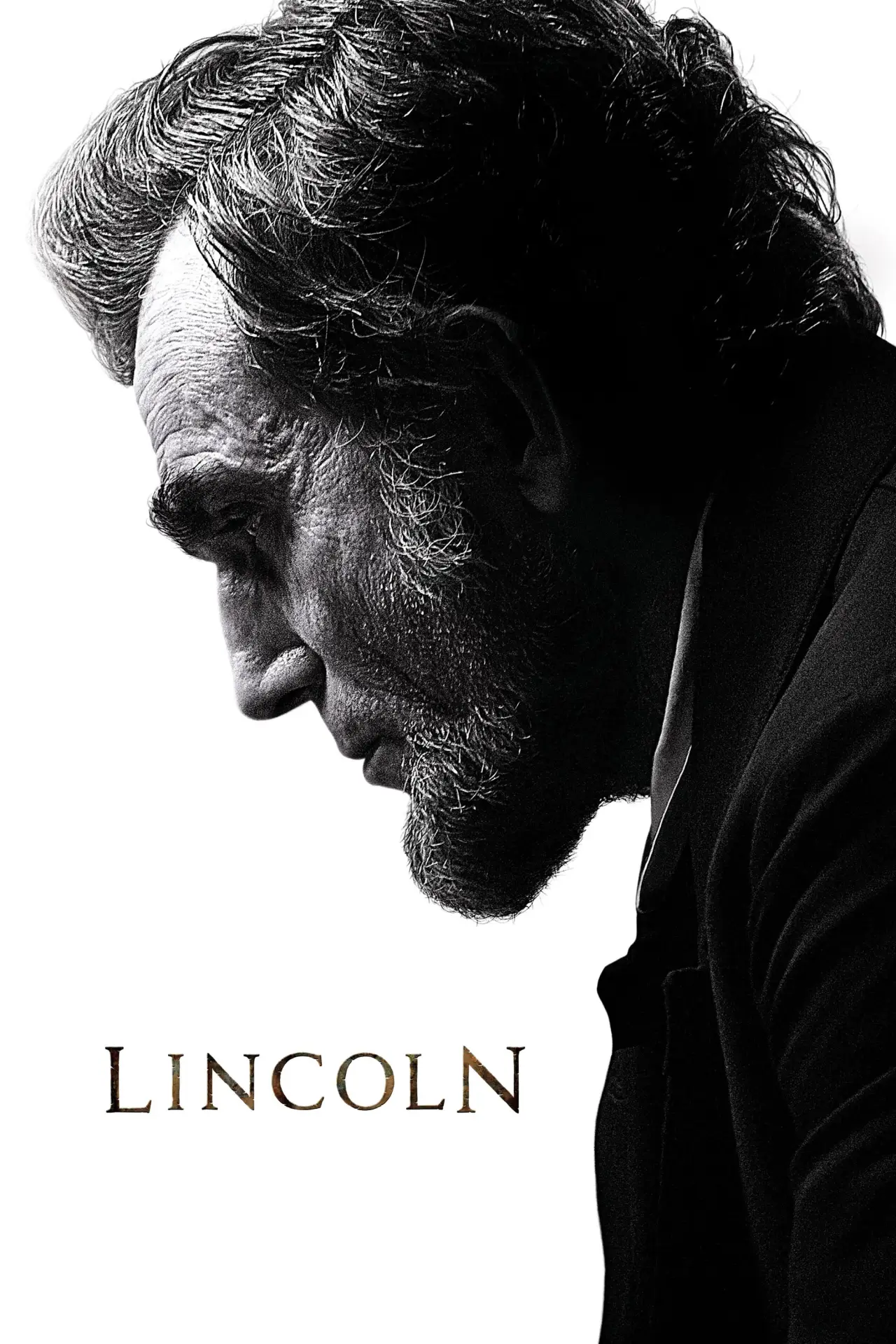
Lincoln
The hours that changed history.




Country
Production
Budget
$65 000 000
Box office
$275 293 450
Director
Actors
Scenario
Producer
Steven Spielberg, Kathleen Kennedy, Daniel Lupi, Jonathan King, Jeff Skoll, Adam Somner, Kristie Macosko Krieger
Camera operator
Composer
Artist
Audition
Avy Kaufman
Editing
Short description
The revealing story of the 16th US President's tumultuous final months in office. In a nation divided by war and the strong winds of change, Lincoln pursues a course of action designed to end the war, unite the country and abolish slavery. With the moral courage and fierce determination to succeed, his choices during this critical moment will change the fate of generations to come.
What's left behind the scenes
- John Logan and Paul Webb worked on early versions of the script before Tony Kushner joined the project. Steven Spielberg was impressed with Kushner's work on "Munich" (2005), which led to his hiring.
- Steven Spielberg expressed interest in having actor Remo Vincens play the revolutionary leader in his film.
- The letter from Mrs. Bixby to Abraham Lincoln was a subtle plot element in Steven Spielberg's early film "Saving Private Ryan" (1998). Furthermore, the "Gettysburg Address" is quoted by a schoolboy in the opening scene of another Spielberg film – "Minority Report" (2002).
- Liam Neeson, long attached to play the lead role of Abraham Lincoln, left the project, explaining that he was already too old for a role that would require waiting several years. Interestingly, Daniel Day-Lewis, who took on the role, is only five years younger than Neeson, although he is much closer in age to his character, Lincoln, who was 55–56 years old during the period depicted in the film.
- Steven Spielberg was already working on this film when he met Doris Kearns Goodwin and told her he wanted to make a movie about Abraham Lincoln. She, in turn, told him that she had just finished her book, “Team of Rivals.” Spielberg read it and decided to use it as the basis for the film.
- Hal Holbrook, who plays Francis Preston Blair, received an Emmy Award for his role as Abraham Lincoln in the series “Lincoln” (1974–1975). He also played Lincoln in the series “North and South” (1985) and appeared in the role on Ed Sullivan’s “Toast of the Town” (1948–1971).
- Actor Daniel Day-Lewis previously played Bill “The Butcher” Cutting in Martin Scorsese’s “Gangs of New York” (2002) – a character who opposed Abraham Lincoln’s political plans.
- David Strathairn (who played William Seward) had previously played Lincoln in LA Theatre Works’ 2008 production of Norman Corwin’s “The Rivalry,” which depicted the Lincoln-Douglas debates.
- Once Daniel Day-Lewis had settled on a voice for his character, he sent director Steven Spielberg an audio recording of the voice in a box marked with a skull and crossbones, so that no one would hear the recording before him.
- Michael Stanton Kennedy's great-grandfather was a journalist in the city where his character, Hiram Price, lived. When filming the scene where the 13th Amendment was passed, Kennedy burst into tears. He later told Steven Spielberg why: “We are in this room, recreating one of the most important moments in American history... And there, on the balcony, with the press, was my great-grandfather.”
- Steven Spielberg spent 12 years researching this film. He accurately recreated President Abraham Lincoln's residence, with the same wallpaper and books that Lincoln used. The sound of Lincoln's clock ticking in the film is the sound of his actual pocket watch. Lincoln's watch is kept at the Kentucky Historical Society in Frankfort, Kentucky (not at the Lincoln Presidential Library). He was wearing this watch on the day of his assassination.
- Speaking about his role as Lincoln, Daniel Day-Lewis said: “I have never in my life felt such a deep love for a man I have never met. And I think that perhaps Lincoln made the same impression on most people who were interested in his story... I would like his image to stay with me forever.”
- During the three and a half months of filming, Steven Spielberg addressed his actors as their characters. He called Daniel Day-Lewis Mr. President, and Sally Field Mrs. Lincoln or Molly. In addition, he wore a suit to the set every day: “I think I wanted to get into the role more than anyone else, wanted to be a part of all this, because we were recreating a piece of history. And I didn't want to stand out and be the guy in a baseball cap from the 21st century, I wanted to blend in with the actors.”
- During production, on the call sheet, next to the scenes with Abraham Lincoln, was listed 'Abraham Lincoln' instead of Daniel Day-Lewis, who played him.
- Sally Field was determined to play Mary Todd Lincoln. She pleaded with Steven Spielberg to give her a chance to audition alongside Daniel Day-Lewis. Spielberg thought she was too old for the role, but Field was unwavering. She recalled: “I am 10 years older than Daniel and 20 years older than Lincoln’s wife was at the time. And Steven said he didn’t see me in the role. But I knew I was right for it and asked him to let me audition. He kindly agreed, and Daniel was so kind as to fly in from his homeland, Ireland, to audition with me. I will be eternally grateful to him for that.”
- Steven Spielberg told an audience at a preview in Manhattan that screenwriter Tony Kushner spent about six years working on the film. It was originally conceived as a biographical film showing Lincoln’s entire life story, but was eventually reduced to the events surrounding the passage of the 13th Amendment, abolishing slavery in the United States, and detailed in Doris Kearns Goodwin’s book “Team of Rivals.”
- According to Steven Spielberg, it was James Spader’s idea to show his character’s hobby—carving a wooden duck. Spader’s personal research revealed that this was a major pastime during the American Civil War.
- Steven Spielberg explained that in the film’s climactic scene, where the names of members of the House of Representatives are called during the vote on the 13th Amendment, the names of those who voted against it (for various reasons) were changed in the film to avoid embarrassing the living descendants of those people and tarnishing their reputations.
- One of the famous clashes between Abraham Lincoln and Mary was the one in which he threatened to send her to a mental institution. In this film, the subject of their dispute was Robert Lincoln’s enlistment in the army. Incidentally, Robert eventually committed her to a psychiatric hospital, leading to their complete estrangement.
- In one scene in the film Lincoln, a dismissive mention is made of Tammany Hall. In an earlier work by Daniel Day-Lewis—the film "Gangs of New York" (2002)—Day-Lewis's character is in a quasi-alliance with Boss Tweed, who ran Tammany Hall during the Civil War.
- The image of lobbyist William N. Bilbo (James Spader) was created from scratch, as there were no photographs of him, and his mannerisms were taken from various sources.
- In several scenes in the office, a pipe can be seen hanging between the ceiling and the table. This is a rubber hose through which natural gas (methane) from the upper lighting system flowed to the table lamp. The hose sometimes moves slightly, as if on its own. This happens due to fluctuations in the gas system's pressure.
- After 10 years of work, director Steven Spielberg decided that he would “only make this film if Daniel Day-Lewis played the role of Lincoln, and if Daniel refused, there would be no film.”
- After Liam Neeson left the project, Steven Spielberg returned to the actor he had originally chosen for the role, namely Daniel Day-Lewis. Day-Lewis declined because he was unsure if he could portray such an iconic figure. After his refusal, Spielberg told Leonardo DiCaprio about it. It is unknown how it happened, but DiCaprio convinced Day-Lewis to play the role of Lincoln after all.
- Sally Field gained approximately 11 kilograms in order to resemble Mrs. Lincoln as closely as possible.
- All the main characters in the film were based on real people, and the filmmakers also strived to reflect the real actions and thoughts of historical figures.
- Joseph Gordon-Levitt and Gulliver McGrath, who play Lincoln’s sons Robert and Tad, both played the role of David Collins. Gordon-Levitt in the series "Dark Shadows" (1991), and McGrath in Tim Burton’s film "Dark Shadows" (2012).
- Although the use of the word “fuck” in the film was somewhat unexpected, according to the Oxford English Dictionary, it appeared in the early 1500s, which is 350 years before the American Civil War and Lincoln’s presidency. The word is used only twice in the film, and both times by the vulgar and crude character Bilbo specifically to demonstrate his roughness.
- Daniel Day-Lewis initially declined the role of Lincoln, sending Steven Spielberg the following letter: “Dear Steven! It was very pleasant simply to sit and talk with you. I listened very carefully to all your thoughts about this story and, after reading the script, I can say that I find it – with all the details in which it describes these monumental events and the compassionate portraits of all the main characters – strong and moving. But I know for sure that I could only take on this work if I felt that there was no choice. This topic inexplicably coincides with a very personal need and a very specific moment in time. In this case, I would rather be a spectator than a participant. That’s how I feel now, although I cannot be sure that my attitude will not change. I am glad that you are making this film. I wish you the strength for this project, and please accept my sincere gratitude for considering my candidacy. Daniel.”
- Daniel Day-Lewis personally instructed James Spader on how to be “as vile as possible” in the role of William N. Bilbo.
- This film was the first film since "Places in the Heart" (1984) for which Sally Field was nominated for an Oscar. It also marked her first nomination as Best Supporting Actress.
- The baton used by the conductor in the Faust opera scene with the President and Mrs. Lincoln belonged to Tony Kushner's father. It is a genuine 19th-century ebony baton with an ivory handle. Tony requested its use in the film in honor of his father.
- Mary Lincoln fears that Robert Lincoln will be killed by a sniper. The term “sniper” was not used in the United States at that time. Instead, the term “marksman” was used.
- During the scene following one of the sessions, the camera shows the statue of Washington at the Virginia State Capitol. A bust of President Woodrow Wilson, who was born in 1856, can be seen in the foreground of the footage.
- At the beginning of the film, Tadeusz Stevens exits an office. He opens the door, and then it closes with an automatic door closer, which was invented in 1880.
- William Bilbo mentions that Lincoln's face is depicted on the 50-cent coin. Lincoln’s portrait was on a 50-cent coin issued instead of silver coins during the Civil War, but only in 1869.
- The modern 50-star US flag is used in many scenes. However, at the time, it should have had either 25 or 36 stars.
- At the beginning of the film, a young soldier tells Lincoln that he heard his 'Gettysburg Address' two years prior. The scene takes place in December 1864 or early January 1865. Lincoln delivered the 'Gettysburg Address' in November 1863, which was 13 months before this point.
- In the film, Ted's speech is clear and understandable. Historically, Ted Lincoln had a pronounced speech impediment due to a cleft palate, making his pronunciation difficult to understand.
- When the president slams his hand on the table to stop an argument, he knocks his glasses. Shortly after, the glasses disappear.
- When Tadeusz Stevens accepts a bill after a vote, he folds it in half vertically. When his housekeeper, Lydia Smith, reads the bill to him, the document is folded horizontally.
- When President Lincoln speaks with Green and Clark, shots from behind the soldiers show heavy rain, with water running down Clark’s hat every few seconds. But in the shots from the front, the rain is very light, and no water runs down Clark’s hat.
- When Lincoln and Robert travel to the military hospital in a carriage, Lincoln places his papers in a folder to his left. In the next shot, the documents are back on his lap, and he puts them in a briefcase.
- During the surrender at Appomattox, General Grant appears clean and well-groomed. In Ken Burns’s ‘The Civil War’ (1990), historian Shelby Foote said that at Appomattox, Grant was covered in mud and even wearing someone else’s coat.
- Lincoln's secretary, John Nicolay, was Bavarian and spoke with a strong German accent.
- When Congress finally holds a vote on the 13th Amendment, every table in the hall is occupied. 18 seats must remain empty due to the seceded states.
- On the two-seater carriage carrying Lincoln, two men are seated in the front, but they have taken the wrong places. The rider with the rifle should sit on the right, and the coachman on the left, so as not to hit pedestrians with the whip.
- When the Speaker of the House begins to pronounce the names of the states in alphabetical order, Connecticut goes first. He should have started with California, which was admitted to the Union in 1850 and had three representatives at the 38th Congress (March 1863 – March 1865).
- In 1863, Secretary of War Edwin Stanton gave Tad Lincoln the rank of second lieutenant of artillery. In the film, Tad wears the uniform of a lieutenant colonel of infantry, outranking his brother, Captain Robert Lincoln, by two grades.
- In many scenes in the House of Representatives, the words "State of Virginia" are inscribed on the marble slab behind the speaker. All scenes in the House of Representatives were filmed in the old chamber in the Capitol in Richmond, Virginia.
- Raymond H. Johnson played the role of Republican Congressman John F. McKenzie, but a different actor is credited in the final credits. Raymond H. Johnson is credited as Raymond Johnson from the House of Representatives.
- Bilbo (James Spader) addresses a ruthless congressman, calling him Bob Nolister, when the character’s actual name is Harold Hollister, and it is pronounced during a vote on the 13th Amendment.
- In the film, John Hay still works at the White House in 1865. However, Hay (who was technically a clerk in the Interior Department) ceased working at the White House in 1864. Also, in the film, Hay offers Lincoln to sleep in the same bed. Lincoln slept that way for four years with his business partner Joshua Speed, as well as many times with William Green and Charles Derxson. But there is no evidence regarding Hay in this regard.
- In the scene of Lincoln's death, he lies partially on his side on a blanket, on the bed in the Petersen House (across from Ford’s Theatre). In reality, he slowly died over ten hours, and he was laid in bed under a blanket to warm him, placed diagonally, because he was too tall and wouldn’t fit otherwise.
- In the scene where Lincoln speaks with Mrs. Keckley in the North Portico (covered gallery), columns can be seen on the north side of the White House wall, to the left of Lincoln. The White House has never had columns along this wall.
- At the beginning of the film, Lincoln meets with Seward and others in the White House's sitting room, and through the window in the background, it is daytime. Then, the camera briefly captures a clock showing 5 p.m., while in mid-November, the sun usually sets much earlier.
- Shortly after Thaddeus Stevens publicly states that he is not an advocate of racial equality, he goes to the rotunda and sits down. He is joined by an angry member of the House of Representatives. In the shot where he is sitting on the bench, a modern electrical outlet is visible on the wall below.
- During Lincoln’s speech in his office, which begins with him slamming his hand on the table and saying, “I can’t listen to this anymore…”, Seward’s hands are supporting his chin. When Lincoln says, “...with the fate of human dignity in our hands,” Seward lowers his hands. In the next shot, when Lincoln shouts, “Now! Now! Now!”, Seward’s hands are abruptly back under his chin.
- The film is based on Doris Kearns Goodwin’s book “Team of Rivals: The Political Genius of Abraham Lincoln” (2005).
- The film is based on the book "Team of Rivals: The Political Genius of Abraham Lincoln" (2005) by Doris Kearns Goodwin.
- John Logan and Paul Webb worked on early versions of the script before Tony Kushner joined the project. Steven Spielberg was impressed by Kushner's work on the film "Munich" (2005), which led to his hiring.
- Steven Spielberg expressed interest in having actor Remo Vincenzi play the leader of the revolution in his film.
- Mrs. Bixby's letter to Abraham Lincoln was an indirect plot element in Steven Spielberg's earlier film "Saving Private Ryan" (1998). Additionally, the "Gettysburg Address" is quoted by a schoolboy in the opening scene of another Spielberg film, "Minority Report" (2002).
- Liam Neeson, who was attached to the lead role of Abraham Lincoln for a long time, left the project, explaining that he was already too old for a role that required waiting several years. Incidentally, Daniel Day-Lewis, who landed the part, is only five years younger than Neeson, although he is the closest in age to his character, Lincoln, who was 55–56 during the period depicted in the film.
- Steven Spielberg was already working on this film when he met Doris Kearns Goodwin and told her that he wanted to make a movie about Abraham Lincoln. She told him that she had just finished her book, "Team of Rivals." Spielberg read it and decided to use it as the basis for the film.
- Hal Holbrook, who plays Francis Preston Blair, won an Emmy for his role as Abraham Lincoln in the series "Lincoln" (1974–1975). He also played Lincoln in the series "North and South" (1985) and appeared in the role on Ed Sullivan's "Toast of the Town" (1948–1971).
- Actor Daniel Day-Lewis previously played Bill "The Butcher" Cutting in Martin Scorsese's film "Gangs of New York" (2002)—a character who opposed Abraham Lincoln's political plans.
- David Strathairn (who played William Seward) had previously played Lincoln in LA Theatre Works' 2008 production of Norman Corwin's "The Rivalry," which depicted the Lincoln-Douglas debates.
- Once Daniel Day-Lewis had decided on the voice for his character, he sent an audio recording of it to director Steven Spielberg in a box marked with a skull and crossbones, so that no one would hear the recording before he did.
- Michael Stuhldreher's great-grandfather was a journalist in the city where his character, Hiram Price, lived. While filming the scene where the 13th Amendment was adopted, Kennedy burst into tears. Later, he explained to Steven Spielberg why this happened: 'We are in this room, recreating one of the most important moments in American history... and there, on the balcony with the press, sat my great-grandfather.'
- Steven Spielberg spent 12 years researching for this film. He accurately recreated President Abraham Lincoln's residence, using the same wallpaper and books that Lincoln had used. The sound of Lincoln's clock ticking in the movie is the sound of his actual pocket watch. Lincoln's watch is kept at the Kentucky Historical Society in Frankfort, Kentucky (not in the Lincoln Presidential Library). He was wearing this watch on the day of his assassination.
- Speaking about his role as Lincoln, Daniel Day-Lewis said: 'I have never in my life felt such a deep love for a person I have never met. And I think that perhaps Lincoln made the same impression on most people who were interested in his story... I would like his image to stay with me forever.'
- Throughout the three and a half months of filming, Steven Spielberg addressed his actors as their characters. He called Daniel Day-Lewis Mr. President, and Sally Field Mrs. Lincoln or Molly. Additionally, he wore a costume on set every day: 'I think I wanted to get into the role more than anyone else, wanted to be part of it all, because we were recreating a piece of history. And I didn't want to stand out and be the guy in the 21st-century baseball cap; I wanted to blend in with the actors.'
- During production, the call sheet for the actors listed Abraham Lincoln next to the scenes, rather than Daniel Day-Lewis, who was playing the role.
- Sally Field was determined to play Mary Todd Lincoln. She begged Steven Spielberg for the opportunity to screen test with Daniel Day-Lewis. Spielberg felt she was too old for the role, but Field remained adamant. She recalled: 'I am 10 years older than Daniel and 20 years older than Lincoln's wife was at the time. And Steven said he didn't see me in the role. But I knew I was right for it and asked him to let me audition. He kindly agreed, and Daniel was so sweet that he flew in from his home in Ireland for the screen test with me. I will be eternally grateful to him for that.'
- Steven Spielberg told the audience at a preview screening in Manhattan that screenwriter Tony Kushner spent about six years working on the film. It was originally conceived as a biopic showing Lincoln's entire life story, but was eventually narrowed down to the events surrounding the passage of the 13th Amendment, which abolished slavery in the US, and which are detailed in Doris Kearns Goodwin's book 'Team of Rivals'.
- According to Steven Spielberg, it was James Spader's idea to show his character's hobby (carving a wooden duck). Spader's own research revealed that this was one of the primary pastimes during the American Civil War era.
- Steven Spielberg explained that in the film's climactic scene, where the names of the members of the House of Representatives are called during the vote for the 13th Amendment, the names of those who voted against it (for various reasons) were changed in the movie so as not to embarrass their living descendants or tarnish their reputations.
- One of the famous quarrels between Abraham Lincoln and Mary is the one in which he threatens to send her to an asylum. In this film, the subject of their dispute is Robert Lincoln's enlistment in the army. Incidentally, it was Robert who eventually sent her to a psychiatric hospital, which led to their complete estrangement.
- In one scene in the film, Lincoln mentions Tammany Hall with contempt. In an earlier work by Daniel Day-Lewis—the film 'Gangs of New York' (2002)—Day-Lewis's character is in a quasi-alliance with Boss Tweed, who led Tammany Hall during the Civil War.
- The portrayal of lobbyist William N. Bilbo (James Spader) was created from scratch because there were no photographs of him, and his mannerisms were drawn from various sources.
- After 10 years of work, director Steven Spielberg decided that he would 'make this movie only if Daniel Day-Lewis played Lincoln, and if Daniel refused, there would be no filming.'
- After Liam Neeson left the project, Steven Spielberg returned to the actor he had originally chosen for the role, Daniel Day-Lewis. Day-Lewis refused because he was not sure he could successfully portray such an iconic figure. After his refusal, Spielberg told Leonardo DiCaprio about it. It is unknown how it happened, but DiCaprio managed to convince Day-Lewis to take the role of Lincoln after all.
- Asa-Luke Tucroe, who plays Lieutenant Colonel Eli Parker, was also a member of Lincoln's rigging crew. His resemblance to the Seneca chief was simply supernatural, and the casting department approached him with an offer to play the role. He would dress in the costume of Grant's secretary, film a scene, and then change back into a crew member's clothes to continue filming as a rigger.
- Bill Camp and Elizabeth Marvel, who played Mr. and Mrs. Jolly (the couple who visit Lincoln to resolve an issue regarding a post at the outpost), are also married to each other in real life.
- In this film, Lincoln occasionally refers to his wife, Mary Todd Lincoln, as Molly. This was indeed a pet name that Lincoln used when addressing her.
- While delivering a fiery speech against Lincoln, Fernando Wood calls him 'African King Abraham Lincoln.' This epithet is based on real 1864 pamphlets titled 'Abraham African I: His Secret Life, Revealed Under Hypnosis, Secrets of the White House.' This pamphlet, printed by the Copperheads (a group of Democrats from outside the Confederacy who sympathized with the Confederate cause and opposed Lincoln), claimed that Lincoln had signed a contract with Satan to seize the presidency of the United States and 'destroy the freedom of the American people and corrupt their civil aspirations, raining down his cunning upon them and deceiving them with ambiguous speeches and false promises to firmly establish his dynasty.' The real Fernando Wood was a member of the Copperheads.
- According to producer Kathleen Kennedy, the film commission in Richmond, Virginia, helped maintain the historical accuracy of the film by providing the crew with extensive access to government buildings.
- Mary Lincoln fears that Robert Lincoln will be killed by a sniper. The term "sniper" was not used in the US at that time; instead, the term "sharpshooter" was used.
- During a scene following one of the sessions, the camera shows the statue of Washington at the Virginia State Capitol. In the front shots, a bust of President Woodrow Wilson, who was born in 1856, can be seen.
- William Bilbo mentions that Lincoln's face is depicted on a 50-cent note. Lincoln's portrait appeared on 50-cent notes issued in place of silver coins during the Civil War, but only starting in 1869.
- At the beginning of the film, a young soldier tells Lincoln that he heard the "Gettysburg Address" two years prior. The scene takes place in December 1864 or early January 1865. Lincoln delivered the "Gettysburg Address" in November 1863, which was 13 months before that moment.
- When Grant and Lincoln speak in the house during Lincoln's visit to Petersburg, they both stand up, Lincoln extends his hand to Grant, and Grant shakes it. In the following shots, this moment is repeated.
- At the end of Lincoln's conversation with Seward and Mr. and Mrs. Jolly, Seward's cigar is much shorter than it should be after only a few puffs.
- While Robert Lincoln is waiting at the military hospital, a shot from inside the hospital shows the American flag above the door waving in the wind. In the next shot, the flag is completely still.
- In the opening scene, as the soldiers begin to disperse to their units, a shot from behind Lincoln shows Private Green slinging his weapon over his shoulder. In the next scene, he does this again.
- When President Lincoln is speaking with Green and Clark, shots from behind the soldiers show that it is raining heavily, with water dripping from Clark's hat every few seconds. However, in the front-facing shots, the rain is very light, and water is not dripping from Clark's hat.
- When Lincoln and Robert are heading to the military hospital in a carriage, Lincoln places his papers in a folder to his left. In the next shot, the documents are back on his lap, and he puts them into a briefcase.
- During the surrender at Appomattox, General Grant appears clean and well-groomed. In Ken Burns' series 'The Civil War' (1990), historian Shelby Foote stated that at Appomattox, Grant was covered in mud and was even wearing someone else's coat.
- On the two-seater carriage Lincoln is riding in, two men are sitting in front, but they have taken the wrong seats. The rider with the rifle should sit on the right, and the driver on the left, to avoid hitting pedestrians with the whip.
- In 1863, Secretary of War Edwin Stanton gave Ted Lincoln the rank of second lieutenant of artillery. In the film, Ted wears the uniform of an infantry lieutenant colonel, outranking his brother, Captain Robert Lincoln, by two grades.
- Raymond H. Johnson played the role of Republican Congressman John F. McKenzie, but a different actor is listed in the final credits. Raymond H. Johnson is credited as Raymond Johnson from the House of Representatives.
- Bilbo (James Spader) addresses a cruel congressman as Bob Nollister, when the character's actual name is Harold Hollister, which is spoken during the vote for the 13th Amendment.
- In the film, John Hay is still working at the White House in 1865. However, Hay (who was technically a clerk for the Interior Department) stopped working at the White House in 1864. Additionally, in the film, Hay suggests that Lincoln share a bed with him. Lincoln did sleep this way for four years with his business partner Joshua Speed, as well as many times with William Green and Charles Derickson. But there is no evidence regarding Hay in this regard.
- In the scene of Lincoln's death, he is lying partially on his side on a blanket on a bed in the Petersen House (across from Ford's Theatre). In reality, he died slowly over ten hours and was placed in a bed under blankets to keep him warm, positioned diagonally because he was too tall to fit otherwise.
- In the scene where Lincoln speaks with Mrs. Keely in the north portico (covered gallery), columns can be seen on the north side of the White House wall, to Lincoln's left. There were never any columns along that wall of the White House.
- At the beginning of the film, Lincoln meets with Seward and others in the White House living room, and through the window in the background, it is visible that it is daytime outside. Then the camera briefly captures a clock showing 5:00 PM, but in mid-November, the sun has usually already set by that time.
- Sally Field gained about 11 kilograms to look as much like Mrs. Lincoln as possible.
Similar movies
8.4/10

8.2/10
8.1/10
8.1/10
8/10
8/10
8/10
8/10
8/10

8/10


 Auditions in India
 Casting calls in USA
 Castingi w Polsce
 Кастинги в Україні
