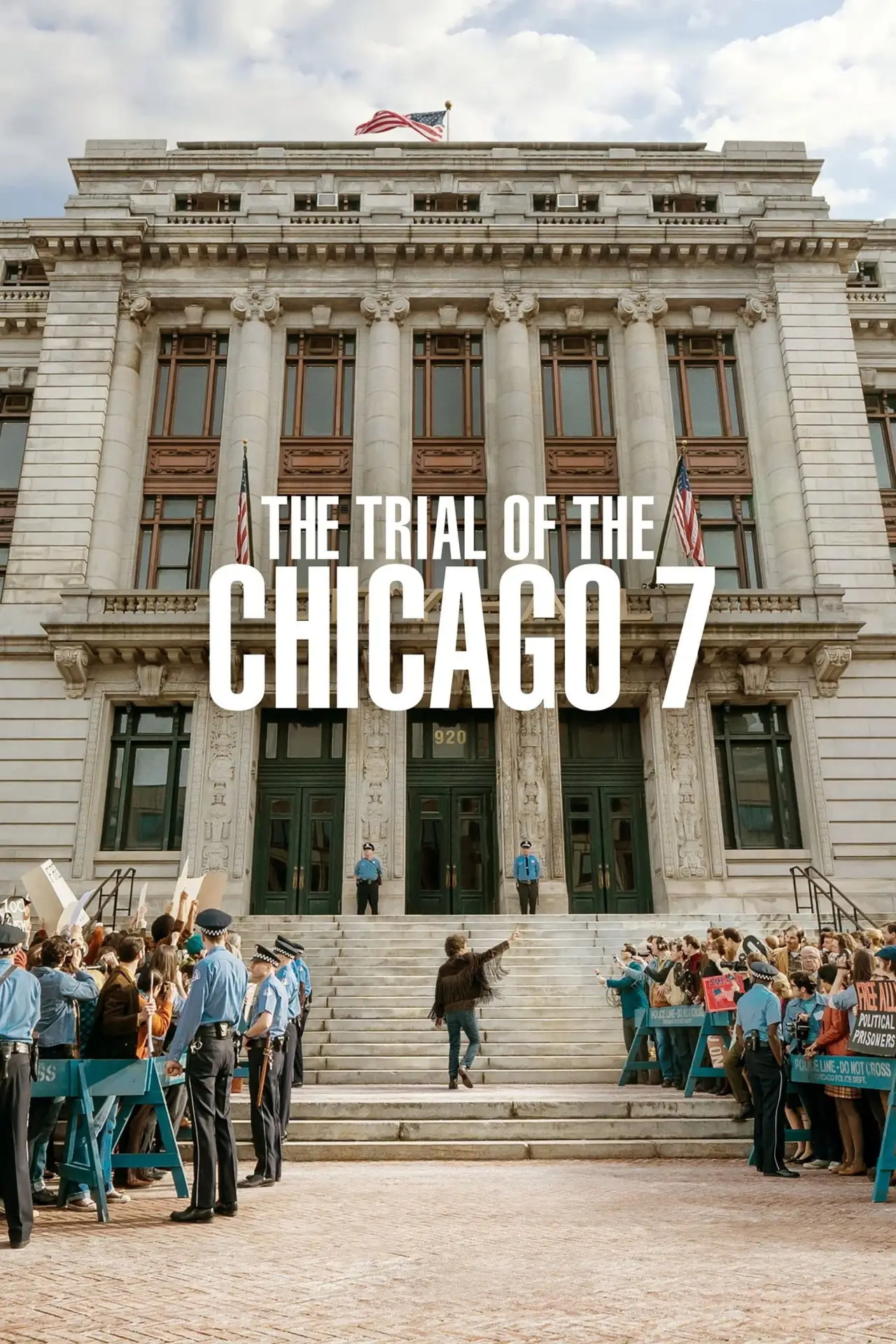
The Trial of the Chicago 7
In 1968, democracy refused to back down.




Country
Production
Budget
$35 000 000
Box office
$24 357
Director
Actors
Scenario
Producer
Marc Platt, Stuart M. Besser, Tyler Thompson, Matt Jackson, Walter F. Parkes, Monica Levinson, Laurie MacDonald, Marc Butan, Anthony Katagas, Jared Underwood
Camera operator
Composer
Artist
Shane Valentino, Shoko Kambara
Audition
Editing
Alan Baumgarten
Whole Team (93)
Whole Team (93)
Short description
What was supposed to be a peaceful protest turned into a violent clash with the police. What followed was one of the most notorious trials in history.
What's left behind the scenes
- When Steven Spielberg was set to direct the film, he arranged a meeting with Heath Ledger to discuss the role he was to play. Ledger (1979-2008) died of acute intoxication the day before the meeting.
- Sacha Baron Cohen admitted he was terrified at the prospect of having to speak with an American accent in the film. He had previously used various versions of the accent in his comedies, but never in dramatic films. The actor knew that his character, Abbie Hoffman (1936-1989), had a unique pronunciation – a Massachusetts accent, but he had studied in California, and the actor rightly feared he would sound 'wrong.' The film's director, Aaron Sorkin, tried to reassure him, but Cohen didn't think he succeeded.
- According to the film, Renny Davis had a notebook with him containing the names of U.S. soldiers who died during the trial. In reality, Davis also had the names of Vietnamese soldiers recorded in the same notebook.
- Jeremy Strong pleaded with the director to allow tear gas to be used on set for realism in the scene where a police officer knocks him down. Aaron Sorkin did not grant permission.
- In 2006, Steven Spielberg approached Aaron Sorkin with a request to write a similar screenplay, but the Writers Guild strike intervened, followed by other projects taking priority. When Sorkin finally agreed to Spielberg’s request, he had to turn to his father, asking him to recount what happened in 1968, and whether a trial actually took place, as Sorkin himself knew nothing about it.
- A committed pacifist, David Dellinger (1915-2004) did not strike a police officer or anyone else during the trial. In fact, he maintained composure, even when one of the bailiffs struck one of Dellinger’s children.
- It was Dellinger, not Tom Hayden (1939-2016), who attempted to read a list of names of those killed in Vietnam, but he was not allowed to do so. The assumption that it was Hayden who did this and that it ended the proceedings is incorrect.
- Richard Schultz, as portrayed by Joseph Gordon-Levitt, is depicted as a man of strong convictions who, against his will, carries out orders from his superiors and pursues a case whose accusatory slant he does not believe in. In reality, Schultz wholeheartedly supported the prosecution, and when asked about it, denied having stood when the names of those killed in the war were read.
- Judge Hoffman truly treated Bobby Seale, a co-founder of the Black Panther Party, terribly – even worse than depicted in the film. As shown on screen, Seale was chained during the trial and had a gag in his mouth. However, based on the film, he was in that position for a very short time, whereas in reality, he was first chained and gagged on October 29, 1969, and it continued every time he appeared in court (i.e., every day) until November 5, 1969.
- The film claims that the reason for Seale’s outburst, which led to the decision to bring him to court with a gag and chains, was the murder of Fred Hampton (chairman of the Illinois Black Panther Party). However, Hampton’s death actually occurred after Seale’s trial, when Seale was no longer present at the 'Chicago Seven' trial.
- The character played by Caitlin Fitzgerald – she portrays an undercover agent monitoring Jack Ruby (1938-1994) – is a fictional creation of the film's authors.
- When Steven Spielberg was listed as the film's director, he arranged a meeting with Heath Ledger to discuss the role he was to play. Ledger (1979-2008) passed away from acute intoxication the day before the meeting.
- Sacha Baron Cohen admitted that he was terrified of having to speak with an American accent in the film. Previously, he had used various versions of such accents in his comedies, but never in dramatic films. The actor knew that the pronunciation of his character, Abbie Hoffman (1936-1989), was unique, as he spoke with a Massachusetts accent despite having studied in California, and the actor rightly feared that he would not sound "right." The film's director, Aaron Sorkin, tried to reassure him, but Cohen felt that he had failed to do so.
- For the film, Ronny Davis kept a notebook with the names of US Army soldiers who died during the trial. In reality, Davis had also recorded the names of Vietnamese soldiers in the same notebook.
- Jeremy Strong begged the director to release tear gas on set for the sake of authenticity during the scene where a policeman knocks him down. Aaron Sorkin did not grant permission.
- In 2006, Steven Spielberg approached Aaron Sorkin with a request to write a similar screenplay, but a writers' strike intervened, followed by other projects. When Sorkin finally agreed, he had to ask his father if he remembered anything about what happened in 1968 and whether there really had been a trial, as Sorkin himself knew nothing about it.
- As a convinced pacifist, David Dellinger (1915-2004) did not strike any police officer or anyone else during the trial. In fact, he maintained his composure even when one of the bailiffs struck one of Dellinger's children.
- It was Dellinger, not Tom Hayden (1939-2016), who attempted to read the list of names of those killed in Vietnam, but he was not allowed to do so. The assumption that it was Hayden, and that this brought the trial to an end, is incorrect.
- The character played by Caitlin Fitzgerald—an undercover agent monitoring Jerry Rubin (1938-1994)—was a fictional creation of the filmmakers.
- Richard Schultz, played by Joseph Gordon-Levitt, is depicted as a man of firm convictions who carries out his superiors' orders against his own will and manages a case whose prosecutorial bias he does not believe in. In reality, Schultz wholeheartedly supported the prosecution, and when asked about it, denied the fact that he had stood up when the names of those killed in the war were read.
Similar movies
8.7/10

8.6/10

8.5/10

8.5/10
8.4/10

8.4/10

8.4/10
8.4/10
8.2/10

8.2/10


 Auditions in India
 Casting calls in USA
 Castingi w Polsce
 Кастинги в Україні
