Enchanted
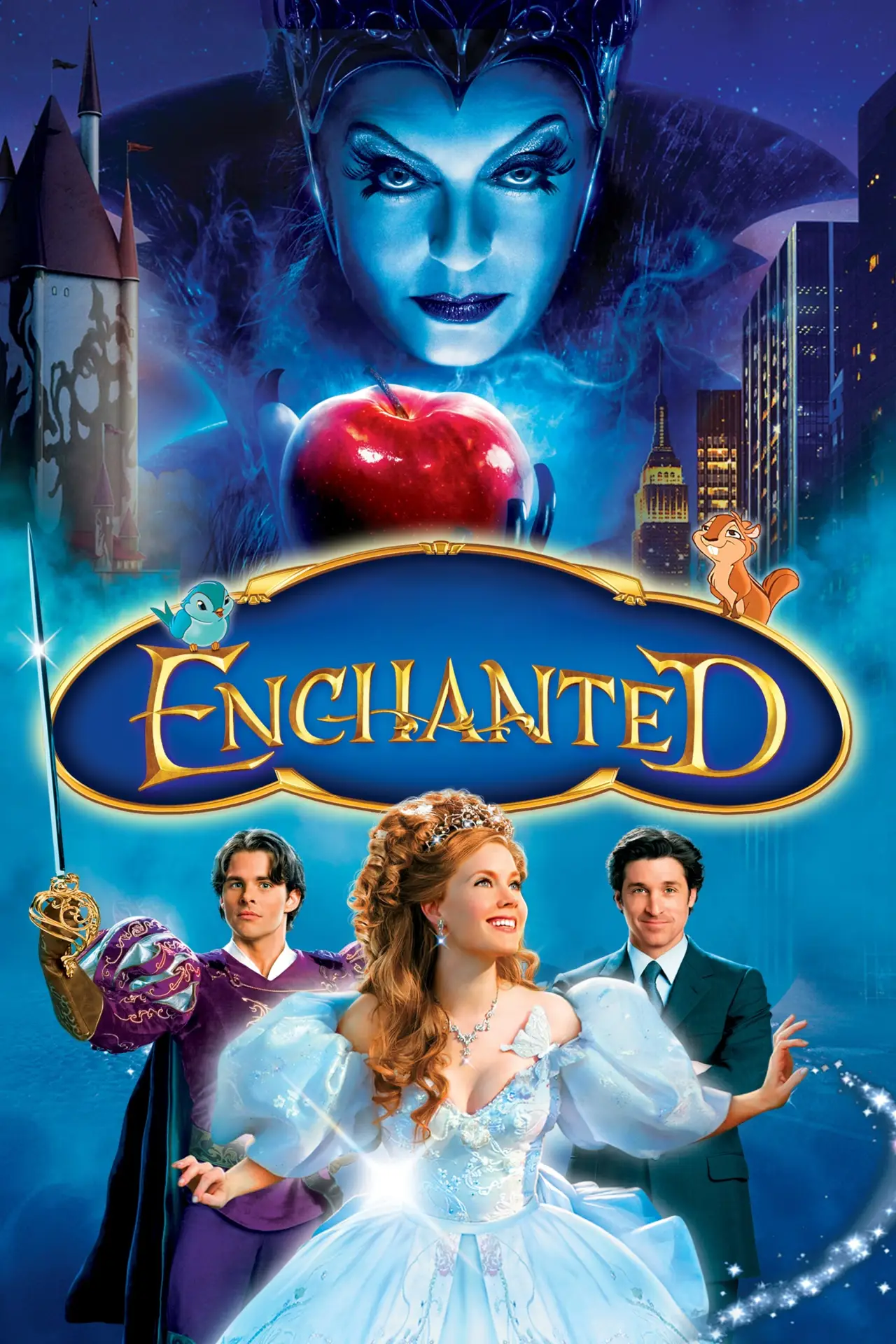
The real world and the animated world collide.




Country
Budget
$85 000 000
Box office
$340 487 652
Director
Actors
Scenario
Bill Kelly, Rita Hsiao
Producer
Barry Sonnenfeld, Barry Josephson, Ezra Swerdlow, Christopher Chase, Sunil Perkash
Camera operator
Composer
Artist
Stuart Wurtzel, Andreas Deja, Trevor Tamboline
Audition
John Papsidera, Marcia Ross
Editing
Stephen A. Rotter, Gregory Perler
Whole Team (131)
Whole Team (131)
Short description
The beautiful princess Giselle is banished by an evil queen from her magical, musical animated land and finds herself in the gritty reality of the streets of modern-day Manhattan. Shocked by this strange new environment that doesn't operate on a "happily ever after" basis, Giselle is now adrift in a chaotic world badly in need of enchantment. But when Giselle begins to fall in love with a charmingly flawed divorce lawyer who has come to her aid - even though she is already promised to a perfect fairy tale prince back home - she has to wonder: Can a storybook view of romance survive in the real world?
What's left behind the scenes
- Uma Thurman auditioned for the lead female role.
- The film was originally scheduled for release in 2002, with Rob Marshall directing, but he left the project due to "creative differences" with the producers.
- Work on the project lasted almost two years. About a year was spent creating the animated portion, while filming with actors, which began in the summer of 2006 and took place in various parts of New York, was completed in 72 days.
- New York was chosen as the location for the film, and filming took place there. Despite careful preparation, the shooting process was constantly complicated by the changing environment of the city; the film crew had to work in conditions of "ongoing construction, renovations, and the appearance of new stores".
- The first scene in New York, in which Giselle emerges from a manhole, was filmed in the center of Times Square. There was constantly a huge number of people on the square, which was very difficult to control, so it was decided to film ordinary passersby together with the actors and extras placed in the foreground in this episode.
- The original screenplay, written by Bill Kelly, was purchased by the cinematic division of Disney's Touchstone Pictures and the Sonnenfeld/Josephson Productions production company for $450,000 in September 1997. However, it was deemed inconsistent with the studio's image, as it was intended for a mature audience. To Kelly's dismay, the script was rewritten several times.
- Kevin Lima began designing the world of Andalasia before the actors were cast in the lead roles. After the casting and approval of the actors, Lima was involved in the final design of the project so that the drawn characters would correspond as closely as possible to their real-life counterparts.
- In the late 1990s, due to the development and widespread adoption of computer graphics, many animators were laid off from the Studio, so the creation of the animated part of the film was carried out by the independent company James Baxter Animation, located in Pasadena, under the direction of chief artist James Baxter.
- To demonstrate the connection between the animated and real worlds, Lima early in production invited costume designer Mona May to the project, whose task was to create a unified style for the costumes of both worlds. He also shot footage of Amy Adams as Giselle, which was used by the animators as a reference, allowing them to achieve both visual similarity and correspondence of the animated character’s movements to the actress’s movements. So that the actors had an idea of what their drawn counterparts would look like and how they would move, the animators showed them finished test scenes.
- Many episodes were filmed at Steiner Studios, which had three large stages necessary for filming. Filming also took place on the Brooklyn Bridge and at The Paterno—a residential complex with a curved, richly decorated ivory-colored facade where the film’s protagonists, Robert and Morgan, live.
- For "Enchanted," Tippett Studio created the majority of the shots with visual effects. These 320 shots contained various virtual sets, weather effects, and computer-generated characters interacting with real actors, in episodes such as Robert’s apartment being cleaned by wild animals or Pip battling Narissa as she transforms into a dragon. CIS Hollywood was responsible for 36 visual effects shots, concealing safety wires and compositing. Additionally, Reel FX Creative Studios and Weta Digital created 6 shots with a camera move in the form of a pop-up book page turn.
- Among the animals present in the apartment cleaning episode during the song “Happy Working Song,” trained rats and pigeons were real. Filmed on camera, they helped Tippett Studio create computer models, which were then used to depict the active behavior of pigeons holding brooms in their beaks and rats cleaning with toothbrushes. All insects involved in the episode are entirely computer-generated.
- In 2001, John Turteltaub took the director's chair but soon left it in favor of a joint Disney and Jerry Bruckheimer project, "National Treasure". Adam Shankman became the film's director in 2003, and at the same time, Disney Studios hired Robert Shul and Mark McCorkle for another script rewrite. At this stage of the project's development, actresses Kate Hudson and Reese Witherspoon were considered for the role of Giselle. However, the film never went into production.
- In 2005, Kevin Lima was appointed director of the film, and Bill Kelly returned to the project to create a new version of the script. Lima and Kelly worked together on the script, with a central idea being to combine the plot of "Enchanted" with Disney's rich heritage through numerous references to the studio's past works. Lima created a visual storyboard, recreating the film's plot from beginning to end, which occupied an entire floor of the production building. After the director demonstrated it to the head of Disney Studios, Dick Cook, the project received the green light.
- "Enchanted" is the first full-length film from Disney Studios to combine live-action and animated characters since "Who Framed Roger Rabbit" in 1988.
- The film's runtime is 107 minutes, with the animated portion lasting approximately 13 minutes, 10 of which are at the beginning. During these 10 minutes, Lima attempted, in his words, to "reflect as many details of iconic Disney images" as possible. This part of the film was intentionally created using traditional hand-drawn animation (instead of computer-generated three-dimensional animation) as a tribute to old Disney fairy tales such as "Sleeping Beauty," "Cinderella," and "Snow White and the Seven Dwarfs."
- The most challenging scenes, according to director Kevin Lima, were the filming of the musical number "That's How You Know" in Central Park. Due to bad weather, 17 days were spent on the five-minute episode, of which only seven were sunny enough for filming. Furthermore, fans of Patrick Dempsey sometimes interfered with the process. John O’Connell, who previously worked on the musical "Moulin Rouge!", was responsible for the choreographic staging of the number, which involved 300 extras and 150 dancers.
- The design of all costumes in the film was created by Mona May. To determine the style of the characters' clothing, May and her costume department, consisting of 20 people, worked with the animators for a whole year in preparation for the project. She also contracted with five clothing stores in Los Angeles and New York. May was involved in the project at the stage of creating the faces and bodies of the characters, when it became necessary to determine the possibility of making real costumes suitable for the actors based on two-dimensional drawings. Her task was to preserve the essence of Disney design while adding something new, fashionable, and fun. May admitted that it was quite difficult, "because she had to deal with iconic Disney characters whose images had been ingrained in the memory of viewers for many years."
- To make Giselle's waist appear very narrow in her wedding dress, “incredibly voluminous” sleeves and a huge crinoline with a metal hoop were created, which supported 20 layers of skirts and ruffles. A total of 11 versions of the wedding dress were made for filming, each consisting of 183 meters of silk and other fabrics and weighing approximately 18 kg. Actress Amy Adams described her feelings while wearing such a dress as “exhausting,” as “all the weight was on the hips, and sometimes it felt like something was holding her up.”
- Only one costume was created for James Marsden. When creating it, May’s main goal was to ensure that “Marsden’s appearance wouldn’t get lost against the backdrop of the outlandish outfit, while still allowing him to look handsome.” The costume featured padding on the chest, buttocks, and groin, which gave Marsden’s figure “exaggerated proportions like a cartoon character” and “a pose – straight back, arms not drooping.”
- When creating Queen Narissa’s costume, May was pleased to learn of the director’s desire to make it more fashionable. To achieve this, she decided to give Narissa’s appearance the look of a runway model, whose dress would still look Disney-esque, but also resemble clothing from the world of high fashion. Since Narissa appears in three versions in the film – drawn, real, and computer-generated – May needed to achieve a similarity in “color, shape, and texture” of her costume in all three versions. The costume, consisting of a bodice, skirt, and cape, was made of leather to give it a “serpentine” look. Working in conjunction with animators, May ensured that the costume details resembled various parts of a dragon: the cape’s design resembles wings, the multi-layered fitted skirt resembles a tail, and the crown transforms into horns during Narissa’s transformation into a dragon.
- Disney initially planned to add Giselle to the lineup of Disney Princesses – at the 2007 Toy Fair, a doll of her was even presented, with packaging stating that Giselle held this status – however, when it became clear that the Studio would have to pay Amy Adams for the lifetime right to use her image, they abandoned this idea. And although Giselle did not become one of the Disney Princesses, and merchandise featuring her in this capacity did not go on sale, various products based on “Enchanted” were released, using Adams' animated image.
- Pip, the talking chipmunk in the animated world of Andalasia, loses this ability in the real world and therefore has to communicate with those around him through mime and gestures. The animators’ task was to create a realistic chipmunk that expresses its thoughts and feelings through sign language. For the Tippett Studio team, creating Pip began with observing real chipmunks, filming them from all possible angles. After that, using the computer editors 3D graphics “Maya” and “Furrocious,” a photorealistic three-dimensional model was created. When special effects supervisor Thomas Scalesi first showed it to director Kevin Lima, he was very surprised to learn that the model was computer-generated. To make Pip’s facial expressions more expressive, modelers added eyebrows, which real chipmunks lack. During filming of scenes featuring the computer-generated Pip, various tools were used to indicate the chipmunk’s physical presence in the frame. One such tool was a small dummy with a wire frame. In some cases, to show the actors and the cameraman where Pip was at the moment, a stick with a marker on the end or a laser pointer was used.
- The computer model of the dragon's design was inspired by traditional images of the Chinese dragon and the appearance of Susan Sarandon. During the filming of the scene where Narissa transforms into a dragon, special effects artists used a long pole instead of a laser pointer to direct the gaze of the extras to the correct spot. This scene was very complex, as it required the simultaneous operation of several components: moving sets, a computer-controlled lighting system, and repeated camera moves. To film Patrick Dempsey in the film's climactic scene, where Narissa, clutching Robert in her claws, climbs the Woolworth Building, a mechanical arm installation was built, operated by three specialists working in sync. The actor was placed in this arm, mimicking the movements of the computer dragon's paw, against a chroma key background, with all his movements captured by the camera.
- The original script written by Bill Kelly was purchased by Disney's Touchstone Pictures and Sonnenfeld/Josephson Productions for $450,000 in September 1997. However, it was deemed inconsistent with the studio's image as it was intended for an adult audience. To Kelly's dismay, the script was rewritten several times.
- In 2001, Jon Turteltaub took over as director, but soon left to work on the Disney and Jerry Bruckheimer joint project 'National Treasure.' Adam Shankman became the film's director in 2003; at the same time, Disney hired Robert Shuley and Mark McCorkle for another rewrite of the script. At this stage of development, Kate Hudson and Reese Witherspoon were considered for the role of Giselle. However, the film never entered production.
- In 2005, Kevin Lima was appointed as the film's director, and Bill Kelly returned to the project to create a new version of the screenplay. Lima and Kelly worked on the script together, with one of the core ideas being to blend the plot of "Enchanted" with Disney's rich heritage through numerous references to the studio's past works. Lima created a visual storyboard depicting the film's plot from start to finish, which occupied an entire floor of the production building. After the director presented it to the head of Disney Studios, Dick Cook, the project was given the green light.
- Kevin Lima began designing the world of Andalasia before the lead actors were cast. After the casting and approval of the actors, Lima became involved in the final design of the project to ensure that the animated characters matched their real-life counterparts as closely as possible.
- "Enchanted" is the first Disney feature film to combine live-action actors and animated characters since "Who Framed Roger Rabbit" in 1988.
- The film's runtime is 107 minutes, with the animated portion lasting about 13 minutes, 10 of which occur at the beginning. During these 10 minutes, Lima attempted, in his own words, to "reflect the smallest details of iconic Disney imagery" as much as possible. This part of the film was intentionally created using traditional hand-drawn animation (instead of 3D computer animation) as a tribute to old Disney fairy tales such as "Sleeping Beauty," "Cinderella," and "Snow White and the Seven Dwarfs."
- To show the connection between the animated and real worlds, Lima invited costume designer Mona May to the project during the early stages of production; her task was to create a unified style for the costumes of both worlds. He also filmed footage of Amy Adams as Giselle, which the animators used as a reference to achieve both visual similarity and a match between the animated character's movements and the actress's movements. To give the actors an idea of how their animated doubles would look and move, the animators showed them completed test scenes.
- According to director Kevin Lima, the most challenging part of filming was the musical number "That's How You'll Know" in Central Park. Due to inclement weather, 17 days were spent on a five-minute episode, only seven of which were sunny enough for filming. Additionally, Patrick Dempsey's fans occasionally interfered with the process. The choreography for the number, which involved 300 extras and 150 dancers, was handled by John O'Connell, who had previously worked on the musical "Moulin Rouge!".
- All the costume designs in the film were created by Mona May. To determine the characters' clothing style, May and her 20-person costume department spent an entire year preparing the project in collaboration with the animators. She also secured contracts with five clothing stores in Los Angeles and New York. May was involved in the project during the creation of the characters' faces and bodies, when the need arose to determine whether real costumes fitting the actors could be manufactured based on two-dimensional drawings. Her task was to preserve the essence of the Disney design while introducing something new, fashionable, and fun. May admitted that this was quite difficult because "she had to deal with iconic Disney characters whose images had been ingrained in the viewers' memories for many years."
- To make Giselle's waist look very narrow in her wedding dress, "incredibly puffy" sleeves and a huge crinoline with a metal hoop were created, which supported 20 layers of skirts and ruffles. In total, 11 versions of the wedding dress were produced for filming, each consisting of 183 linear meters of silk and other fabrics and weighing approximately 18 kg. Actress Amy Adams described her experience wearing such a dress as "exhausting," as "all the weight was on the hips, and it sometimes felt as if something was holding her back."
- Only one costume was created for James Marsden. In creating it, May's primary goal was to ensure that "Marsden's appearance would not get lost against the backdrop of a crazy outfit, while still looking handsome." The costume featured padding on the chest, buttocks, and groin, which gave Marsden's figure the "exaggerated proportions of a cartoon character" and a "posture—straight back and high sleeves that did not sag."
- When creating Queen Narissa's costume, May was pleased to learn of the director's desire to make it more fashionable. To achieve this, she decided to give Narissa the look of a runway model, whose dress would still look Disney-esque but also reminiscent of high fashion. Since Narissa appears in the film in three versions—animated, live-action, and CGI—May needed to ensure the consistency of the "color, shape, and texture" of her costume across all three. The details of the costume, consisting of a bodice, skirt, and cape, were made of leather to give it a "serpentine" look. Working with the animators, May ensured that the costume's details resembled various parts of a dragon: the cape design evokes wings, the multi-layered form-fitting skirt resembles a tail, and the crown transforms into horns when Narissa turns into a dragon.
- Disney Studio originally planned to add Giselle to the lineup of Disney Princesses—a doll was even presented at the 2007 Toy Fair with packaging that granted Giselle this status. However, when it became clear that the studio would have to pay Amy Adams for the lifelong right to use her likeness, they abandoned the idea. Although Giselle did not become one of the Disney Princesses and no merchandise was released identifying her as such, various products based on 'Enchanted' were released using Adams' animated image.
- Pip the chipmunk, who is capable of speaking in the animated world of Andalasia, loses this ability in the real world and is therefore forced to communicate with others through facial expressions and gestures. The animators' task was to create a realistic chipmunk that expresses its thoughts and feelings through a gestural language. For the team at Tippett Studio, the creation of Pip began with observing real chipmunks and filming them from every possible angle. Subsequently, a photorealistic 3D model was created using the computer graphics editors 'Maya' and 'Furrocious.' When visual effects supervisor Thomas Skelesni first showed it to director Kevin Lima, the latter was quite surprised to learn that the model was computer-generated. To make Pip's facial expressions more emotive, the modelers added eyebrows, which real chipmunks do not have. During the filming of scenes featuring the digital Pip, various tools were used to indicate the chipmunk's physical presence in the frame. One such tool was a small puppet with a wire frame. In some cases, to show the actors and cinematographer where Pip was located at any given moment, a stick with a marker on the end or a laser pointer was used.
- The design of the computer model of the dragon was inspired by traditional depictions of the Chinese dragon and the appearance of the character played by Susan Sarandon. During the filming of the scene where Narissa transforms into a dragon, the special effects artists used a long pole instead of a laser pointer to guide the extras' gaze to the correct spot. This scene was very complex, as it required the synchronized operation of several components: moving sets, a computer-controlled lighting system, and repeated camera dollies. To film Patrick Dempsey in the film's climactic scene, in which Narissa climbs the Woolworth Building while clutching Robert in her claws, a mechanical arm rig was built and operated by three specialists working in synchronization. The actor was placed in this arm, which simulated the movements of the computer-generated dragon's paw, against a chroma key background, and all his movements were recorded on camera.
Similar movies
8/10

8/10
8/10
7.9/10
7.9/10
7.9/10
7.8/10
7.8/10
7.7/10
7.7/10


 Auditions in India
 Casting calls in USA
 Castingi w Polsce
 Кастинги в Україні
