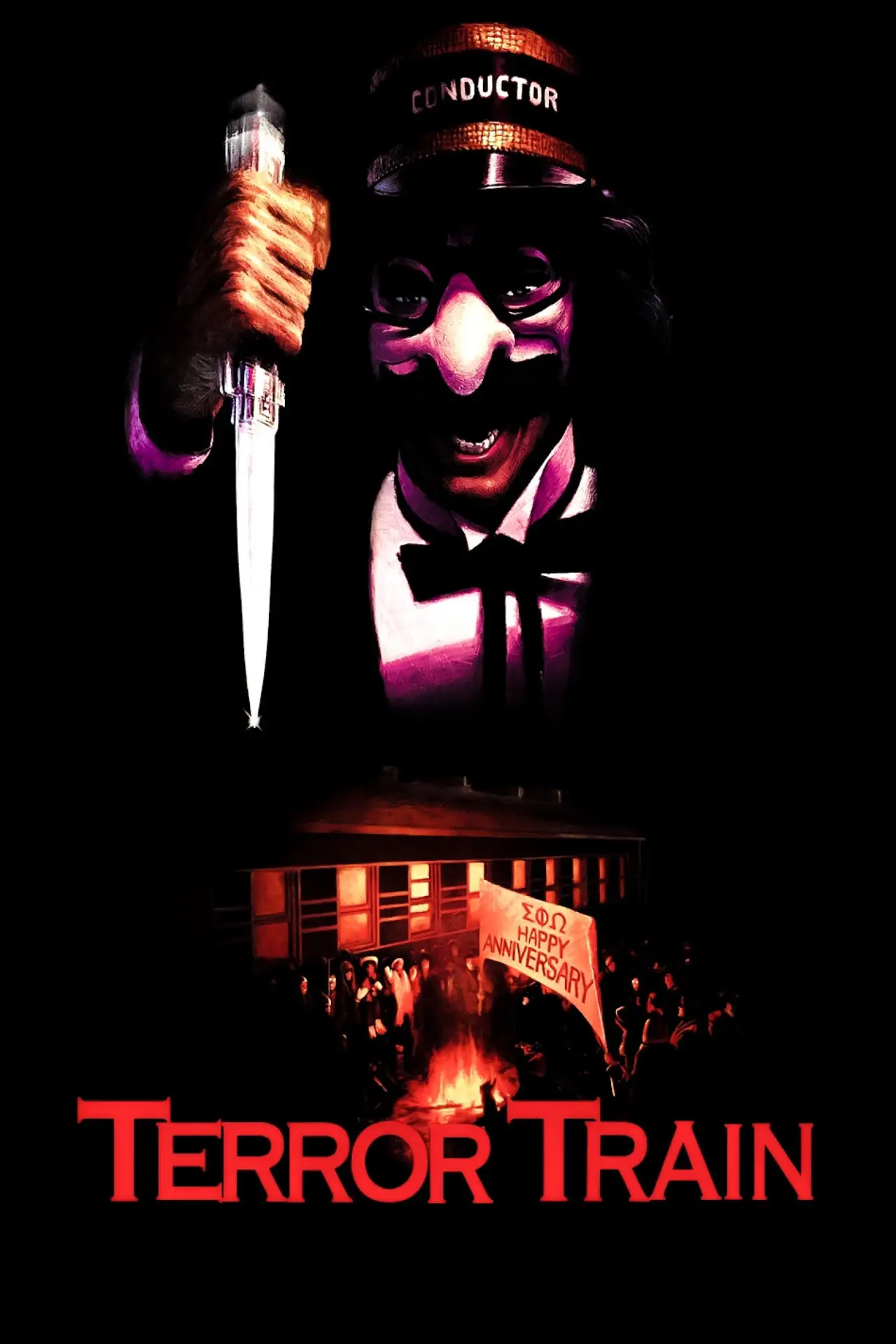
Terror Train
The boys and girls of Sigma Phi. Some will live. Some will die.




Country
Budget
$3 500 000
Box office
$0
Director
Actors
Ben Johnson, Jamie Lee Curtis, Hart Bochner, Sandee Currie, Timothy Webber, Derek McKinnon, Anthony Sherwood, Joy Boushel, Vanity, Steve Michaels
All actors and roles (10)
All actors and roles (10)
Scenario
T.Y. Drake
Producer
Harold Greenberg, Daniel Grodnik, Lamar Card
Camera operator
Composer
John Mills-Cockell
Artist
Glenn Bydwell
Audition
Ingrid Fischer, Anna St. Johns
Editing
Anne Henderson
Whole Team (20)
Whole Team (20)
Short description
A masked killer targets six college kids responsible for a prank gone wrong three years earlier and who are currently throwing a large New Year's Eve costume party aboard a moving train.
What's left behind the scenes
- David Copperfield had so much trouble delivering his lines, and it irritated him so much, that he vowed never to act in films again.
- Cinematographer John Alcott devised a unique lighting setup. He ran lighting throughout the train and installed individual dimmers inside the cars. By using bulbs of various wattages and controlling them via external dimmers, he was able to light the entire set very quickly. Occasionally, he also used handheld flashlights to illuminate the actors' faces.
- The steam engine smoke was the result of burning coal and church incense.
- The very last scene filmed was the bonfire at the college, which opens the movie. It was added during post-production about a month after filming ended to tie in with the character Kenny, played by Derek McInniston.
- Most of the filming on the train had to be done at night because during the day the hangar-warehouse was teeming with people and very noisy. Filming began at 6 p.m. and ended early the next morning.
- The idea for the film "Terror Train" came to screenwriter Daniel Grodnik in a dream. After watching John Carpenter's "Halloween" (1978) and Arthur Hiller's (1923-2016) "Silver Streak" (1976), he asked his wife in the middle of the night: "What if we staged Halloween on a train? How does that sound?" She replied, "Horrible," and he wrote "Horrible Train" on a piece of paper. The next morning he changed the title of the future film to "Terror Train," wrote 22 pages of the script, and by 3 p.m. had made a deal with Sandy Howard's (1927-2008) production company.
- The very last scene filmed was the bonfire scene that opens the movie. It was added during post-production, about a month after principal photography wrapped, to tie in with the character of Kenny, played by Derek McKinnon.
- In the final fight scene, Jamie Lee Curtis's character was fighting off a stuntman playing the villain. At one point, she slams a door right in the attacker's face. The door was supposed to be designed to collapse at the slightest impact, but for some reason, this was forgotten, and the actress's partner suffered a facial injury. The actress was so upset that she left the set and did not appear for two days.
- The idea for the movie 'Terror Train' came to screenwriter Daniel Grodnik in a dream. Sometime after watching John Carpenter's 'Halloween' (1978) and Arthur Hiller's 'Silver Streak' (1976), he asked his wife in the middle of the night, 'What if we did Halloween on a train? What do you think of that idea?' She replied, 'Terrible,' and he wrote 'Terrible Train' on a piece of paper. In the morning, he changed the title of the future film to 'Terror Train,' wrote 22 pages of the script, and by 3 p.m. had already closed a deal with Sandy Howard's production company.
- The film was shot on board a real train in specially converted cars (they had to be converted to accommodate staff and equipment). To create the effect of movement, the train traveled back and forth inside a huge hangar-warehouse in Montreal.
- During the final fight scene, the heroine, played by Jamie Lee Curtis, defended herself against a stuntman portraying the villain attacking her. At one point, she slammed the door shut right in the attacker's face. The door was supposed to fall apart with the slightest impact, but for some reason, that wasn't done, and the actress's partner suffered an injury to the facial area. The actress was so upset that she left the set and didn't appear on set for two days.
- Cinematographer John Alcott (1930-1986) devised a unique lighting scheme. He ran lighting throughout the entire train and installed individual dimmers inside the cars. By using bulbs of varying wattage and controlling them via external dimmers, he was able to quickly illuminate the entire set. He also sometimes used handheld flashlights to light the actors' faces.
- David Copperfield had such significant problems delivering his lines, and it frustrated him so much, that he vowed never to act in movies again.
Similar movies
8.5/10
8.3/10
7.4/10
7.2/10
7.1/10
7.1/10
7/10
6.9/10
6.9/10
6.8/10


 Auditions in India
 Casting calls in USA
 Castingi w Polsce
 Кастинги в Україні
