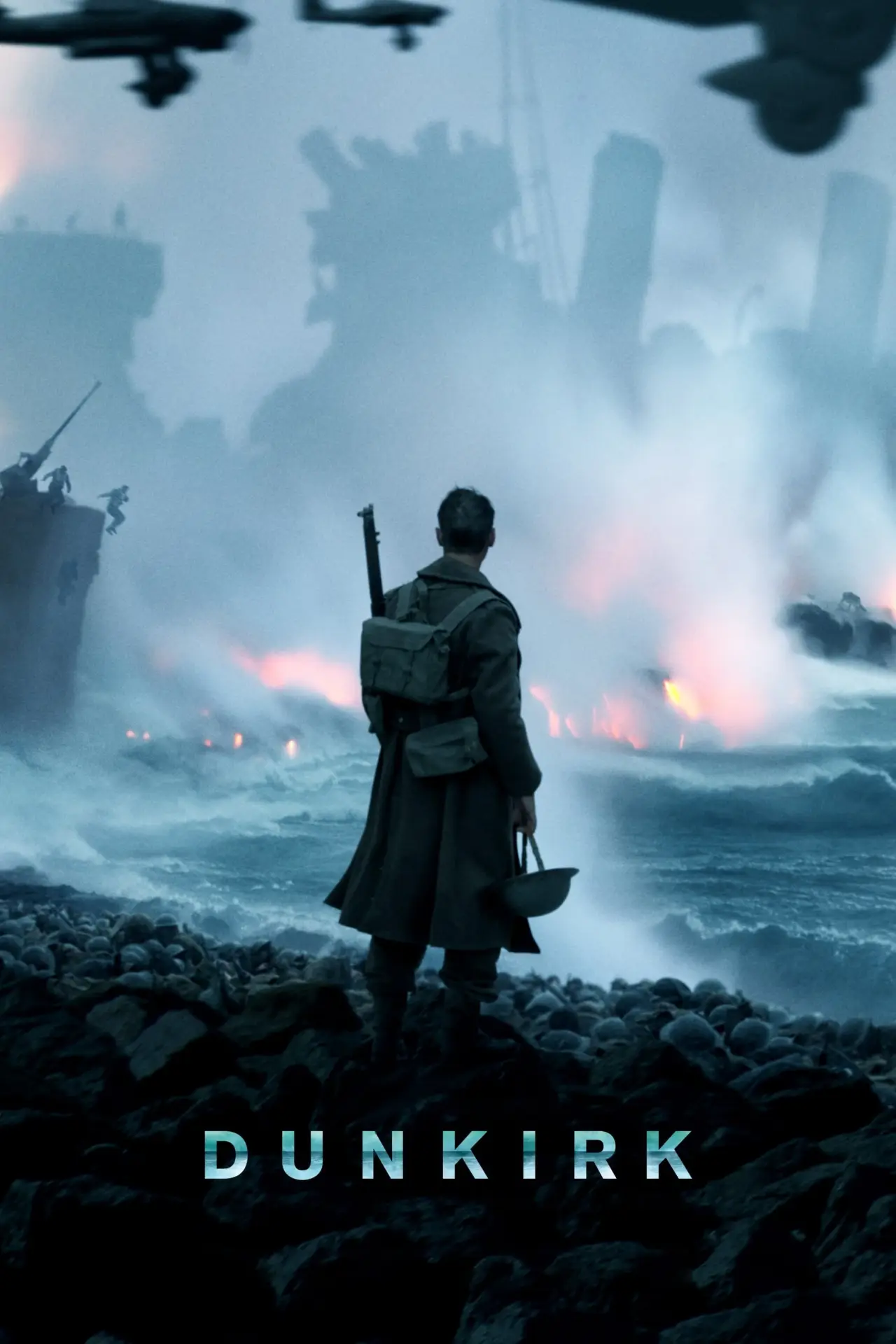
Dunkirk
When 400,000 men couldn't get home, home came for them.



![Video for the film Dunkirk — Dunkirk - Trailer 1 [HD]](https://i.ytimg.com/vi/F-eMt3SrfFU/maxresdefault.jpg)
Country
Production
Budget
$100 000 000
Box office
$549 084 745
Website
Director
Actors
Scenario
Producer
Christopher Nolan, Emma Thomas, Jake Myers, Greg Silverman
Camera operator
Composer
Artist
Nathan Crowley, Jenne Lee
Audition
John Papsidera, Toby Whale
Editing
Short description
The story of the miraculous evacuation of Allied soldiers from Belgium, Britain, Canada and France, who were cut off and surrounded by the German army from the beaches and harbour of Dunkirk between May 26th and June 4th 1940 during World War II.
What's left behind the scenes
- This is Christopher Nolan's first film based on historical events. Until now, he had only filmed original screenplays, remakes, and adaptations of novels and comics.
- While filming took place on the artificial freshwater lake of IJsselmeer in the central Netherlands, the actors and film crew stayed in Urk, a village and municipality in the province of Flevoland.
- To avoid using computer graphics, the props department prepared cardboard cutouts of soldiers and vehicles, which were placed as far from the camera as possible but effectively enhanced the impression of the vast size of the Allied troops trapped.
- The cinematic debut of Harry Styles from the boy band One Direction.
- A bodyguard was constantly on set to protect Harry Styles from fans if necessary.
- Striving for maximum authenticity, Christopher Nolan installed cameras in the cockpits and on the wings of fighter planes and sent operators into the water with the actors.
- Nearly 6,000 extras participated in the filming.
- Radio-controlled models were used instead of real Junkers Ju 87 dive bombers and Heinkel He 111 bombers, as was done for other aircraft in scenes depicting their fall/ditching.
- Christopher Nolan's first blockbuster filmed for under $100 million. According to producer Emma Thomas, they deliberately limited the budget, understanding the experimental nature of the film's script, which consisted almost entirely of one action sequence and featured very little dialogue for the characters.
- Christopher Nolan decided to use real destroyers in the naval battle scene rather than resorting to computer graphics.
- During the evacuation episode, 333,000 soldiers from the Allied armies were depicted using 1,500 extras, a crane, and a flamethrower.
- In some scenes of the film, two fishing trawlers preserved from that time – UK12 and UK114 – are visible in the background. In this case, the letters do not signify Great Britain, as one might assume. It is a Dutch letter code denoting Urk, a village near which the filming took place.
- To film the aerial combat scenes, an IMAX camera was installed in the cockpit of one of the three Spitfire aircraft used in the film, which was not easy considering its weight and size.
- Following Paul Thomas Anderson’s “The Master” (2012) and Quentin Tarantino’s western “The Hateful Eight” (2015), “Dunkirk” is the third major cinematic project of the decade shot primarily on 70mm film and shown in the same format.
- This is Christopher Nolan’s third film for which he wrote the screenplay himself, following “Following” (1999) and “Inception” (2010).
- Christopher Nolan received $20 million plus 20% of the box office receipts for his work on the film. This is the largest sum ever paid to a director. Peter Jackson was the first to receive such an amount for “King Kong” (2005).
- The film was shot in France under the working title “Bodega Bay” (Bodega is a Pacific bay on the coast of California, USA, where the town of Bodega Bay is located).
- Hans Zimmer (composer), Hoyte van Hoytema (cinematographer), Nathan Crowley (production designer), John Papsidera (casting director), and actors Tom Hardy and Cillian Murphy all worked with Christopher Nolan again on “Dunkirk.” Many members of the film crew had been continuously working with Nolan since the “Dark Knight” trilogy (2005, 2008, 2012), and Hoytema since “Interstellar” (2014).
- The dialogue in the film is minimized. While preparing for filming, Christopher Nolan rewatched a large number of silent films to understand how the classics of cinema depicted mass scenes—specifically, Erich von Stroheim’s "Greed" (1924), D.W. Griffith’s "Intolerance" (1916), and F.W. Murnau’s "Sunrise" (1927).
- A Soviet two-seat sports and training aircraft, the Yak-52, was used as the Spitfire fighter. It was modified so that the actor and pilot could switch places depending on the scene being filmed.
- The prototype for Mark Rylance’s character (the yacht captain) was likely Charles Lightoller (1874-1952), best known as the second officer of the Titanic. During Operation Dynamo, Lightoller, along with his son and a cabin boy, went to Dunkirk on his yacht and evacuated 130 people. One of Lightoller’s five children was also a pilot, and he died on the first day of the war; the elder son of Rylance’s character has a similar fate.
- Christopher Nolan's first film based on historical events. Until now, he had filmed exclusively from original scripts, remakes, and adaptations of novels and comics.
- Following Paul Thomas Anderson's drama 'The Master' (2012) and Quentin Tarantino's western 'The Hateful Eight' (2015), 'Dunkirk' is the third major cinematic project of the decade shot primarily on 70mm film and exhibited in the same format.
- Christopher Nolan's third film for which he wrote the screenplay himself, following 'Following' (1999) and 'Inception' (2010).
- Christopher Nolan received $20 million plus 20% of the box office receipts for his work on the film. This is the most significant amount ever paid to a director. Peter Jackson was the first to receive such a sum for the film 'King Kong' (2005).
- Harry Styles' bodyguard was constantly on duty on set to shield him from female fans if necessary.
- For the film 'Dunkirk', Christopher Nolan once again worked with Hans Zimmer (composer), Hoyte van Hoytema (cinematographer), Nathan Crowley (production designer), John Papsidera (casting director), as well as actors Tom Hardy and Cillian Murphy. Many crew members have worked continuously with Nolan since 'The Dark Knight' trilogy (2005, 2008, 2012), and Hoytema since the film 'Interstellar' (2014).
- Dialogue in the film is kept to a minimum. While preparing for the shoot, Christopher Nolan revisited a vast number of silent films to understand how cinema classics depicted mass scenes—specifically, Erich von Stroheim's 'Greed' (1924), D.W. Griffith's 'Intolerance' (1916), and F.W. Murnau's 'Sunrise' (1927).
- Striving for the greatest possible authenticity, Christopher Nolan mounted cameras on the cockpits and wings of fighter jets and sent camera operators into the water along with the actors.
- Christopher Nolan's first blockbuster, filmed for less than 100 million dollars. According to producer Emma Thomas, they intentionally limited their budget, recognizing the experimental nature of the screenplay, which consisted almost entirely of a single action and featured very few lines for the characters.
Similar movies
8.6/10
8.5/10
8.5/10
8.4/10
8.4/10
8.4/10
8.4/10
8.2/10
8.2/10
8.2/10


 Auditions in India
 Casting calls in USA
 Castingi w Polsce
 Кастинги в Україні
