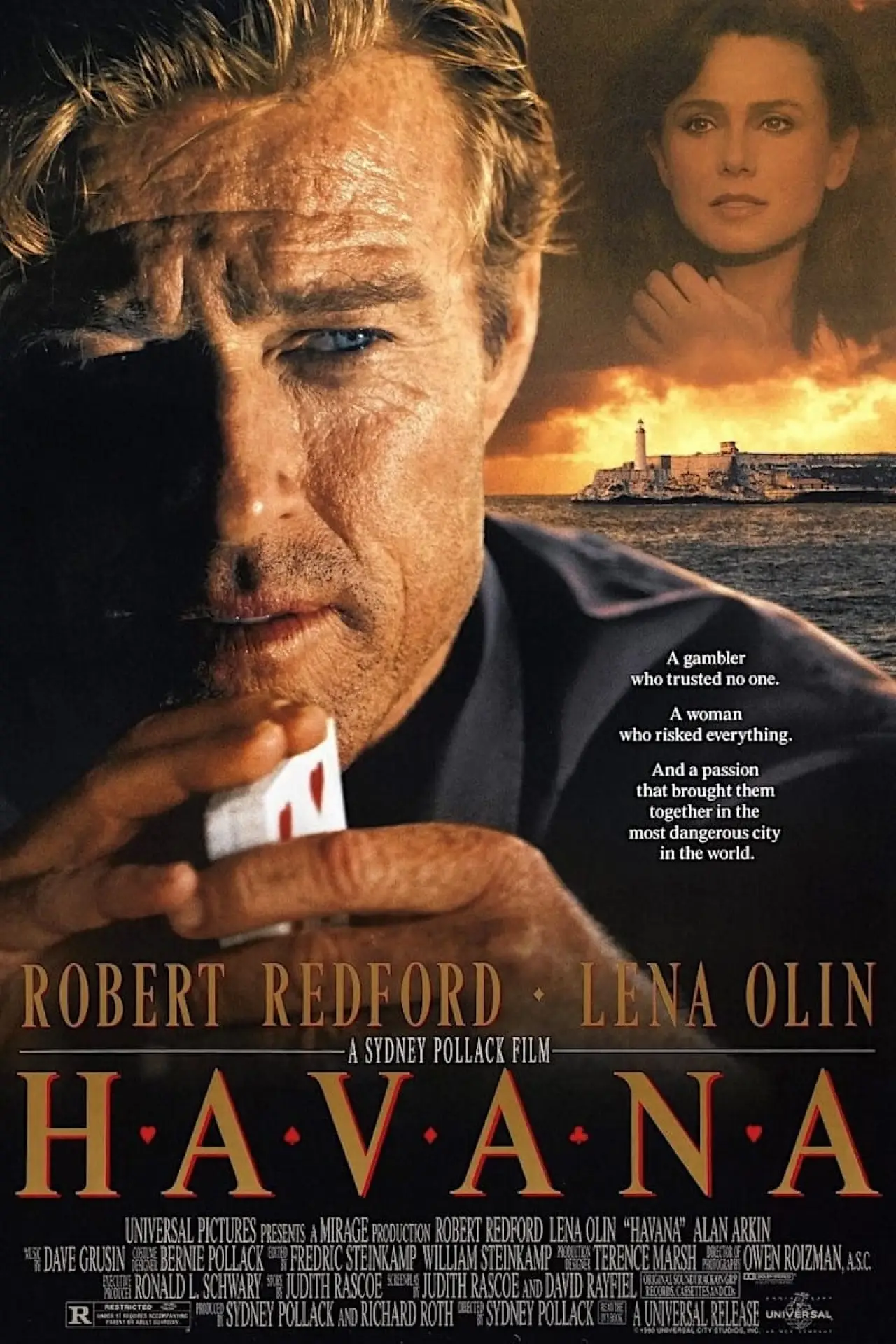
Havana
A gambler who trusted no one. A woman who risked everything. And a passion that brought them together in the most dangerous city in the world.



Country
Production
Budget
$40 000 000
Box office
$9 243 140
Director
Actors
Scenario
Producer
Richard A. Roth, Sydney Pollack, Ronald L. Schwary
Camera operator
Composer
Artist
Audition
Editing
William Steinkamp, Fredric Steinkamp
Whole Team (33)
Whole Team (33)
Short description
During the revolution, a high-stakes gambler arrives in Cuba seeking to win big in poker games. Along the way, he meets and falls in love with the wife of a Communist revolutionary.
What's left behind the scenes
- Initially, Sydney Pollack wanted to film directly in Havana, but for several reasons, this proved impossible. At that time, US citizens were legally prohibited from visiting Cuba. According to US law at the time, producers were not allowed to invest money in filming in Cuba. Official relations between Cuba and the US in 1989-1990 were extremely strained. Therefore, filming was organized in another Caribbean country—the Dominican Republic. The vegetation there was similar, and there was a certain resemblance in the architecture. The final scene was filmed in Key West, Florida.
- The original screenplay for the film was written by Judith Resnik in the mid-1970s. At that time, it was intended that Jack Nicholson and Jane Fonda would play the lead roles, but they left the project due to delays in the start of filming.
- Raúl Juliá appeared in a supporting role that was important for the plot's development. The actor had received an Oscar nomination for Best Actor for his role in Hector Babenco's drama 'Kiss of the Spider Woman' (1985), yet he was not even mentioned in the credits of 'The Havana'. The actor himself wanted his name to appear immediately after Robert Redford's, but for certain contractual reasons, this proved impossible; consequently, Juliá requested that he not be listed in the credits at all. This is why Lena Olin's name followed Redford's in the credits, followed by Alan Arkin.
- Approximately one hundred American cars and buses from the 1950s were used in the filming.
- The main filming location was a street section lined with facades of casinos, restaurants, and hotels. Interior scenes were shot in recreated interiors of casino gambling halls, hotel rooms, and cafes. Havana’s Prado Boulevard was recreated on the grounds of a former US Air Force base in the Dominican Republic. Around 300 people worked on this. Over 80 neon signs were made in the US and delivered to the Dominican Republic. It took 20 weeks to build the main filming location.
- The central plot line—featuring three main characters in which a woman must choose between her husband and his rival, with the latter saving the couple out of simple humanity at one point—was borrowed from Michael Curtiz's melodrama 'Casablanca' (1942).
- Many of the extras were political emigrants from Cuba, residing in the Dominican Republic during the film's production. According to director Sydney Pollack, the atmosphere on set was quite emotional, as the extras reminisced about the homeland they had left three decades prior.
- Around 2,000 extras and supporting actors were involved in the film, requiring between 8,000 and 10,000 costumes, as many of them changed outfits during the shooting of various scenes.
- The central plotline, featuring three main characters and a woman forced to choose between her husband and his rival – with the latter ultimately saving the couple out of simple human kindness – was borrowed from Michael Curtiz’s melodrama “Casablanca” (1942).
- The original screenplay for the film was written by Judith Rascoe in the mid-1970s. At that time, Jack Nicholson and Jane Fonda were slated to star in the film, but they left the project due to delays in the start of filming.
- Initially, Sydney Pollack wanted to film directly in Havana, but this proved impossible for several reasons. At that time, it was illegal for US citizens to legally visit Cuba. According to then-current US law, producers were not allowed to invest money in filming in Cuba. Official relations between Cuba and the United States were extremely strained in 1989-1990. Therefore, filming was organized in another Caribbean country – the Dominican Republic. The vegetation there was similar, and there was some resemblance in the architecture. The final scene was filmed in Key West, Florida.
- Raúl Juliá appeared in a supporting, but important role for the plot of the film. This actor received an 'Oscar' for Best Actor for his work in Héctor Babenco's drama 'Kiss of the Spider Woman' (1985), but he wasn't even mentioned in the credits of 'Havana'. The actor himself wanted his name to appear in the credits immediately after Robert Redford's, but for contractual reasons this was impossible, and then Juliá asked that his name not be included in the credits at all. That is why Lena Olin's name followed Redford's in the credits, followed by Alan Arkin's.
- Many of the extras were political emigrants from Cuba who were staying in the Dominican Republic while the film was being shot. According to director Sydney Pollack, the atmosphere on set was very emotional because the extras were reminiscing about the homeland they had left three decades prior.
Similar movies
8.5/10
8.4/10
8.2/10
8.1/10
8.1/10
8.1/10
8.1/10
8.1/10
7.9/10
7.9/10


 Auditions in India
 Casting calls in USA
 Castingi w Polsce
 Кастинги в Україні
