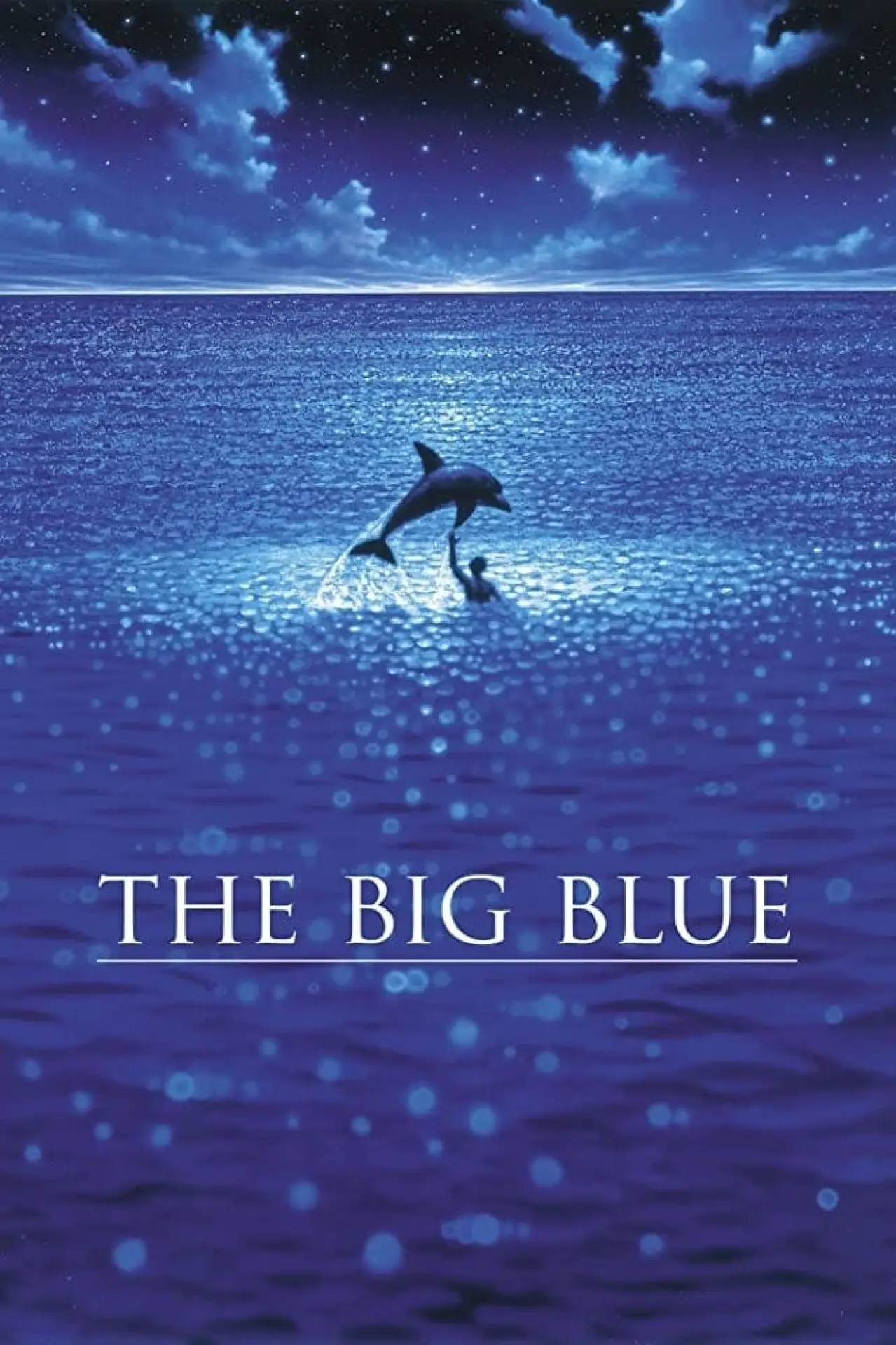
The Big Blue
Danger...Like Passion...Runs Deep




Country
Production
Budget
$80 000 000
Box office
$3 597 884
Director
Actors
Scenario
Producer
Patrice Ledoux
Camera operator
Carlo Varini
Composer
Artist
Dan Weil
Audition
Nathalie Chéron, Lissa Pillu, Celestia Fox
Editing
Olivier Mauffroy
Whole Team (25)
Whole Team (25)
Short description
Childhood friends Jacques and Enzo share a passion for the danger of free diving. Jacques, following in the footsteps of his father, who died at sea when Jacques was a boy, harbors a remarkable ability to adjust his heart rate and breathing patterns in the water, with his vital signs more closely resembling those of dolphins than men.
What's left behind the scenes
- Jacques Mayol worked closely with the filmmakers, acting as a technical consultant.
- Director Luc Besson appears in a cameo as one of the divers.
- The film is dedicated to Luc Besson's daughter, who became seriously ill while he was working on the movie.
- Luc Besson wanted to showcase the entire beauty of freediving in his film, and the most spectacular element of freediving is the dive itself. He asked Enzo Maiorca, the great diver who consulted him during filming, which fins were the most beautiful in his opinion; Maiorca replied that there wasn't much of a choice. At that time, the most beautiful fins were also the best. These were the first detachable fins with a long, effective blade featuring longitudinal grooves that kept the water flow on the blade during the stroke. To this day, these fins—the Elit model by Hugues Dessault—remain the most recognizable in the world.
- "The Big Blue" became one of the most successful French films of the 80s. The film's theatrical run lasted a whole year, and during that time it was seen by 9.2 million French viewers.
- The role in the film was the last for renowned American actor Paul Shenar. He died of AIDS at the age of 53 on October 11, 1989.
- Luc Besson struggled for a long time to find the ideal actor for the role of Jacques Mayol. His initial choice was Christopher Lambert, who preferred to star in Michael Cimino's crime drama “The Sicilian” (1987). Next on the list was Mickey Rourke, who declined the offer due to a fear of deep-sea diving. Gérard Lanvin and Mel Gibson also turned down the role. Ultimately, the key role went to Jean-Marc Barr, who was completely unknown at the time.
- The original French version had a runtime of 132 minutes. The initial American version was 119 minutes long and received a “PG-13” rating. After re-editing, it was reduced to 118 minutes, achieving an even milder “PG” rating. The version shown in other European countries was also 118 minutes long. The most complete director’s cut ran 168 minutes and received a strict “R” rating in the US.
- Jacques Mayol worked closely with the filmmakers, serving as a technical consultant.
- Luc Besson wanted to show the beauty of freediving in his film. And the most spectacular element of freediving is the dive itself. He asked the great diver Enzo Maiorca, who was consulting on the film, which fins he considered the most beautiful, and Maiorca replied that the choice was actually limited. At that time, the most beautiful fins were also the best. These were the first detachable fins with a long, effective blade featuring longitudinal channels that kept the water flow on the blade during the stroke. To this day, these fins are the most recognizable in the world – the Elit model from Hugue Dessault.
- Underwater scenes with dolphins were filmed in the Virgin Islands. The dolphins themselves were flown in from a dolphinarium located on Grassy Key off the coast of Florida.
- The majority of the film's shooting took place in the Cyclades archipelago in Greece (Amorgos Island).
- The film is dedicated to Luc Besson's daughter, who became seriously ill during his work on the film.
- Underwater filming with dolphins was done in the Virgin Islands. The dolphins themselves were flown in from a dolphinarium located on Grassi Key off the coast of Florida.
- For the American theatrical release, the film underwent significant re-editing. The finale was completely changed, and Eric Serra's soundtrack, which had received critical acclaim, was replaced with a version specifically written for the US release by Bill Conti.
- The film was based on the real rivalry and friendship between record-breaking divers, Frenchman Jacques Mayol (1927-2001) and Italian Enzo Maiorca (1931-2016). The latter received a slightly altered name, Enzo Molinari, in the film. Unlike the film, they were four years apart in age and never competed face to face.
- The film was the final role for renowned American actor Paul Shenar. He died of AIDS on October 11, 1989, at the age of 53.
- The underwater filming proved particularly grueling – fifteen dives each day. All scenes were filmed without the use of stunt doubles.
- The majority of the film was shot in the Cyclades archipelago in Greece (Amorgos island).
- The film was based on the real-life rivalry and friendship between record-breaking divers Jacques Mayol (1927–2001) of France and Enzo Maiorca (1931–2016) of Italy. In the film, the latter was given the slightly altered name Enzo Molinaras. Unlike in the movie, there was a four-year age difference between them, and they never competed head-to-head.
- One of the underwater cinematographers was Luc Besson himself.
- Luc Besson himself is one of the underwater cinematographers.
- For the American theatrical release, the film underwent significant re-editing. Its ending was completely changed, and Eric Serra’s critically acclaimed soundtrack was replaced with a version by Bill Conti specifically written for the American release.
- Director Luc Besson makes a cameo appearance as one of the divers.
- Luc Besson struggled for a long time to find the perfect actor for the role of Jacques Mayol. His initial choice was Christopher Lambert, who preferred to star in Michael Cimino's crime drama 'The Sicilian' (1987). Next on the list was Mickey Rourke, who turned down the offer due to a fear of deep-sea diving. Gérard Lavennec and Mel Gibson also declined. Ultimately, the lead role went to Jean-Marc Barr, who was completely unknown at the time.
Similar movies
8.5/10
8.4/10
8.1/10
8.1/10
8.1/10
8.1/10
8.1/10
8/10
8/10
7.9/10


 Auditions in India
 Casting calls in USA
 Castingi w Polsce
 Кастинги в Україні
