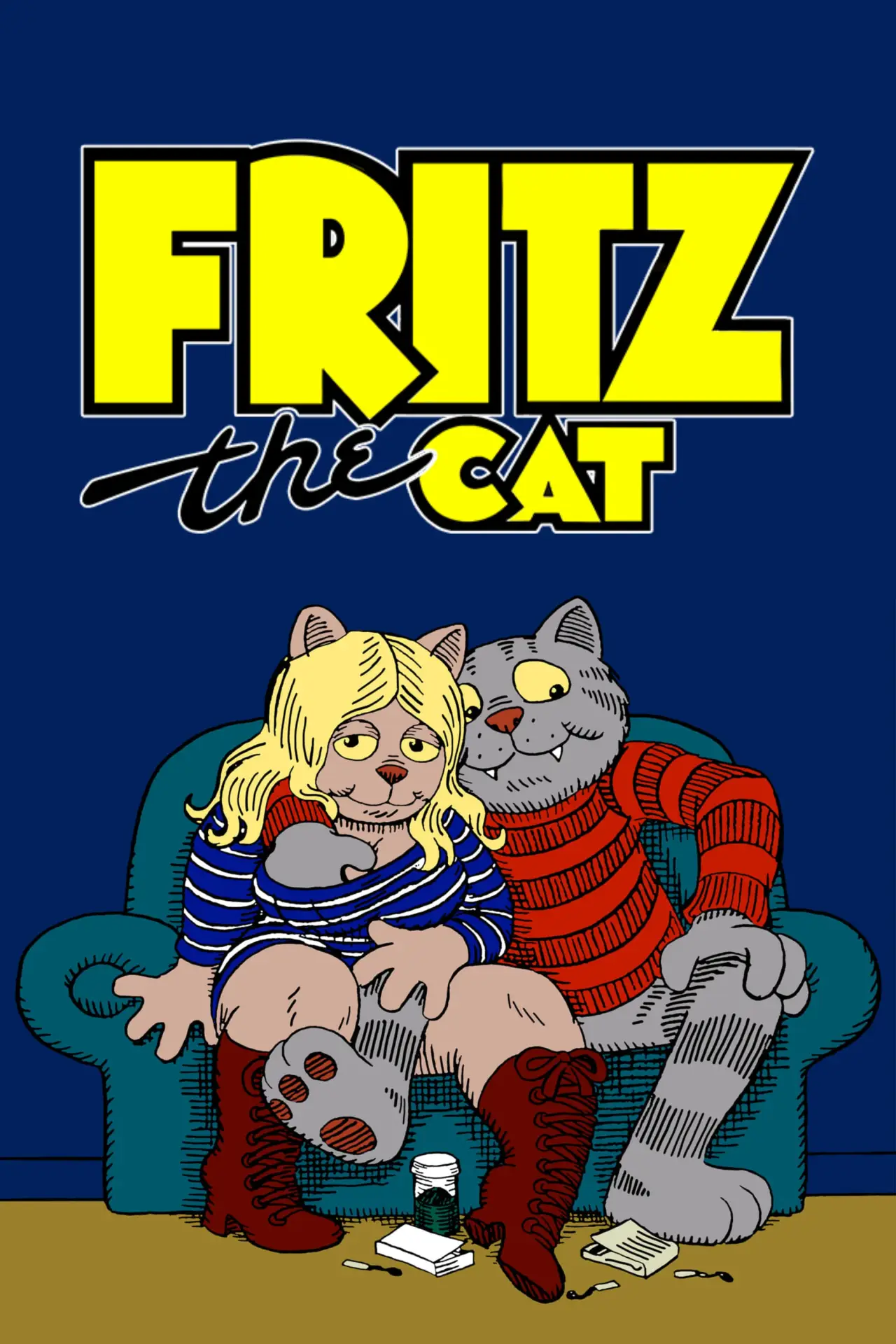
Fritz the Cat
We're not rated X for nothin', baby!




Country
Production
Budget
$850 000
Box office
$25 000 000
Director
Actors
Skip Hinnant, Rosetta LeNoire, John McCurry, Phil Seuling, Judy Engles, Ralph Bakshi, Mary Dean, Charles Spidar
All actors and roles (8)
All actors and roles (8)
Scenario
Producer
Steve Krantz, Jay Fukuto
Camera operator
Ted C. Bemiller
Composer
Ed Bogas
Artist
Edwin Aardal, Dick Lundy, Ted Bonnicksen
Audition
Editing
Renn Reynolds
Whole Team (56)
Whole Team (56)
Short description
In late 1960s New York City, fed up with monotonous college life and police repression, free-spirited Fritz, an impenitent seducer and unrestrained party-animal, decides to explore the world. And just like that, as he flees NYC, heading to San Francisco, Fritz embarks on an endless adventure of illumination. Immersed in a world surrounded by drugs and sex, Fritz participates in mad orgies, brings about a revolution, incites mass urban riots, and crosses paths with drug-addled Nazi bikers.
What's left behind the scenes
- Due to a modest budget, the entire animated film was created without so-called pencil tests (early versions of animated scenes consisting of sketches that are photographed or scanned; such tests are necessary for animators to see how their work looks in motion before passing the drawings to the cleanup and coloring stage). Ralph Bakshi had to judge the animation timing by manually flipping through the sketches and roughs created by the animators.
- To create backgrounds in the style of the film's screenwriter, Robert Crumb, animator Ira Turek used a technical pen. This is a professional tool for precise drafting and graphics, which was Crumb's preferred choice.
- According to director and screenwriter Ralph Bakshi, when he first met producer Steve Krantz, he told him about his plans to open a film studio dedicated to producing adult animated films. Bakshi intended to make 'Hard Way' as his first feature film. Krantz noted that Bakshi would have a better chance of securing funding if the project were an adaptation of adventures featuring pre-existing characters (and, consequently, belonged to an author according to copyright law). Thus, both arrived at the idea of adapting the story of Fritz the Cat, created by Robert Crumb. Bakshi said that he initially did not want to direct this film because he had spent many years working on animated series featuring animal characters and wanted to make a feature film with humans.
- According to director and screenwriter Ralph Bakshi, shortly after launch, the project lost two animators. One had no animation experience at all and wanted to draw exclusively obscene images, so he was fired. The second had some experience but was ashamed to tell his family that he made a living drawing for children, so he resigned.
- According to director and screenwriter Ralph Bakshi, when meeting producer Steve Krantz, he told him about his plans to open a film studio dedicated to producing adult animated films. Bakshi intended to make 'Hard Way' as his first feature film. Krantz noted that Bakshi would have a better chance of securing funding for the project if it were an adaptation of the adventures of characters already created by someone else (and thus belonging to the author according to copyright law). This led them both to the idea of adapting the story of Fritz the Cat, created by Robert Crumb. Bakshi stated that he initially did not want to direct this film because he had spent many years working on animated series featuring animals, and he wanted to make a live-action film with people.
- According to director and screenwriter Ralph Bakshi, the project lost two animators shortly after launch. One had no animation experience at all and wanted exclusively to draw obscene pictures, so he was fired. The second had some experience, but he was too embarrassed to tell his family that he made a living drawing for children and quit on his own.
- To film a scene in a Harlem bar, director and screenwriter Ralph Bakshi went to a park in Washington. There, he found several Black activists, invited them to the studio, and let them say whatever they liked. He recorded their speeches, processed them, and edited them into lines for the film.
- To create backgrounds in the style of the film's screenwriter Robert Crumb, animator Ira Turek used a technical pen. This is a professional tool for precision drafting and graphics, which was preferred by Crumb.
- Due to a modest budget, the entire animated film was created without so-called pencil tests (an early version of an animated scene consisting of sketches that are photographed or scanned; such tests are necessary for animators to see how their work looks in motion before the drawings move to the clean-up and coloring stage). Ralph Bakshi had to judge the animation timing by manually flipping through the sketches and drafts created by the animators.
- Initially, the sponsor and future distributor of the cartoon was Warner Bros. When director and screenwriter Ralph Bakshi and producer Steve Krantz showed a specially edited clip to the studio executives, the management was horrified and demanded that movie stars be hired for the voice acting and that the explicit scenes involving Fritz and Bertha (voiced by Rosetta LeNoir) be cut. Bakshi responded with a categorical refusal, and Warner Bros. withdrew from the project.
- The cartoon contains satire on the works of Walt Disney. When American planes drop napalm on a predominantly Black neighborhood during a riot, silhouettes of a joyful Mickey Mouse, Minnie Mouse, and Donald Duck are shown on screen. In another episode, Fritz imagines a pink feline creature flying into his bedroom, which is a reference to the 'Pink Elephants on Parade' scene from the feature film 'Dumbo' (1941).
- The cartoon contains satire of Walt Disney's work. When American planes drop napalm on a predominantly Black neighborhood during a riot, the silhouettes of a joyful Mickey Mouse, Minnie Mouse, and Donald Duck are shown on screen. In another episode, Fritz imagines a pink feline flying into his bedroom, which is a reference to the 'Pink Elephants on Parade' scene from the feature-length animated film 'Dumbo' (1941).
- Initially, the sponsor and future distributor of the animated film was Warner Bros. When director and screenwriter Ralph Bakshi and producer Steve Krantz showed a specially edited clip to the studio executives, the management was horrified and demanded that movie stars be hired for the voice acting and that the explicit scenes featuring Fritz and Bertha (voiced by Rosetta LeNoir) be cut. Bakshi responded with a categorical refusal, and Warner Bros. withdrew from the project.
- To film a scene in a Harlem bar, director and screenwriter Ralph Bakshi went to a park in Washington. There, he found several Black activists, invited them to the studio, and let them say whatever they pleased. He recorded their speeches, processed them, and edited them into lines for the film.
Similar movies
8.1/10
7.8/10
7.7/10
7.7/10

7.5/10
7.4/10
7.3/10
7.2/10
7.2/10
7.2/10


 Auditions in India
 Casting calls in USA
 Castingi w Polsce
 Кастинги в Україні
