Suspicion
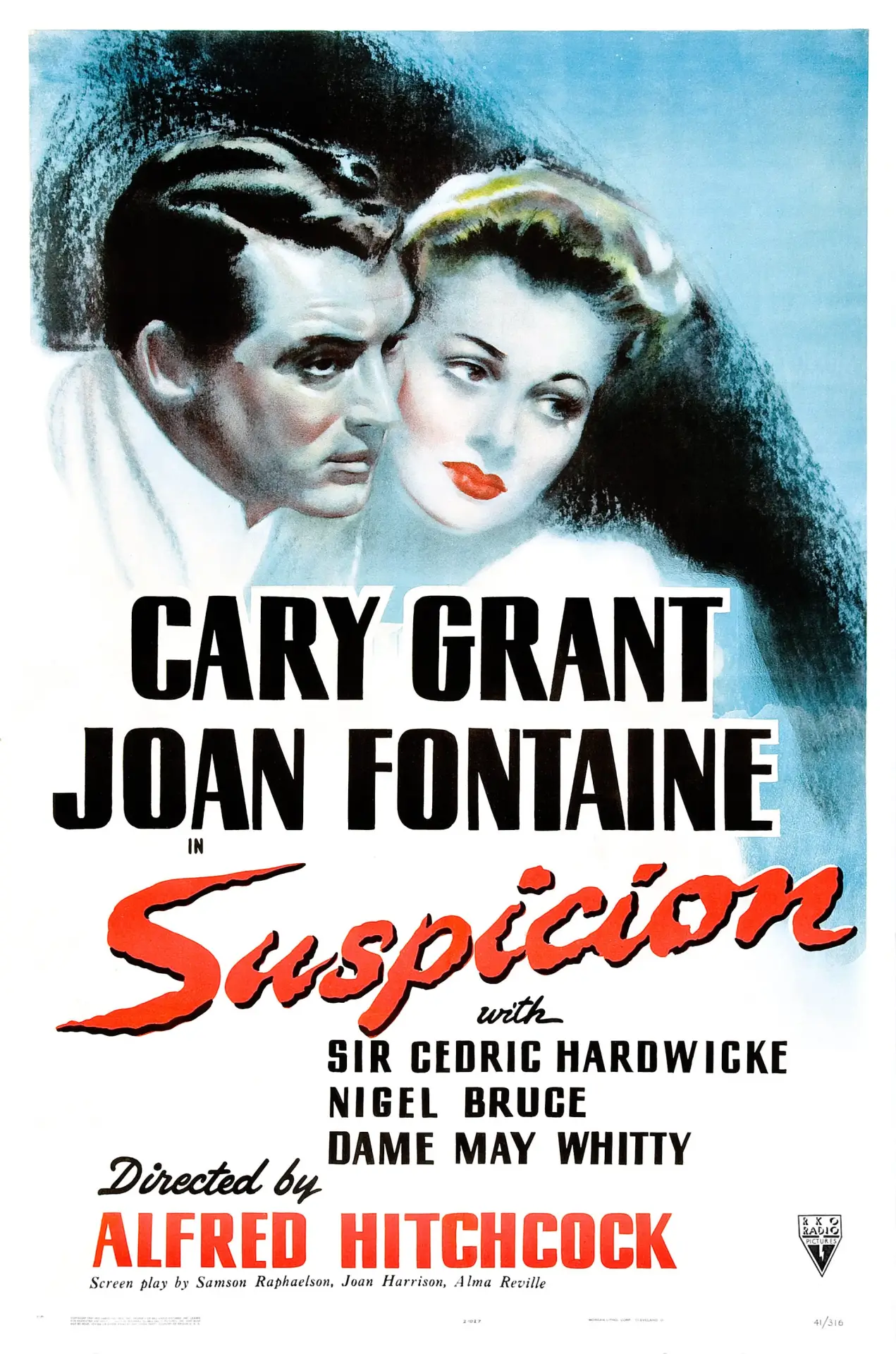
In his arms she felt safety...in his absence, haunting dread!



Country
Production
Budget
$1 800 000
Box office
$4 500 000
Director
Actors
Scenario
Producer
Harry E. Edington
Camera operator
Composer
Artist
Audition
Editing
Short description
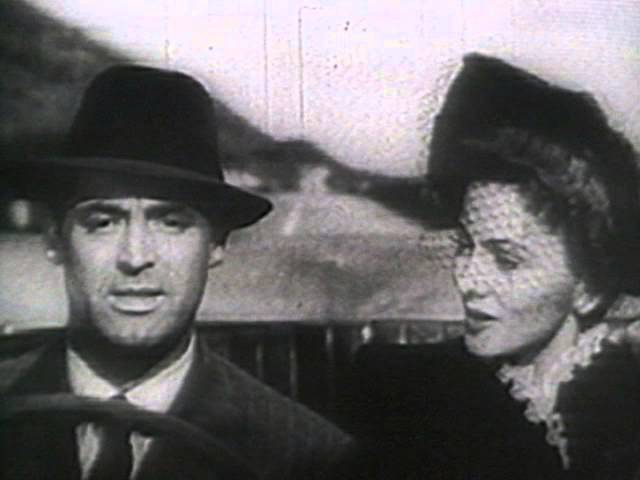
A sheltered heiress falls for a charming playboy and elopes with him, but soon discovers his gambling vice and mounting debts. As his lies deepen and those around them meet mysterious ends, she begins to suspect that her husband’s affection may conceal a deadly motive—and that she could be his next victim.
What's left behind the scenes
- Hitchcock can be seen mid-film – he is throwing a letter into a rural mailbox.
- The film features a famous scene – when the protagonist climbs the stairs in the dark, carrying a glass of milk for his wife – and in complete darkness, the glass literally glows, drawing the viewers' attention. Hitchcock achieved this effect by placing a light source inside the glass.
- Joan Fontaine (1917-2013) was so captivated by Lina from the 1932 novel by Anthony Berkeley (1893-1971), writing under the pseudonym Francis Iles, that after reading the novel she wrote to Hitchcock stating she was willing to play the role even without a fee if he ever decided to adapt it for the screen.
- The film features a famous scene where the protagonist walks up the stairs in the dark, carrying a glass of milk for his wife; in the total darkness, the glass literally glows, drawing the viewers' attention. Hitchcock achieved this effect by placing a light source inside the glass.
- The film features a famous scene where the main character climbs the stairs in the dark carrying a glass of milk for his wife, and in complete darkness, the glass literally glows, drawing the viewers’ attention. Hitchcock achieved this effect by placing a light source inside the glass.
- Joan Fontaine (1917-2013) liked the character of Lina from the 1932 novel by Anthony Berkeley (1893-1971), writing under the pseudonym Francis Iles, so much that after reading the book, she wrote to Hitchcock saying she was ready to play the role even without a fee if he ever undertook a screen adaptation.
- Subsequently, director Alfred Hitchcock (1899-1980) recounted in numerous interviews that a high-ranking employee of "RKO Pictures" ordered the removal of all scenes from the film in which the character Cary Grant (1904-1986) appeared menacing. Once all such scenes were cut, it turned out that the film's duration was reduced to 55 minutes. They had to be restored to the film, because, according to Hitchcock himself, he shot all parts of the film in such a way that it could only be normally assembled in one way. This shooting technique was called "in-camera editing" (instead of editing the footage sequentially after shooting, the director or cinematographer shoots sequences in strict order), and Hitchcock used it while working on the thriller "Rebecca" (1940) to prevent producer David O. Selznick (1902-1965) from interfering with the film's editing process.
- Hitchcock can be seen mid-film – he is dropping a letter into a rural mailbox.
- Hitchcock can be seen in the middle of the film—he is dropping a letter into a rural mailbox.
- Hitchcock's original idea was that Johnny was guilty, but the studio insisted that the audience wouldn't accept Cary Grant in the role of a murderer. In the original ending, Johnny kills Lynn by poisoning her milk, but gives himself away by sending a letter she had written.
- Director Alfred Hitchcock (1899-1980) later recounted in numerous interviews that a high-ranking executive at RKO Pictures ordered all scenes in which Cary Grant's (1904-1986) character looked menacing to be cut from the film. Once these scenes were removed, it turned out that the film's duration had been reduced to 55 minutes. They had to be restored because, according to Hitchcock himself, he had filmed all parts of the movie in such a way that they could only be edited together in one specific way. This filming technique was called 'in-camera editing' (instead of editing the footage sequentially after filming, the director or cinematographer shoots the sequences in a strict order), and Hitchcock employed it while working on the thriller 'Rebecca' (1940) to prevent producer David O. Selznick (1902-1965) from interfering in the editing process.
Similar movies
8.1/10
8/10
7.8/10
7.7/10
7.7/10
7.4/10
7.4/10
7.3/10
7.2/10
7.2/10


 Auditions in India
 Casting calls in USA
 Castingi w Polsce
 Кастинги в Україні
