King Kong
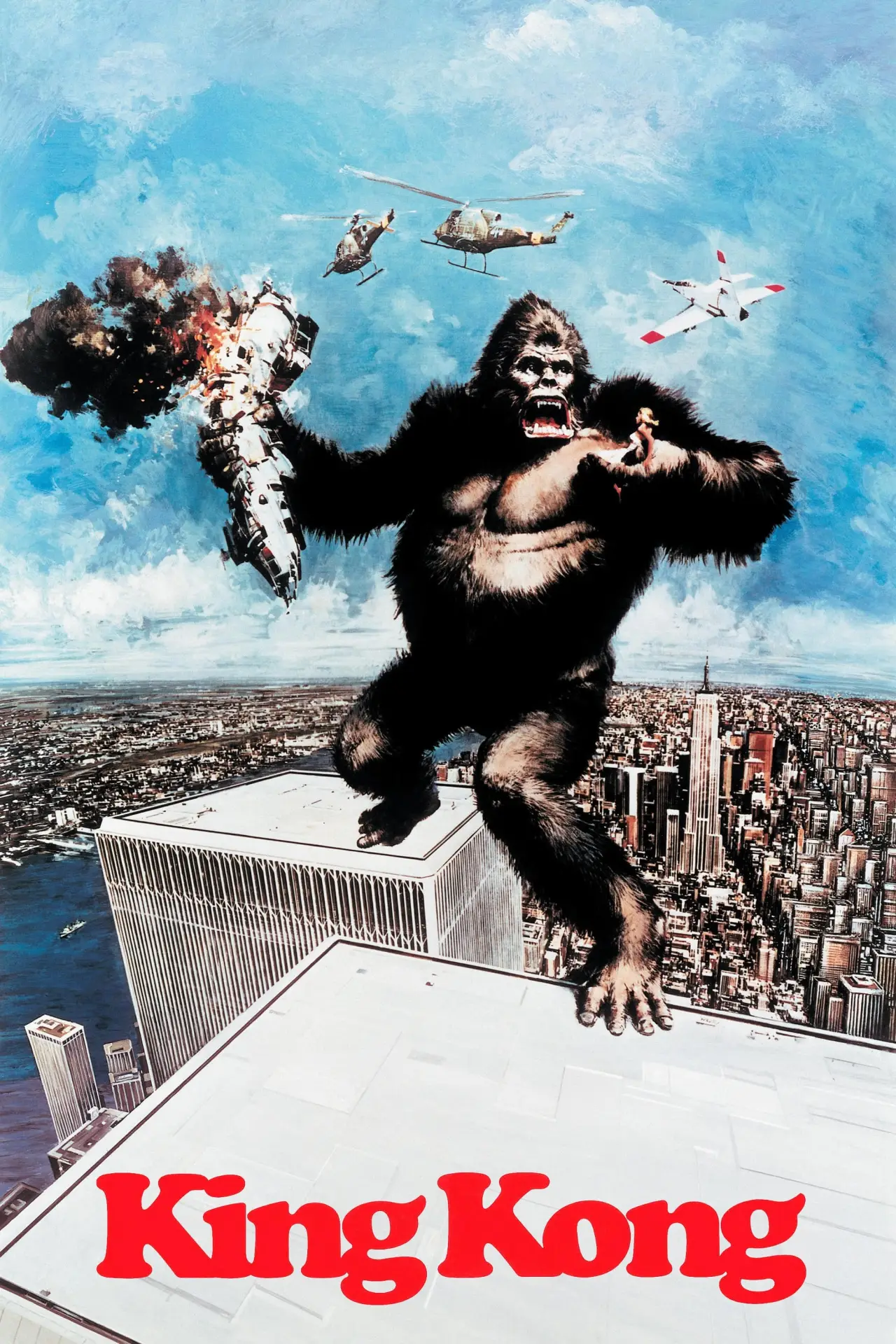
The most exciting original motion picture event of all time.




Country
Production
Budget
$24 000 000
Box office
$52 614 445
Director
Actors
Jeff Bridges, Jessica Lange, Charles Grodin, John Randolph, René Auberjonois, Julius Harris, Jack O'Halloran, Ed Lauter, John Agar, Jorge Moreno
All actors and roles (10)
All actors and roles (10)
Scenario
Producer
Dino De Laurentiis, Christian Ferry, Federico De Laurentiis
Camera operator
Composer
Artist
Dale Hennesy, Mario Chiari
Audition
Joyce Selznick
Editing
Ralph E. Winters
Whole Team (62)
Whole Team (62)
Short description
An oil company expedition disturbs the peace of a giant ape and brings him back to New York to exploit him.
What's left behind the scenes
- Producer Dino De Laurentiis had only two requirements for the creation of the remake: that the action take place in the present day and that the recently constructed Twin Towers of the World Trade Center appear in the film.
- King Kong, over 12 meters tall, consisted of an aluminum frame (weighing 3.5 tons) covered with rubber and horsehair tails sewn onto it (460 kg). Inside, there were over 900 meters of hydraulic hoses and almost 1,400 meters of electrical wiring. 20 operators controlled Kong, and its construction cost $1.7 million.
- King Kong's sounds are owed to Peter Cullen, who was not even mentioned in the credits, despite the fact that he poured his heart and soul into the work, straining his vocal cords to the point where he would occasionally cough up blood.
- Carlo Rambaldi made four versions of the ape, filled with electronics – from a 1.5-meter one to a 13-meter one, which appeared on screen for less than a minute.
- Michael Winner was a candidate for the director's position.
- The scenes filmed on the island, where the heroes pass through an arch in the cliff and then climb the slope, were shot in Hawaii, on the north side of the island of Kauai.
- The film ranks 22nd in attendance among foreign films in Soviet cinema distribution.
- Outraged by the filmmakers' decision to shoot the finale of the remake of the original film “King Kong” (Merian C. Cooper and Ernest B. Schoedsack, 1933) in the World Trade Center building, employees of the Empire State Building, dressed in monkey costumes, organized protest actions on the 102nd floor of the skyscraper.
- Directors such as Roman Polanski and Sam Peckinpah declined to direct the film.
- Directors such as Roman Polanski and Sam Peckinpah declined to make the film.
- In addition to the theatrical release version, this film has a so-called extended version, which is 45 minutes longer than the first. This version, lasting three hours and divided into two parts, was shown on American television in the early 80s, and it was its broadcasts that revived interest in the film. It is also known that the full version was much more favorably received by both critics and fans of the original 'King Kong'. The full version has never been released on cassette or disc.
- Rick Baker (a special effects and makeup artist) created four gorilla suits for the film. Beneath the gorilla fur was a special suit filled with silicone, which realistically emphasized the animal's muscles. The animatronic hands were controlled by operators located outside the filming area.
- In one of the episodes, makeup artist Rick Baker—who worked on animating the gorilla's facial expressions—appeared in the King Kong suit.
- To convey various emotions of King Kong, special effects artists Carlo Rambaldi and Rick Baker created seven masks. It was necessary to use different masks because all the electrical wiring and mechanical devices required to display a particular expression could not fit into a single mask. Each mask consisted of a plastic skull on which facial muscles were placed with control wires attached to them, which ran inside the costume through the legs, and a rubber skin was placed over everything. Hydraulic drives were responsible for the movement of the masks, and operators controlled everything with remote controls. Baker, who played Kong, wore contact lenses to make his eyes look like those of a gorilla.
- While working on the models of the World Trade Center buildings, the film's artist Dale Hennessy used original blueprints of the buildings, which allowed him to construct models with precision down to the smallest details. Among other things, the main plaza was recreated (built on the studio lot), and this set featured a three-dimensional model of the South Tower and a two-dimensional model of the North Tower.
- Barbra Streisand was considered for the role of Duane.
- In addition to Kong and his hands, Carlo Rambaldi constructed a full-scale pair of gorilla legs (the legs were shown in the scene with Jessica Lange's character on the tanker, in the scene of the character played by Charles Grodin's death, and in the scene on the roof of one of the World Trade Center buildings). He also constructed a full-size rubber figure of Kong lying on the asphalt after the fall.
- Originally, it was intended for Fred, played by Charles Grodin, to survive. Dino De Laurentiis planned to make a sequel soon and asked Grodin if he would be willing to reprise the role. However, when audiences at previews disliked that Kong was aiming to crush Fred with his foot but missed, the scene was rewritten and Grodin's character died (which automatically resolved the issue of his participation in any sequels).
- Filming took place from January 15 to August 27, 1976.
- For some shots in the helicopter scene, Rick Baker stood on a platform while real helicopters fired blanks at him (a forced perspective technique was used here to make the helicopters appear closer). The shell casings hit Baker, but thanks to the Kong costume, he barely felt them.
- It was originally intended that Fred, played by Charles Grodin, would survive. Dino De Laurentiis planned to make a sequel shortly after and asked Grodin if he would like to reprise the role. However, when preview audiences disliked the scene where Kong intends to crush Fred with his foot but misses, the scene was rewritten, and Grodin's character died (which automatically resolved the question of his participation in any sequels).
- The film was shot in Hawaii, Los Angeles, San Pedro, and New York.
- To film the scenes where King Kong holds Jessica Lange's character in his hand, massive gorilla hands with hydraulic drives were created. Each hand weighed 750 kg. Their construction was completed after filming had already begun. Producer Dino De Laurentiis was invited for a test. As he walked toward the studio building, the giant hand extended in his direction, after which the palm slowly opened and the middle finger pointed upward. At that moment, something in the hand broke, and it froze in place. Repairs took a week, and during that entire time, the middle finger remained pointing up.
- In addition to Kong himself and his arms, Carlo Rambaldi constructed a full-size pair of gorilla legs (the legs were shown in the scene with Jessica Lange's character on the tanker, in the scene of Charles Grodin's character's death, and in the scene on the roof of one of the World Trade Center buildings). He also created a full-size rubber figure of Kong lying on the asphalt after the fall.
- Producer Dino De Laurentiis had only two requirements for the remake: that the action take place in the present day and that the recently built Twin Towers of the World Trade Center feature in the film.
- Scenes in which Kong had to fight prehistoric monsters were cut from the script for budgetary reasons. Within the film's budget, only Kong's fight with a giant python could be filmed.
- Makeup artist Rick Baker appeared in one of the episodes in a King Kong costume – working on 'bringing to life' the gorilla's features.
- The climactic scenes in New York were filmed in June 1976, and 5,000 extras were called for the shoot. However, over 30,000 people showed up, and everyone was given a role.
- To film the shots of King Kong holding the heroine Jessica Lange in his hand, enormous gorilla hands were created with hydraulic drives. Each such hand weighed 750 kg. Their construction was completed after filming had already begun. Producer Dino De Laurentiis was invited for testing. He walked towards the studio building, and a huge hand extended in the same direction, after which the fist slowly relaxed, and the middle finger pointed upwards. At that moment, something broke in the fist, and it froze motionless. Repair took a week, and all that time the middle finger pointed upwards.
- Bo Derek and Britt Ekland were considered for the role of Dawn.
- For some shots in the helicopter scene, Rick Baker stood on a platform, and real helicopters fired blanks at it (forced perspective was used here, making the helicopters appear closer). The casings fell on Baker, but thanks to the Kong suit, he barely felt them.
- While working on the models of the World Trade Center buildings, the film's artist Dale Hennessy used the original blueprints of the buildings, which allowed him to create the models with meticulous detail. Among other things, the main square was recreated (built on the studio grounds), and this set featured a three-dimensional model of the South Tower and a two-dimensional model of the North Tower.
- Outraged by the filmmakers' decision to shoot the finale of the remake of the original film 'King Kong' (Merian C. Cooper and Ernest B. Schoedsack, 1933) at the World Trade Center, employees of the Empire State Building dressed in monkey suits organized protests on the skyscraper's 102nd floor.
- Following the September 11, 2001 attacks, Paramount Home Video voluntarily recalled all sold DVD copies of the film with a cover depicting Kong on the roof of one of the World Trade Center buildings surrounded by helicopters. The DVD was subsequently re-released with a different cover.
- The scene with the World Trade Center had to be filmed twice, and cost nearly a quarter of a million dollars. Approximately 45,000 extras participated in the filming – to this day, it is the largest scene in the history of cinema.
- Barbra Streisand was considered for the role of Dwan.
- “King Kong” marked the debut for 27-year-old model Jessica Lange.
- Bo Derek and Britt Ekland were considered for the role of Dwan.
- William Cronick later recalled preparing for the filming of the film's finale, in which, among other things, Kong passes by a priest on the steps of St. Patrick's Cathedral. This all took place on a stifling summer evening. The filmmakers needed to block off traffic on 5th Avenue for several blocks on either side of the cathedral. The only lights on were those in the cathedral and nowhere else. Among other things, it was necessary to prepare a scene with a carriage without a driver and resolve many other issues. And when all the issues were resolved and everything was ready, it suddenly started to rain, and the filming had to be canceled, and everything had to start over the next day.
- The film is based on the novel by Marian K. Cooper and Edgar Wallace.
- Steven Spielberg could have directed the film, but he was busy filming 'Close Encounters of the Third Kind' (1977).
- The plot generally mirrors that of the film 'King Kong' (1933), but differs notably in the details: an oil exploration team, rather than a film crew, arrives on the island and discovers Kong. Jessica Lange's character is far more concerned with her career than with the fate of the captured Kong (when they are left alone on the island after the 'sacrifice,' she even tries to hit him and screams hysterically, calling him a monkey; however, later on the tanker, she tries to calm him down so he doesn't destroy the ship). In New York, King Kong climbs not the Empire State Building, but one of the World Trade Center buildings. Kong is shot down not by biplanes, but by attack helicopters. Instead of a Tyrannosaurus, Kong fights a giant boa constrictor.
- The working title of the film was “King Kong: Legendary Rebel.”
- To film the scene in which King Kong destroys a subway train running on the surface, a large section of track and several miniature subway cars with appropriate graffiti (from the 1970s era) were constructed. A cable was attached to one of the cars to lift it in the scene where Kong picks it up and then throws it against a building wall. A series of explosions was arranged in the same way for after the car hit the wall. According to Baker, the explosions were so powerful that he seriously feared his gorilla suit would catch fire, which, fortunately, did not happen.
- To film the scene where King Kong breaks a subway train traveling on the surface, a large section of track and several miniature subway cars with appropriate graffiti (from the 1970s) were constructed. A cable was attached to one of the cars, which lifted the car in the scene where Kong lifts it and then throws it into the wall of a building. A series of explosions were arranged in a similar manner after the car hits the wall. According to Baker, the explosions were so powerful that he seriously feared his gorilla suit would catch fire, which fortunately did not happen.
- King Kong's sounds are credited to Peter Cullen, who wasn't even mentioned in the credits, despite dedicating himself to the work to the point of straining his vocal cords so much that he sometimes coughed up blood.
- The plot generally repeats that of the film "King Kong" (1933), but differs from it in details: A film crew is replaced by an oil exploration group that arrives on the island and discovers Kong. The character of Jessica Lange is much more concerned about her career than about the fate of the captured Kong (when they are left alone on the island after the "sacrifice," she even tries to hit him and screams hysterically, calling him a monkey, but later, on the tanker, she tries to calm him down so that he doesn't destroy the ship). In New York, King Kong climbs not the Empire State Building, but one of the buildings of the World Trade Center. Kong is shot down not by biplanes, but by military helicopters. Kong fights not a Tyrannosaurus, but a giant python.
- Rick Baker (special effects and makeup artist) created four gorilla suits for the film. Under the gorilla's skin was a special suit filled with silicone, which realistically emphasized the animal's muscles. The animatronic hands were operated by technicians located outside the set.
- To convey King Kong's various emotions, special effects masters Carlo Rambaldi and Rick Baker created seven masks. Using different masks was necessary because a single mask could not accommodate all the electrical wiring and mechanical devices required to show a particular expression. Each mask consisted of a plastic skull upon which the facial muscles were placed with attached control wires; these ran inside the suit through the legs, and Kong's rubber skin was placed over everything. The movements of the masks were powered by hydraulic drives and controlled by operators using remote control panels. Baker, who played Kong, wore contact lenses to make the eyes look like those of a gorilla.
Similar movies
8.2/10
8/10
7.4/10
7.3/10
7.2/10
7.2/10
7.1/10

7.1/10
7.1/10

6.9/10


 Auditions in India
 Casting calls in USA
 Castingi w Polsce
 Кастинги в Україні
